S.C. Gwynne
Samuel C. Gwynne was born in 1953 and built his career in journalism, working as a reporter and editor at outlets including Time magazine and the Dallas Morning News, where he spent years as executive editor. His journalism was distinguished by narrative ambition and a talent for making complex institutional and historical subjects accessible to general readers, skills he eventually brought to the writing of long-form narrative history.
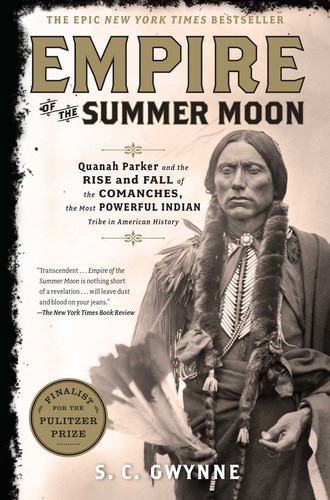
His first major book, Empire of the Summer Moon: Quanah Parker and the Rise and Fall of the Comanches, the Most Powerful Indian Tribe in American History, published in 2010, was a finalist for the Pulitzer Prize in General Nonfiction and became a widely praised work of popular history. The book told the story of the Comanche nation’s rise to dominance on the Southern Plains—a dominance so complete that they effectively halted Spanish, Mexican, and American expansion for over a century—and its eventual destruction at the hands of the U.S. Army. At the center of the narrative was Quanah Parker, the son of a Comanche war chief and a white woman, Cynthia Ann Parker, who had been captured as a child and fully assimilated into Comanche life. Quanah became one of the last great Comanche war leaders and then, after the tribe’s defeat, one of the most successful Native American leaders of the reservation era—a figure who embodied the tragic complexity of the frontier’s end.
Gwynne’s narrative approach combined careful historical research with the pacing and character development of adventure writing, producing a book that was both rigorously grounded and compulsively readable. He was candid about the Comanches’ own capacity for violence while insisting on the humanity and sophistication of a culture that American mythology had caricatured for generations.
His second major book, Rebel Yell: The Violence, Passion, and Redemption of Stonewall Jackson (2014), brought the same approach to the Confederate general Thomas “Stonewall” Jackson, examining his extraordinary military career—particularly his Valley Campaign of 1862, considered one of the most brilliant pieces of strategic maneuvering in American military history—alongside his fervent Calvinist faith, his eccentric personality, and the deeply problematic cause he served with such devastating effectiveness.
S.C. Gwynne continues to write from Texas, and his work represents the best of popular military and frontier history: deeply researched, honestly rendered, and committed to understanding rather than sentimentalizing the brutal processes through which the American West was won and lost.