
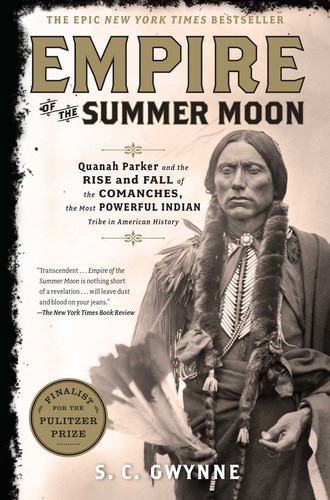
Empire of the Summer Moon
Scribner · 2010 · 371 pages
ISBN: 9781416591054
Review Editor
Thomas Calloway
Summary
For forty years in the middle of the nineteenth century, the Comanche Indians of the southern plains were the most powerful military force in North America. They stopped Spanish expansion cold, devastated Apache and Navajo populations, and held the Texas frontier at bay long after the United States Army had defeated every other major Native American resistance. Their warriors were the finest light cavalry in the world. Their empire, which they called Comancheria, stretched across what is now Texas, Oklahoma, Kansas, Colorado, and New Mexico. No other Native American group had ever built anything remotely comparable.
S.C. Gwynne’s Empire of the Summer Moon tells the story of the Comanche nation’s rise and fall, organized around the life of Quanah Parker, the last great Comanche chief. Quanah was the son of Peta Nocona, a Comanche war chief, and Cynthia Ann Parker, a white girl who was captured in a raid on her family’s fort in 1836 at age nine, lived as a Comanche for twenty-four years, married into the tribe, and was forcibly “rescued” by Texas Rangers in 1860. Quanah Parker’s story is the story of two worlds colliding, and Gwynne uses it to illuminate the larger history of the Texas frontier with a clarity and moral complexity that the subject demands.
The book is the product of extensive research: Gwynne spent years with primary sources on both sides of the frontier, including Comanche oral histories, ranger accounts, army records, and the memoirs of captives. The result is a history that does justice to both the Comanche achievements and the violence on which those achievements depended, and to both the settlers’ perspective and the catastrophic cost that manifest destiny imposed on the people who were already there.
Character Arcs and Development
Quanah Parker is the book’s most complex figure. Born into a world that was already disappearing, he fought as a warrior against the United States Army through the Red River War of 1874-75, and then, after the Comanche defeat, became a rancher, businessman, and political leader who negotiated the transition from nomadic warrior culture to reservation life with extraordinary practical intelligence. He maintained multiple wives, held onto traditional Comanche practices including the peyote religion, and simultaneously became wealthy through leasing tribal lands. His contradictions were the contradictions of his historical moment.
Cynthia Ann Parker is the book’s most haunting figure. Her story is told with sympathy for the genuine impossibility of her situation: she went native so completely that when she was recaptured in her thirties, she was unable to readjust to white society and spent her remaining years attempting to escape back to the Comanche. The forced “rescue” that white Texans celebrated as a triumph was, for her, the destruction of everything she knew. Her son Quanah never saw her again after her recapture and spent his adult life trying to find her grave.
Pacing
The book moves with the urgency of the best narrative nonfiction, alternating between the large-scale history of the Comanche nation and the specific stories of the individuals whose lives illuminate it. Gwynne handles the violent material, and there is a great deal of violent material, without either sensationalizing it or sanitizing it. The raids, the captivities, the battles, and the massacres are described with accuracy and appropriate gravity, which is the only defensible approach to a history this violent.
The pacing slows somewhat in the middle sections, which cover the post-Civil War period when the army’s campaign against the Comanche intensified. These passages are necessarily more complex, involving more actors and more tactical detail, but Gwynne holds the reader’s attention through the specificity of his research. The final chapters, covering Quanah Parker’s reservation years, are quietly devastating: the world described has been destroyed, and Gwynne does not pretend otherwise.
Deeper Thematic Exploration
The book’s most important achievement is its refusal to simplify the moral landscape of the Texas frontier. The Comanche were extraordinary: their culture of total mobility, their mastery of the horse, their political organization, and their military prowess were genuine achievements that Gwynne describes with admiration. They were also extraordinarily violent: their raids on frontier settlements involved torture, murder, and captivity taken to extremes that Gwynne documents without euphemism. Both things are true, and the book holds them simultaneously.
Gwynne is equally honest about the settlers. The Texas Rangers and the United States Army eventually defeated the Comanche not through superior valor or strategy but through superior technology, logistics, and the deliberate destruction of the buffalo herds on which the Comanche economy depended. The starvation campaign that ended Comanche resistance is not presented as an achievement to be celebrated. It is presented as what it was: the systematic destruction of a way of life that had no other means of defense.
Style and Voice
Gwynne writes with the pace and confidence of a seasoned journalist. His sentences are clear and propulsive, his research visible but not intrusive, and his judgments offered with the honesty of someone who has spent enough time with the material to have earned them. He is particularly good at rendering the physical world of the southern plains: the scale of the landscape, the heat, the distances, and the total absence of shelter that made the Comanche’s mobility both their great advantage and, ultimately, their great vulnerability.
Verdict
Empire of the Summer Moon is one of the finest works of narrative American history published in the twenty-first century. It is impossible to read it and not come away with a radically revised understanding of the Texas frontier, the Comanche nation, and the cost of American expansion. It gives the Comanche their full due as a civilization and a military power, and it tells the story of their defeat without the triumphalism that lesser histories have indulged.
Five stars: essential reading for anyone interested in American history, the history of the West, or the relationship between two civilizations that could not coexist.
Who was Quanah Parker?
Quanah Parker (approximately 1845-1911) was the last great chief of the Quahadi band of the Comanche people. His mother was Cynthia Ann Parker, a white woman captured by the Comanche in 1836, and his father was Peta Nocona, a respected Comanche war chief. After the defeat of the Comanche in 1875, Quanah became a successful rancher, political leader, and advocate for Comanche rights, living on the reservation in Oklahoma until his death. He is one of the most significant figures in the history of the American West.
Is this book sympathetic to the Comanche or to the settlers?
It is genuinely sympathetic to both, which is its greatest achievement. Gwynne presents the Comanche as a sophisticated, powerful civilization that he clearly admires for its mobility, military genius, and cultural vitality. He also documents without sanitizing the extreme violence of Comanche raiding culture. He presents the settlers as people defending their families against real danger, and he presents the army’s eventual starvation campaign against the Comanche as a moral failure even as he acknowledges its military logic. The book refuses easy sides, which is why it is important.
What was the Comanche Empire?
The Comanche empire, or Comancheria, was the territory controlled by the Comanche people in the eighteenth and nineteenth centuries, covering much of what is now Texas, Oklahoma, Kansas, Colorado, and New Mexico. At its height in the early nineteenth century, the Comanche were the dominant military force on the southern plains, having driven the Spanish, the Apache, and eventually the Mexican settlers from much of the region. They controlled access to the buffalo herds that were the economic foundation of plains life.
What happened to Cynthia Ann Parker?
Cynthia Ann Parker was captured by Comanche raiders in 1836 at age nine and lived with the Comanche for twenty-four years. She married Peta Nocona and had three children, including Quanah. In 1860, Texas Rangers killed Peta Nocona and recaptured Cynthia Ann, who had become fully Comanche in her identity and repeatedly attempted to escape back. She never readjusted to white society, lost her young daughter to illness, and died around 1871, still trying to return to the people she considered her own.
Why did the Comanche lose to the United States Army?
The Comanche were never militarily defeated in the conventional sense. They were defeated by a combination of factors: the deliberate destruction of the southern buffalo herds, which eliminated the food supply that sustained their nomadic life; the use of scouts with superior knowledge of the terrain; and a winter campaign strategy that attacked their winter camps when mobility was most restricted. The Red River War of 1874-75 was essentially a starvation campaign rather than a military defeat, and Gwynne documents this honestly.
Is this book appropriate for readers who are sensitive to violent content?
The book contains detailed descriptions of frontier violence on both sides, including raids, captivities, torture, and combat. Gwynne handles this material with historical seriousness rather than sensationalism, but readers who find such content distressing should be aware that it is substantial and integral to the history. Sanitizing it would falsify the record, which Gwynne correctly declines to do.
How does this book relate to Cormac McCarthy’s Blood Meridian?
Both books engage with the violence of the Texas-Mexico frontier, though from very different angles. McCarthy’s novel is a literary rendering of frontier violence as a kind of metaphysical condition; Gwynne’s book is a work of historical scholarship grounded in primary sources. Readers who respond to one will likely find the other illuminating, but they are different forms of engagement with the same historical territory. Gwynne’s history provides context that deepens the reading of McCarthy’s novel.
What makes this book a Pulitzer Prize finalist?
The Pulitzer Prize committee recognized Empire of the Summer Moon for the combination of its scholarly rigor, its narrative drive, and its moral seriousness. It is a book that manages to be both thoroughly researched and compulsively readable, and it addresses a chapter of American history that had never received this quality of attention. Its willingness to hold complexity without simplifying to either hagiography or condemnation distinguished it from comparable works.
Book Details
- Title
- Empire of the Summer Moon
- Author
- S.C. Gwynne
- Genre
- History
- Publisher
- Scribner
- Year Published
- 2010
- Pages
- 371
- ISBN
- 9781416591054
- WritersReview Rating
- 5.0 / 5