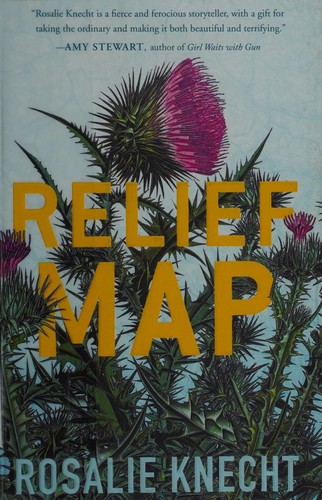
Rosalie Knecht
Rosalie Knecht is an American novelist and translator whose work brings together literary precision, genre intelligence, and a quietly radical social consciousness. She is the author of the Vera Kelly series of crime novels, which follows a bisexual, working-class private investigator navigating the political upheavals and social margins of mid-twentieth-century America, and of stand-alone literary fiction that engages directly with contemporary social crisis. Her voice is distinctive: economical, wry, capable of sudden emotional depth, and consistently attentive to the ways class, sexuality, and gender shape what kinds of stories get told and who gets to survive them.
Knecht’s debut novel Relief Map (2016) established her literary credentials immediately. Set during a single tense weekend in a small Appalachian town placed under lockdown while police search for a fugitive, it uses the mechanics of thriller plotting to explore questions of community, belonging, and the violence that underlies ordinary American life. The novel received strong critical praise for its ability to hold together genre tension and literary ambition without sacrificing either. Her subsequent Vera Kelly novels — Who Is Vera Kelly? (2018), Vera Kelly Is Not a Mystery (2021), and The Metropolitans (2022) — continued her exploration of outsider identity through the lens of mid-century history, placing a queer, economically precarious protagonist at the center of stories in which her marginality becomes both a source of vulnerability and of perceptiveness unavailable to those more comfortably positioned. Her novel reviewed on WritersReview showcases the full range of these concerns.
As a translator, Knecht has brought important Latin American literature to English-language readers, most notably her translation of Ariana Harwicz’s Die, My Love (with Carolina Orloff), a fierce and formally innovative Argentine novella that won the French Prix du Style and was longlisted for the Man Booker International Prize. This translation work is not incidental to her fiction writing; it reflects a deep engagement with world literature and with the formal possibilities of prose, and it has clearly influenced the lucid, pressurized quality of her own prose style. Knecht reads translation not as service work but as a form of intimate literary conversation.
What makes Knecht’s fiction endure is her refusal of comfort. Her protagonists are not redeemed by the narrative; they survive it, sometimes barely, carrying their damage forward. Her social observation is sharp without being didactic, and her plotting is efficient without being mechanical. She belongs to a generation of American crime and literary writers — alongside Rachel Kushner, Garth Greenwell, and Hanya Yanagihara — who are using genre frameworks and literary intensity together to document what contemporary American life actually feels like from its edges. She is a writer worth reading closely and following carefully.