
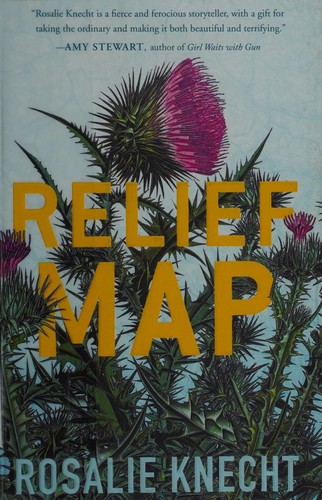
Rosalie Knecht’s debut novel, Relief Map, published in 2016 by Tin House Books, drops a sixteen-year-old girl into the kind of crisis that forces growing up in real time. Set in the fictional rust-belt town of Lomath, Pennsylvania, the novel follows Livy Marko through a sweltering summer that begins with babysitting, creek-swimming, and hanging out with her best friend Nelson, and ends somewhere far more complicated. When the FBI shuts down every road in and out of town, cuts the electricity, and launches a manhunt for a fugitive from the Republic of Georgia, Livy’s small world cracks open. What follows is part coming-of-age story, part slow-burn thriller, and entirely its own thing.
The premise is deceptively simple. A man named Revaz, wanted under an extradition order, has taken refuge in the hills above Lomath. The authorities respond with force that feels wildly disproportionate to the setting: roadblocks, house-to-house searches without warrants, a total communications blackout. For the residents of Lomath, a town already accustomed to being overlooked, this feels less like protection and more like occupation. And for Livy, watching the adults around her buckle under pressure, it becomes the summer she stops seeing the world through their eyes and starts assembling her own moral compass.
The novel runs 296 pages and moves quickly, but Knecht never sacrifices depth for pace. This is a book that trusts its readers to sit with uncertainty, to watch small choices ripple outward, and to leave without every question answered.
Character Arcs and Development
Livy Marko is one of the more convincing teenage protagonists in recent literary fiction. Knecht resists the temptation to make her precocious or wise beyond her years. Instead, Livy is exactly what a sixteen-year-old caught in an impossible situation would be: confused, stubborn, half-brave, and operating on instinct rather than principle. When she stumbles into involvement with the fugitive’s fate, she does not make a considered ethical stand. She reacts, and then spends the rest of the novel trying to figure out whether what she did was right.
That process of retroactive moral reasoning is the engine of Livy’s growth. Early in the novel, she is largely passive, content to observe the lockdown from her front porch. But as the situation escalates and the adults around her prove unreliable, Livy begins making decisions with real consequences. She lies to police. She keeps secrets from her parents. She takes physical risks she would not have imagined a week earlier. None of these choices feel heroic in the moment; they feel improvised, which is exactly why they ring true.
Nelson, Livy’s best friend, serves as a quiet foil. Where Livy is reactive, Nelson is cautious. Their friendship is one of the novel’s strongest elements, built on years of shared boredom and proximity rather than any grand declarations of loyalty. Knecht captures the particular texture of adolescent friendship: the long silences that are comfortable rather than awkward, the unspoken negotiations about who leads and who follows, the way a crisis can reveal fault lines that were always there. When the lockdown puts pressure on their relationship, the tension feels earned rather than manufactured.
Livy’s parents are drawn with surprising complexity for characters who could easily have been background fixtures. Her father’s quiet frustration with Lomath’s decline, her mother’s practical toughness, and the secrets they carry all contribute to the novel’s central question: how well do you know the people closest to you? Knecht lets these revelations emerge naturally, without melodrama, and they land harder for it.
The weakest characters are the peripheral townspeople. Knecht populates Lomath with enough residents to make it feel lived-in, but a handful of them blur together. In a novel this compact, that occasional crowding is a minor cost, though it can momentarily pull attention from the central story.
Pacing
Relief Map moves with the controlled tension of a pressure cooker. The lockdown structure is a brilliant narrative device: by trapping her characters, Knecht eliminates the usual avenues of escape and forces every conflict to simmer in close quarters. The early chapters establish the rhythms of Livy’s ordinary summer, then the power goes out, and the novel tightens steadily from there.
Knecht is remarkably disciplined about when to release tension. Violence never quite erupts, but it lurks beneath every interaction between residents and police. A push during a confrontation at a bridge. A search that goes on too long. Knecht understands that sustained threat is more unsettling than a single dramatic event, and she uses that understanding to keep the pages turning without resorting to cliffhangers or cheap surprises.
The novel does include periodic sections from Revaz’s perspective as he hides in the hills, and these are the one place where pacing slightly falters. His story is interesting on its own terms, but it lacks the immediacy of Livy’s narrative. Every time the novel leaves Lomath for the woods, the reader feels the loss of momentum, however briefly. These sections are short enough that they do not derail the book, but they do occasionally break the spell of Livy’s consciousness, which is where Knecht’s writing is at its most precise.
Deeper Thematic Exploration
At its core, Relief Map is a novel about authority and what happens when people who have never questioned it are forced to. The FBI agents and local police in Lomath operate with near-total impunity: cutting power, restricting movement, searching homes. For most of the residents, the response is resigned compliance. They grumble, but they cooperate. Livy, watching this play out, begins to notice the gap between what authority claims to be and what it actually does. This is not a political novel in any heavy-handed sense, but it is a novel that asks you to pay attention to how power works in small places.
The figure of Revaz complicates things further. He is described as a fugitive, but the novel deliberately withholds the details of his alleged crimes. The residents of Lomath do not know who he is or what he has done; they only know that the government wants him badly enough to shut down their town. Knecht uses this ambiguity to explore how fear of the unknown, particularly fear of foreign otherness, can be weaponized. In a post-9/11 landscape, a man from the Republic of Georgia hiding in the Pennsylvania hills triggers a response calibrated more to anxiety than to any specific threat. The novel does not editorialize about this; it simply shows it happening and lets the reader draw conclusions.
The coming-of-age thread is woven through these larger concerns with real skill. Livy’s moral education happens in the space between what adults tell her and what she observes. Her parents, her neighbors, the police all operate according to systems she is only beginning to see. The novel’s central tension is not whether Revaz will be caught, but whether Livy will become the kind of person who questions what she is told or the kind who accepts it. By the end, she has not fully resolved that question, and the novel is better for it. Growing up, Knecht suggests, is not a single decisive moment but a series of small, uncertain steps taken without a map.
Class is present throughout, quiet but persistent. Lomath is not a prosperous town. The lockdown costs people wages they cannot afford to lose. The FBI’s willingness to disrupt an entire community in pursuit of one person reads differently when that community is already struggling. Knecht handles this without ever turning it into a sermon, letting the economic realities of Lomath speak through specific details: the jobs people hold, the state of their houses, the way they talk about the town’s decline.
Style and Voice
Knecht writes in a close third person filtered almost entirely through Livy’s consciousness, and the fit is excellent. The prose is clean, direct, and free of ornamentation. Sentences tend to be short and declarative, which matches Livy’s way of processing the world: she observes, records, and moves on. When Knecht does extend a sentence or slow down for description, the effect is noticeable, marking moments of heightened awareness or confusion.
The voice has a quality that several reviewers have compared to Hitchcock’s Rear Window: the tension comes not from what happens but from what might happen, filtered through a single limited perspective. Livy cannot see everything that is going on in Lomath, and neither can the reader. That restriction, rather than feeling claustrophobic, creates a sense of mounting unease. You know more is happening than Livy can perceive, and you know she is making decisions with incomplete information.
The novel’s restraint is its greatest stylistic asset. Knecht resists the pull toward dramatic set pieces, keeping her most intense moments deliberately understated. A confrontation between a resident and police at a roadblock is described with the same measured clarity as a scene of Livy eating dinner with her parents. This evenness of tone makes the moments of real danger feel genuinely alarming, because the prose does not telegraph them in advance.
Verdict
Relief Map is a quiet debut that punches above its weight. It will appeal most to readers who value character-driven fiction with real stakes, who enjoy novels that trust them to sit with ambiguity, and who appreciate prose that does not call attention to itself. If you have ever looked at a small town and wondered what would happen if outside pressure cracked its surface, this is a novel that takes that thought experiment seriously.
It is not a perfect book. The secondary characters occasionally blur, and the fugitive’s sections feel less essential than the rest. But these are minor flaws in a novel that gets the big things right: a protagonist you believe in, a setting that feels specific and real, and a moral landscape that refuses to simplify. Knecht went on to write the Vera Kelly series, and you can see the seeds of that confidence here. Relief Map is the work of a writer who already knows how to control a story, how to build tension without spectacle, and how to write about young people without condescension. It deserves more readers than it has found.
Frequently Asked Questions about Relief Map
What is Relief Map by Rosalie Knecht about?
Relief Map follows sixteen-year-old Livy Marko in the small Pennsylvania town of Lomath during a summer when the FBI locks down the entire community to hunt a fugitive from the Republic of Georgia. The novel tracks Livy’s coming-of-age against the backdrop of escalating tension between residents and authorities, exploring questions of moral ambiguity, authority, and identity.
Is Relief Map by Rosalie Knecht based on a true story?
Relief Map is a work of fiction, not based on a specific real event. However, Knecht has drawn on the general atmosphere of post-9/11 America, where small communities sometimes found themselves caught up in federal law enforcement operations that felt disproportionate to their daily lives. The fictional town of Lomath is set in the rust-belt region of Pennsylvania, which Knecht renders with convincing specificity.
What are the main themes in Relief Map by Rosalie Knecht?
The novel explores several interconnected themes: the nature of authority and how ordinary people respond when it overreaches; the process of growing up and developing a personal moral framework; the fear of the foreign “other” in post-9/11 America; and the economic vulnerability of small, declining towns. Class and community dynamics run quietly beneath the surface of the story throughout.
How long is Relief Map and is it a difficult read?
Relief Map is 296 pages and reads quickly. Knecht’s prose is clean and accessible, without dense literary experimentation or complicated narrative structures. Most readers will finish it in a few sittings. The vocabulary and sentence structure are straightforward, though the thematic content rewards thoughtful attention. It is suitable for adult readers and older teens.
Is there a movie or TV adaptation of Relief Map?
As of 2026, there is no movie or television adaptation of Relief Map. The novel’s contained setting and suspenseful structure would lend themselves well to a film adaptation, but none has been announced. Knecht’s later Vera Kelly series has attracted more mainstream attention, but Relief Map remains her debut without a screen version.
What age group or reading level is Relief Map appropriate for?
Relief Map is published as adult literary fiction, but its teenage protagonist and accessible prose make it appropriate for readers aged sixteen and up. The novel contains some mild drug use (marijuana), mild language, and scenes of police intimidation, but nothing graphic or explicit. It could work well for advanced high school readers interested in contemporary literary fiction with a coming-of-age focus.
How does Relief Map compare to Rosalie Knecht’s Vera Kelly novels?
Relief Map is Knecht’s debut, written before her Vera Kelly spy series (beginning with Who Is Vera Kelly? in 2018). The two share Knecht’s talent for controlled suspense and character-driven storytelling, but differ significantly in scope. Relief Map is a compact, single-setting novel focused on adolescence, while the Vera Kelly books are globe-spanning Cold War thrillers featuring an adult protagonist. Readers who enjoy Knecht’s precise prose and her ability to build tension from small moments will find both worth exploring.
Should I read Relief Map by Rosalie Knecht and is it worth it?
If you enjoy character-driven literary fiction with a suspenseful edge, Relief Map is well worth your time. It is best suited for readers who appreciate quiet tension over dramatic action, and who like novels that trust them to think rather than telling them what to feel. Readers looking for a fast-paced thriller with a tidy resolution may find it too restrained. But for anyone who values sharp prose, a believable young protagonist, and moral questions without easy answers, this is a rewarding read that holds up after the last page.
Book Details
- Title
- Relief Map
- Genre
- Literary Fiction
- WritersReview Rating
- 4.9 / 5