Patti Smith
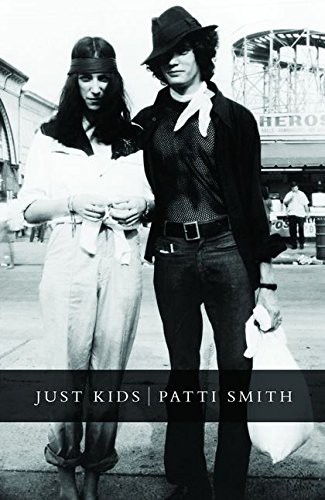
Patti Smith was born Patricia Lee Smith on December 30, 1946, in Chicago, Illinois, and grew up in Deptford Township, New Jersey, the eldest of four children in a working-class family. From early childhood she was drawn to books, drawing, and the idea of making art. She graduated high school in 1964, worked briefly in a factory, and attended Glassboro State College before dropping out. In 1967, she arrived in New York City with little more than a suitcase, some art supplies, and a copy of Rimbaud’s Illuminations, determined to become an artist. She found work at the Scribner’s bookstore, barely scraped by, and began the period of her life she would later immortalize in her memoir Just Kids.
The most important relationship of her early years was with the photographer Robert Mapplethorpe. The two were inseparable companions and collaborators, living together at the Chelsea Hotel and moving through the overlapping worlds of art, bohemia, and downtown New York in the late 1960s and early 1970s. They nurtured each other’s ambitions at a time when both were unknown, and their friendship defined the creative foundation on which Smith would build everything that followed. Mapplethorpe died of AIDS-related complications in 1989, and Smith promised him she would one day tell their story.
Through the early 1970s, Smith built a reputation as a poet and performer, giving readings with guitarist Lenny Kaye and contributing lyrics to Blue Oyster Cult albums while writing rock criticism for Rolling Stone and Creem. She published several poetry collections and developed the live performances that would evolve into the Patti Smith Group. In 1975, the band released Horses, produced by John Cale, an album that fused punk rock and spoken poetry and announced Smith as one of the central voices of the New York music scene. The record’s opening words, “Jesus died for somebody’s sins but not mine,” and its austere Mapplethorpe cover photograph became iconic. Rolling Stone ranked Horses among the greatest albums of all time, and it remains one of the defining documents of American punk and art rock.
The Patti Smith Group continued with Radio Ethiopia (1976), Easter (1978), and Wave (1979). Easter produced “Because the Night,” co-written with Bruce Springsteen, which reached number 13 on the Billboard Hot 100 and became Smith’s most commercially successful single. In 1977, Smith fell fifteen feet off a concert stage in Tampa, breaking several vertebrae, and the recovery period led her to reassess her life. She eventually stepped back from touring and spent much of the 1980s living quietly in Michigan with her husband, guitarist Fred “Sonic” Smith of the MC5. After his death in 1994, she returned to New York and resumed her musical career.
In 2005, the French Ministry of Culture named Smith a Commander of the Ordre des Arts et des Lettres. In 2007, she was inducted into the Rock and Roll Hall of Fame. In 2010, she published Just Kids, the memoir she had promised Mapplethorpe, tracing their years together in New York from their first meeting in 1967 to his death. The book won the National Book Award for Nonfiction and became a bestseller, reaching an audience far beyond Smith’s music following. Its portrait of two young artists finding their footing in a city that was still wide open is both a love story and an elegy, and it is widely considered one of the finest American memoirs of recent decades.
Smith has continued to write, record, and perform across the decades since, releasing the memoir M Train in 2015, the prose poem Year of the Monkey in 2019, and Bread of Angels in 2025. She performs annually at the Tibet House benefit at Carnegie Hall, took the stage at COP26, and in 2016 represented Bob Dylan at the Nobel Prize ceremony in Stockholm, singing “A Hard Rain’s a-Gonna Fall” to the assembled audience. She remains one of the most restlessly creative figures in American cultural life: a poet, rock musician, visual artist, photographer, and memoirist whose career now spans six decades.