
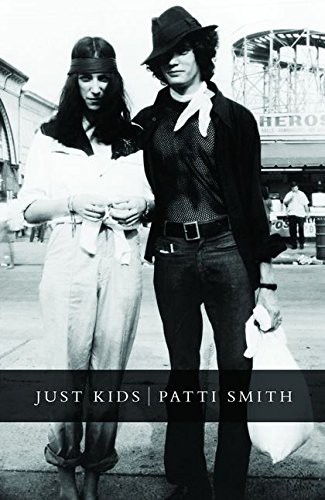
Patti Smith published Just Kids in January 2010, fulfilling a promise she had made at a deathbed sixteen years earlier. As Robert Mapplethorpe lay dying of AIDS in 1989, she promised him she would tell their story. What she produced is a memoir about two young artists arriving in New York City with almost nothing, finding each other, and building entire creative lives from sheer will and the shared conviction that they belonged in the world of art. Smith was twenty years old when she arrived in the city in the summer of 1967, carrying a change of clothes and some paperback novels, not quite sure what kind of artist she was or whether that word even applied to her yet. Mapplethorpe was the same age, sleeping on friends’ floors and assembling collages from magazine images. They met by chance on the streets of Brooklyn. What followed was a years-long partnership, a love story that changed form many times but never weakened.
The book covers roughly two decades: from Smith and Mapplethorpe’s first precarious months in New York, to their years living communally in grimy downtown apartments, to their time at the Chelsea Hotel, to Mapplethorpe’s emergence as one of the most important photographers of the twentieth century and Smith’s own rise as the godmother of punk. The book won the National Book Award for Nonfiction in 2010, and it was immediately recognized as something unusual in the memoir genre: a life story written with the rhythm and compression of poetry, by a woman who had spent her whole life thinking in images and sounds. Smith wrote it not to settle scores or perform revelations, but to keep a promise. That purpose runs through every page.
Character Arcs and Development
Smith and Mapplethorpe are this book’s two poles, and the great achievement of Just Kids is how fully Smith portrays both of them without making either into a symbol. She was a girl from a working-class family in New Jersey, bookish and determined, who arrived in New York carrying Rimbaud’s poetry and not much else. Over the course of the memoir, you watch her become herself: she works at the Scribner’s bookstore, begins making visual art, starts performing her poems, and eventually fronts the Patti Smith Group and helps redefine what rock and roll could contain. Smith never narrates this as a clear ascent. She describes it as a gradual uncovering, as if her artistic identity was always present and the city simply stripped away whatever had been covering it. The humility is genuine, and it gives the book a quality that memoirs about famous people rarely achieve: you believe her.
Mapplethorpe is drawn with even more complexity, which is a considerable feat given that he can only be known here through Smith’s eyes and memory. He was beautiful and charismatic and deeply uncertain, for a long time, about what kind of artist he was. He made jewelry, drew, assembled collages. He came to photography almost by accident, borrowing a camera and discovering that it was the right instrument for how he saw the world. Smith portrays his ambition without making him cold, and she traces his emerging sexuality (he was gay, or bisexual, and the memoir follows his gradual understanding of this) without sensationalism or false resolution. There is a moment when Smith realizes she will not be the center of Mapplethorpe’s romantic life, and she describes it with such restraint that heartbreak and acceptance arrive in the same breath. You do not pity either of them. You understand that the relationship was reconfiguring itself into something that would last longer.
Secondary figures move through the book with purpose. Allen Ginsberg mistakes the young Smith for a pretty boy at their first meeting and offers to buy her dinner. Sam Wagstaff, Mapplethorpe’s patron and eventual lover, appears as a figure of genuine cultivation and genuine feeling. Janis Joplin, Jim Morrison, and Jimi Hendrix drift through the background of the story, alive and then suddenly gone, which functions as a kind of anticipatory grief for what the book must eventually tell you about Robert.
Pacing
The book moves the way memory moves: not always at the speed events demand, but at the speed of what mattered. The early sections covering Smith and Mapplethorpe’s first months in New York, living in rooms they could barely afford and eating when they could, have a quality of deliberate accumulation. Smith describes days spent in purposeful drift, visiting bookstores and museums, talking for hours, and the pacing mirrors that unhurried state. Some readers may wish these early chapters moved faster. They do not. But they build something.
The Chelsea Hotel years are the richest and densest portion of the book, partly because more is happening and partly because Smith’s prose seems to sharpen in that period. These chapters carry a texture and specificity that the earlier sections build toward. If the book has a quieter stretch, it falls in the mid-1970s, when both Smith and Mapplethorpe are finding success but the memoir lingers in transition rather than momentum. The final sections dealing with Mapplethorpe’s illness and death strip the prose down to almost nothing, as if Smith is conserving every word for the weight she knows she is carrying toward the reader.
Deeper Thematic Exploration
At its core, Just Kids asks what it costs to dedicate a life to art, and what it gives back. Smith and Mapplethorpe lived in poverty for years, by circumstance and sometimes by choice, sustained by the certainty that they were artists before they were anything else. Smith does not romanticize this poverty, but she does not strip away its particular texture either. She describes cold rooms, empty refrigerators, and the specific pleasure of finding a secondhand book for thirty cents, and the reader understands that these conditions were not obstacles to the work but, in a real sense, part of it. The creative life Smith and Mapplethorpe shared was inseparable from the material conditions in which they lived it.
The book also thinks carefully about love between two people that resists easy categorization. Smith and Mapplethorpe were romantic partners, then not, then something that has no clean English word: devoted collaborators who knew each other better than anyone else did, who shaped and witnessed each other’s work across decades, and who needed each other’s recognition in a way that most relationships cannot carry. Smith is honest about the pain of the reconfiguration, but she is equally insistent that what they had after the romantic period ended was not diminished. It was harder to name, but it was real.
New York itself functions as a third major theme. Smith portrays the city in the late 1960s and 1970s as a place that was genuinely dangerous and genuinely affordable, and that combination allowed people with nothing to survive long enough to make something. She describes a New York that no longer exists: the cheap rooms at the Chelsea Hotel, the communal art world of Max’s Kansas City and CBGB, the sense that being young and broke and ambitious was a condition to work with rather than a problem to solve. The book does not wallow in nostalgia for this lost city. It documents it, with the particular accuracy of someone who was there, and in doing so produces something closer to witness than to elegy.
Running beneath everything is the theme of testimony itself. Smith promised Mapplethorpe she would tell their story, and Just Kids is the fulfillment of that promise. The book positions itself openly as an act of witness, and this gives it a seriousness of purpose that keeps any tendency toward self-indulgence firmly in check. Smith is not primarily writing about herself. She is writing about what she saw and who she loved, and the distinction matters.
Style and Voice
Smith’s prose is spare and imagistic, considerably closer to poetry than to conventional literary memoir. She tends to describe through specific sensory details rather than through analysis: the smell of a hotel room, the way Mapplethorpe’s hands looked when he worked, the quality of light on a particular afternoon in 1969. The effect is that the reader accumulates impressions rather than a sequence of facts, and the book’s emotional weight builds through this accumulation rather than through declaration. When Smith wants you to feel something, she does not tell you to feel it. She puts you in the room.
The voice is consistently distinctive without drawing attention to itself. Smith writes in a plain register that shifts, in certain passages, into something closer to incantation, particularly in moments of loss or unexpected beauty. She does not announce that these moments are significant. She trusts the images to carry the weight. There are sections describing the Chelsea Hotel’s corridors, or specific early pieces of Mapplethorpe’s work, or a night listening to music at a downtown club, that stay with you not because of what Smith says about them but because of how precisely she places you inside the experience. This is the hardest thing a prose writer can do, and Smith does it without apparent effort.
Verdict
Just Kids rewards any reader who cares about art, about New York, about memory, or about the kind of love that reshapes the people who carry it. Smith’s prose is beautiful without being precious, and her portraits of herself and Mapplethorpe feel genuinely honest rather than constructed for sympathy or effect. If you approach the book expecting conventional biography or narrative drive, you may find it too associative, too content to follow feeling rather than event. That is a fair response. But if you give it the attention it asks for, you will find a book that accumulates into something more affecting than most straight narratives manage.
Read it if you have ever devoted yourself to something creative and wondered whether the devotion was worth the cost. Read it if you want to understand what the New York art world of the 1970s actually felt like from the inside rather than from the outside. Read it if you have ever loved someone whose life moved away from yours, and learned that the love did not have to move with it. The book has a genuine weakness: the early sections before Smith and Mapplethorpe establish themselves in the city can feel thin, and some of the famous-person cameos are too brief to carry their intended weight. But by the time you reach the Chelsea Hotel, those reservations are behind you. The ending is quietly devastating, and Smith earns it with everything that came before.
Frequently Asked Questions about Just Kids
What is Just Kids by Patti Smith about?
Just Kids is Patti Smith’s memoir about her years in New York City with photographer Robert Mapplethorpe, beginning with their chance meeting in 1967 and ending with Mapplethorpe’s death from AIDS in 1989. The book traces their shared life in poverty, their artistic development, and the bond between them that survived every change in form their relationship went through. Smith wrote it to fulfill a promise she made to Mapplethorpe as he was dying.
Did Just Kids win any awards?
Yes. Just Kids won the National Book Award for Nonfiction in November 2010, one of the most prestigious literary prizes in the United States. The book was also a New York Times bestseller and received widespread critical acclaim when it was published in January 2010 by Ecco, an imprint of HarperCollins.
What are the main themes in Just Kids by Patti Smith?
The book explores artistic devotion and the cost of dedicating a life to creative work. It examines a bond between two people that does not fit standard romantic or platonic categories, and New York City in the late 1960s and 1970s as a space that incubated artistic identity. Other themes include poverty as both constraint and creative condition, AIDS and the grief of watching a generation disappear, and the responsibility of the living to keep faith with those who are gone.
How long is Just Kids and is it a difficult read?
Just Kids is 304 pages in most editions. The prose is accessible but reads more like poetry than conventional nonfiction, so readers who prefer narrative momentum may need to adjust their expectations. Smith trusts images and sensory impressions rather than explanation, and the book rewards slow, attentive reading. It is not challenging in a technical sense, but it asks you to be present with it.
Is there a film or TV adaptation of Just Kids?
As of 2026, there is no completed film or TV adaptation of Just Kids. Showtime announced a limited series adaptation with Dakota Fanning attached to play a younger Patti Smith, and the project generated significant interest. It had not aired as of this writing. The book has occasionally been discussed for feature film development, but no completed production exists.
What age group is Just Kids appropriate for?
Just Kids is best suited for adult readers. The memoir contains frank discussion of sexuality, drug use, extreme poverty, and illness, as well as emotionally complex themes around loss and identity. Mature high school readers with an interest in art history, music history, or literary memoir could engage with it meaningfully, but the book is written for adults and works best with readers who have some life experience to bring to it.
How does Just Kids compare to Patti Smith’s other books?
Just Kids is Smith’s most celebrated book, but she has written other memoirs in a similar lyrical vein. M Train (2015) is the closest companion piece, blending memory, grief, and daily life into an associative, image-driven whole, though it is less focused than Just Kids and more openly experimental. Year of the Monkey (2019) is more fragmentary still. Readers who love Just Kids typically find M Train the most satisfying follow-up, even though it takes more patience to enter.
Should I read Just Kids if I know nothing about Patti Smith or Robert Mapplethorpe?
Absolutely. The book does not require any existing knowledge of Smith’s music or Mapplethorpe’s photography to work on you. It functions as a memoir about two people finding their way in a city and in their art, about a particular kind of creative love, and about what it means to survive loss with your commitments intact. Many readers who came to it with no prior interest in either artist found it among the most affecting books they had encountered.
Book Details
- Title
- Just Kids
- Author
- Patti Smith
- Genre
- Biography
- Publisher
- Ecco
- Year Published
- 2010
- Pages
- 304
- ISBN
- 9780747548409
- WritersReview Rating
- 4.6 / 5