Mihaly Csikszentmihalyi
Mihaly Csikszentmihalyi was a Hungarian-American psychologist and author widely regarded as the world’s leading researcher on the psychology of optimal experience. His concept of “flow” — a state of complete absorption in a challenging, meaningful activity — has become one of the most influential ideas in twentieth-century psychology, reshaping understanding of creativity, happiness, productivity, and the conditions under which human beings perform and feel at their best.
Csikszentmihalyi was born in 1934 in Fiume (now Rijeka, Croatia), then part of Italy. His early life was profoundly marked by the upheaval of World War II; he spent time in an Italian prisoner-of-war camp as a child and witnessed firsthand the fragility of human happiness and civilization. These experiences drove a lifelong intellectual curiosity about what makes life genuinely worth living — a question he pursued not through philosophy or theology but through empirical psychological research.
He came to the United States in 1956 and eventually pursued graduate studies in psychology at the University of Chicago, where he spent much of his career as a professor and department chair. His research on the psychology of creativity and intrinsic motivation, conducted over decades using innovative methods including the Experience Sampling Method — in which subjects are paged at random intervals and asked to record their activity, thoughts, and emotional state — led to his identification and codification of the flow state.
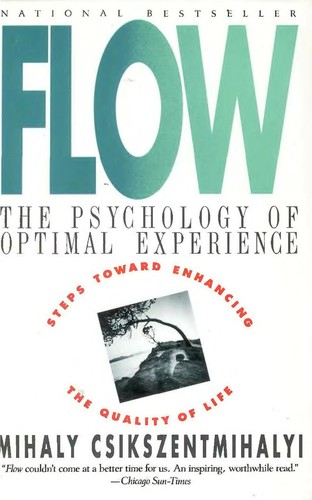
His landmark book, Flow: The Psychology of Optimal Experience (1990), introduced his concept to a general audience and became an international bestseller. Drawing on decades of research with thousands of subjects — artists, athletes, surgeons, chess masters, assembly-line workers, and many others — Csikszentmihalyi described flow as a state that occurs when the challenge of an activity precisely matches one’s skill level, producing a condition of effortless concentration, loss of self-consciousness, and deep satisfaction. The book argued that the pursuit of flow, rather than pleasure or relaxation, is the most reliable path to lasting happiness.
Csikszentmihalyi followed Flow with a prolific body of related work, including Creativity: Flow and the Psychology of Discovery and Invention (1996), Finding Flow (1997), and Good Work: When Excellence and Ethics Meet (2001, with Howard Gardner and William Damon). He later served as a professor at Claremont Graduate University, where he directed the Quality of Life Research Center until his death in 2021. His contributions to the science of human flourishing and the psychology of everyday experience remain foundational to positive psychology and to any serious inquiry into what makes work and life meaningful.