
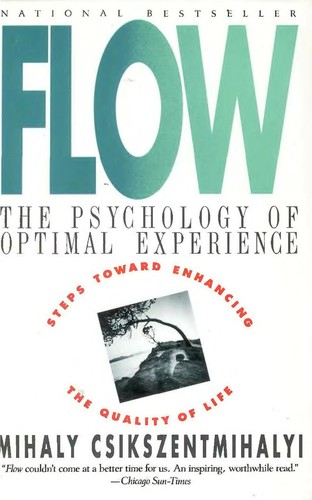
In 1975, a Hungarian-American psychologist named Mihaly Csikszentmihalyi published a study of chess players, rock climbers, surgeons, and factory workers. He was looking for something most researchers weren’t measuring: not what made people miserable, but what made them feel genuinely alive. What he found was a mental state so consistent across cultures, ages, and activities that he gave it a name borrowed from the people who described it. Again and again, they reached for the same word: flow.
Flow: The Psychology of Optimal Experience, published in 1990 by Harper and Row, is Csikszentmihalyi’s attempt to translate fifteen years of empirical research into something any reader can use. The result is one of the most quietly influential books in popular psychology, a work that launched an entire field and changed how millions of people think about happiness, work, and the architecture of a good life.
Csikszentmihalyi spent decades running what he called the Experience Sampling Method: beepers given to subjects who were asked to record, at random intervals, exactly what they were doing and how they felt. The data pointed to something surprising. People were not happiest when they were relaxing. They were happiest when they were stretched to the edge of their abilities, fully absorbed in a task that demanded everything they had. This was flow: the state in which challenge and skill meet so precisely that self-consciousness dissolves and time bends. The surgeon who loses herself in a complex procedure, the teenager locked into a guitar solo, the grandmother playing bridge for five hours without noticing: all are experiencing the same fundamental thing.
Character Arcs and Development
Flow is not a novel, and its characters are the researchers, case study subjects, and historical figures Csikszentmihalyi draws on to illustrate his argument. There is no protagonist who transforms across the book’s three hundred pages, but there is something that functions like one: the concept of the autotelic self, the person who has learned to find flow in almost any circumstance.
Csikszentmihalyi traces this figure through history and across cultures. He writes about Lorenzo de’ Medici’s Florence, where the intersection of commerce, art, and civic life created conditions for widespread optimal experience. He writes about Japanese potters and Italian farmers who, by his account, brought the same focused attention to their craft that rock climbers bring to a difficult pitch. The people who appear across these chapters are not defined by talent or privilege but by a relationship to activity, a quality of engagement that Csikszentmihalyi argues can be cultivated.
What emerges is a portrait of human consciousness at its most capable. The secondary figures in the book, from the bored assembly-line worker who redesigns his own job to create challenge, to the prisoner who survives solitary confinement by building an elaborate mental life, are not passive victims of circumstance. They are active architects of attention. Csikszentmihalyi returns to them throughout the book to show that the conditions for flow are not given by the world but constructed by the mind. This is the book’s central humanist argument, and it is genuinely moving once you see it clearly.
Pacing
The book’s pacing is uneven, and it is honest to say so. The first three chapters, which lay out the theory of flow and the structure of consciousness, move with real momentum. Csikszentmihalyi is an elegant writer, and these sections reward careful reading. The middle chapters, which apply the flow framework to specific domains (the body, thought, work, family, solitude), are less consistent. Some feel fully developed; others read like extended footnotes. The chapter on solitude and the chapter on work are exceptional. The chapter on family, by contrast, occasionally drifts into territory that reads more like advice than analysis, and some readers will find the examples dated or culturally narrow.
The final chapter, which zooms back out to ask what a life spent pursuing flow might look like, recovers the book’s early energy and leaves you with something to sit with. If the middle sags, the ending earns it back. But readers who push through expecting the density of the opening chapters throughout may find the experience uneven. This is a book best read in the order Csikszentmihalyi wrote it, since the arguments build genuinely, even if the build is sometimes slow.
Deeper Thematic Exploration
The central claim of Flow is not that happiness requires the right job or the right relationships or even the right genetics. It requires attention, specifically the ability to order consciousness in ways that produce engagement rather than entropy. Csikszentmihalyi uses the word “psychic entropy” to describe the baseline condition of the unstimulated mind: a tendency toward disorder, worry, and formless restlessness. Flow is what counteracts it. When your attention is fully engaged, there is no room for anxiety or self-doubt because there is no room for anything except the task in front of you.
This has real philosophical stakes. Csikszentmihalyi is quietly arguing against the dominant model of happiness that his era inherited, the idea that pleasure comes from comfort, leisure, and the removal of obstacles. His data say otherwise. People who describe their happiest moments are almost always describing effort, not rest. This runs against a great deal of what consumer culture sells, and the book doesn’t moralize about it, but the implication is impossible to miss.
There is also a thread about meaning running beneath the happiness argument. Csikszentmihalyi distinguishes between pleasure (which is passive and temporary) and enjoyment (which involves growth and is produced by flow). The person who watches television for six hours may feel pleasant. The person who spends six hours learning a new skill, struggling, failing, and occasionally breaking through, has not necessarily felt pleasant at every moment, but has experienced something deeper. The book’s implicit argument is that a life built around flow will feel more meaningful than a life built around pleasure, even if the second is easier to construct.
The social dimensions are also worth noting. Csikszentmihalyi observes that the same conditions that produce individual flow, clear goals, immediate feedback, a calibrated match between challenge and skill, are also what make communities and workplaces function well. This was prescient in 1990 and has only become more relevant since.
Style and Voice
Csikszentmihalyi writes with the confidence of someone who has spent thirty years thinking about a single question and has arrived somewhere real. His prose is not literary in the showy sense, but it has the authority of genuine expertise worn lightly. He moves between research findings and first-person observation without either becoming a laundry list or slipping into anecdote. When he writes about a chess player who describes the board as “calling to him,” or a surgeon who says that during a difficult case she feels as though her hands are moving independently of her will, you believe him.
The voice is occasionally academic in a way that will slow down readers used to contemporary popular science writing. Csikszentmihalyi is not afraid of complexity, and some of his theoretical sections require patience. But there is warmth underneath the precision. He is not performing objectivity. You can feel his genuine astonishment at what the data kept showing, that human beings are built for engagement and wither without it, surfacing throughout the text.
Verdict
If you have ever been so absorbed in something that hours passed without your noticing, you have experienced what Csikszentmihalyi spent his career studying. Flow gives you a vocabulary and a framework for understanding that experience, and then asks you what it would mean to build more of it into your life. That is a genuinely useful question, and this book is one of the most thoughtful guides to answering it.
It is not a perfect book. Some sections age better than others, and the occasional prescriptive passages feel out of place in what is primarily a work of psychology. Readers looking for a strictly scientific account will find the case studies impressionistic, and readers looking for a purely practical manual will find the philosophical sections more than they bargained for. But for the reader who wants both, a serious argument about the nature of happiness grounded in real research, presented by someone who has clearly spent a life thinking about it, Flow is essential. Positive psychology has produced hundreds of books since 1990. This is the one that started it.
Frequently Asked Questions about Flow: The Psychology of Optimal Experience
What is Flow: The Psychology of Optimal Experience by Mihaly Csikszentmihalyi about?
Flow is a 1990 psychology book that introduces the concept of “flow”: a mental state of total absorption in a challenging activity, in which time seems to disappear and performance peaks. Csikszentmihalyi draws on decades of research and thousands of interviews to argue that flow, not comfort or pleasure, is the foundation of genuine happiness.
Who is Mihaly Csikszentmihalyi and why is he important?
Mihaly Csikszentmihalyi (1934-2021) was a Hungarian-American psychologist at the University of Chicago who became one of the founders of positive psychology. His research into optimal experience and happiness made him one of the most-cited researchers in his field, and his work on flow influenced education, sports psychology, workplace design, and game development.
What are the main themes in Flow?
The book’s central themes are optimal experience, the nature of happiness, consciousness and attention, and the conditions for meaningful work. Csikszentmihalyi argues that happiness comes not from relaxation or external rewards but from full engagement with challenging activities, and that anyone can learn to create these conditions in daily life.
What is the flow state, and how do you achieve it?
Flow is a state of complete absorption in an activity where challenge and skill are evenly matched. Csikszentmihalyi identifies nine conditions that characterize it, including clear goals, immediate feedback, and a balance between the difficulty of the task and your level of ability. When all nine are present, self-consciousness fades and time distorts. You achieve it by seeking activities that stretch your current abilities without overwhelming them.
How long is Flow and is it a difficult read?
The main edition runs around 303 pages. It reads at a moderate level, somewhere between academic psychology and popular science. The opening chapters are accessible and compelling; the middle sections are denser and more theoretical. Readers familiar with psychology will move through it quickly; general readers should expect to slow down for the conceptual material.
Is Flow by Csikszentmihalyi still relevant today?
Yes, arguably more than ever. The book was written before smartphones and social media, but its core argument, that human attention is a limited resource and that we are happiest when we spend it on genuinely challenging work rather than passive consumption, maps directly onto contemporary concerns about distraction, burnout, and the attention economy. The framework has only gained relevance since 1990.
How does Flow compare to Csikszentmihalyi’s other books?
Flow is the foundational text, and everything Csikszentmihalyi published afterward, including Finding Flow (1997) and Creativity (1996), can be read as an extension or application of ideas introduced here. Finding Flow is more practical and more accessible; Creativity goes deep on optimal experience in artistic and scientific work. Most readers find Flow the most complete and satisfying of the three, and the obvious place to start.
Should I read Flow, and is it worth it?
If you have ever wondered why some work energizes you and other work drains you, or why the best experiences of your life were often the hardest ones, this book will answer that question in a way that stays with you. It is worth reading for the central idea alone, even if parts of it feel dated. Read it slowly, sit with the framework, and see what it suggests about how you’re spending your attention.
Book Details
- Title
- Flow
- Author
- Mihaly Csikszentmihalyi
- Genre
- Self-Help
- Publisher
- Harper Perennial
- Year Published
- 1990
- Pages
- 303
- ISBN
- 9780061339202
- WritersReview Rating
- 4.3 / 5