Liu Cixin
Liu Cixin is China’s most celebrated science fiction author, widely regarded as the most important voice in contemporary Chinese speculative fiction. Born in 1963 in Yangquan, Shanxi province, he grew up during a period of enormous social and political upheaval in China, an experience that would deeply inform his sweeping, cosmologically ambitious storytelling. He spent much of his career working as a computer engineer at a power plant in Shanxi, writing science fiction in his spare time before his literary output brought him to international prominence. His dual life as both a technical professional and an imaginative author is reflected in the rigorous scientific underpinnings of his fiction.
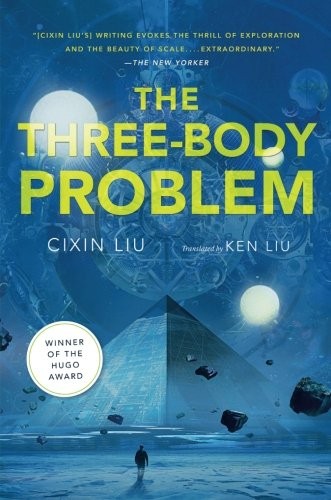
Liu’s breakthrough came with the publication of The Three-Body Problem in China in 2008, the first volume of his celebrated Remembrance of Earth’s Past trilogy. The novel, translated into English by Ken Liu and published by Tor Books in 2014, became a phenomenon unlike anything previously seen in translated science fiction. It tells the story of first contact with an alien civilisation, framing the encounter against the backdrop of China’s Cultural Revolution and building to a portrait of interstellar conflict that spans centuries. The Three-Body Problem, available on WritersReview, earned Liu the Hugo Award for Best Novel in 2015, making him the first Asian writer to win the award. The trilogy as a whole — completed by The Dark Forest and Death’s End — has sold tens of millions of copies worldwide.
Liu’s writing is distinguished by its extraordinary scope and its willingness to engage directly with the hardest questions of physics, cosmology, and game theory. His “Dark Forest” hypothesis, introduced in the second novel of the trilogy, posits that the silence of the universe is a product of existential predation: civilisations hide because to be discovered is to be destroyed. This concept has entered wider scientific and cultural discourse, demonstrating the power of science fiction to generate genuinely provocative intellectual frameworks. His prose, even in translation, is characterised by bold conceptual leaps, vast timescales, and a willingness to make the fate of entire civilisations feel intimately personal.
Beyond the trilogy, Liu has written dozens of short stories and novellas, many collected in The Wandering Earth (translated 2017), which provided the basis for a hugely successful Chinese blockbuster film in 2019. He has been celebrated in China with multiple Galaxy Awards and has received international recognition including the Clarke Award shortlisting and the Locus Award. His work has been credited with opening Western audiences to Chinese science fiction as a serious literary tradition. Among his admirers are Barack Obama, who read the trilogy during his presidency, and Mark Zuckerberg, who recommended it publicly. Liu Cixin stands as a transformative figure whose work has permanently expanded the horizons of the genre.