
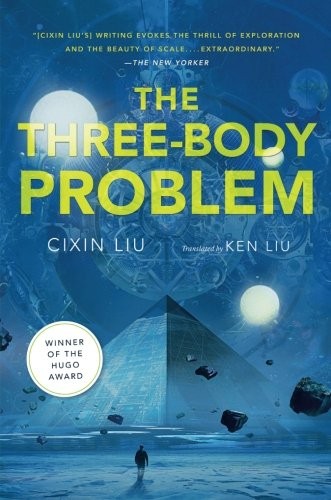
The Three-Body Problem
Tor Books · 2016 · 416 pages
ISBN: 9780765382030
Review Editor
Marcus Webb
The Three-Body Problem opens in the worst possible way for Ye Wenjie, a young Chinese astrophysicist. She watches Red Guards beat her father, the physicist Ye Zhetai, to death in a public struggle session during the Cultural Revolution. His crime: teaching the theory of relativity. From that moment, something breaks in Ye Wenjie’s faith in humanity, and the consequences of that fracture will echo across light-years and centuries.
First serialized in China’s Science Fiction World magazine in 2006 and published as a standalone novel in 2008, Liu Cixin’s book reached English-speaking readers in 2014 in a translation by Ken Liu that earned its own admirers. The novel spans from 1960s China to a near-future Beijing where prominent physicists are dying under mysterious circumstances, the constants of physics appear to be fluctuating, and a virtual-reality game is recruiting players for reasons nobody at first understands. The connecting tissue is a secret that Ye Wenjie has been carrying for decades, one she set in motion from a remote military installation called Red Coast Base.
Our primary guide through the contemporary storyline is Wang Miao, a nanomaterials researcher recruited by a shadowy joint military-civilian task force to investigate the physicist deaths. His investigation leads him into the “Three Body” game: a virtual-reality world where players must build a civilization on a planet with three suns. The planet’s climate swings between predictable “Stable Eras” when civilization can flourish and devastating “Chaotic Eras” when the suns’ combined gravitational pull makes conditions lethal. The game is based on a real physics problem: predicting the movement of three gravitationally interacting bodies has no general analytical solution. The planet in the game is real too. Its name is Trisolaris.
Character Arcs and Development
Ye Wenjie carries the moral weight of this novel, and Liu Cixin never lets you settle into a simple verdict about her. She has watched ideology murder science, watched her father die for physics, watched her own idealism get systematically stripped away by the machinery of revolutionary politics. Her eventual decision at Red Coast Base, to answer an alien transmission and essentially tell the Trisolarans where to find Earth, is monstrous by one reading and entirely comprehensible by another. Liu presents both readings without adjudicating between them. This refusal to condemn or excuse is the book’s most ethically serious achievement.
Wang Miao functions more as a surrogate for the reader’s growing dread than as a fully independent character. He’s curious, capable, and believably shaken by what he encounters, but he doesn’t carry the same emotional charge as Ye Wenjie. Liu compensates with Shi Qiang, known throughout as Da Shi, a brash chain-smoking police detective who cuts through every scene with practical intelligence and sardonic humor. Da Shi is the most immediately human character in the book; his scenes give the story a texture that the more conceptually driven passages lack. When he explains something complicated by lighting a cigarette and telling Wang Miao to stop overthinking it, you feel the pleasure of a genuinely distinctive voice.
The supporting characters in the contemporary storyline are more functional than fully realized, serving the plot’s architecture rather than developing independently. Some readers find this disappointing; it’s worth knowing before you start. If you come to this novel expecting character complexity as its primary currency, you’ll find it thinner than you hoped. If you come for ideas, scenarios, and the particular satisfaction of a mystery that turns out to be stranger and larger than you anticipated, you’ll find the cast entirely adequate for what the book is trying to do.
Pacing
The first third requires patience. Liu builds his mystery carefully: the Cultural Revolution sequences, the science of chaotic orbital dynamics, Wang Miao’s investigation into the physics anomalies, and the increasingly strange experience of the Three Body game all need to be in place before the full picture can emerge. This is a deliberate choice, not a structural failing, but it does mean that some readers bounce off the book before it fully reveals itself.
The payoff arrives in two stages. First, the Three Body game sequences become genuinely extraordinary, dropping famous historical figures (Newton, von Neumann, a Qin Dynasty emperor) into the simulation as characters trying to solve the civilization’s problems. Then the modern-day story accelerates into a third act that contains, among other things, a demonstration involving a piece of technology so elegant and terrible that it lodged in my memory immediately. Liu earns the climax he builds toward.
The middle section, where the game sequences get extended treatment, is the most divisive stretch. The historical figures as characters feel more like Liu testing a thesis than telling a story, and the scenes can feel more like lectures than drama. Whether you experience them as inventive or indulgent will probably tell you a lot about how you’ll receive the trilogy overall.
Deeper Thematic Exploration
The physics problem in the title gives the novel its central metaphor. Predicting the movement of three mutually gravitating bodies has no general analytical solution; the system is fundamentally chaotic. Trisolaris orbits three suns and is therefore unpredictably hostile to life. But the three-body problem also describes, at the book’s moral center, the chaotic forces that brought Ye Wenjie to the moment when she chose to betray her species: ideology, grief, and the collapse of trust in human institutions.
The novel is one of the most sustained serious attempts in fiction to answer the Fermi paradox. If the universe is vast and ancient, why haven’t we heard from anyone else? Liu’s answer, developed more fully in the sequels but introduced here, is grimly elegant. The universe isn’t silent because it’s empty. It’s silent because any civilization that understands the stakes of detection goes quiet. In a universe with finite resources, no possibility of cross-civilizational trust, and asymmetric technological capabilities, the only rational strategy upon detecting another intelligence is to destroy it before it destroys you. This is the dark forest theory, named after a particular kind of silence. The name arrives in the sequel, but the logic begins here.
The Cultural Revolution thread is not decorative. Liu is writing about what ideology does to science: not just the obvious political harm, but the deeper damage to a society’s relationship with empirical inquiry and rational trust. Ye Wenjie’s betrayal of humanity cannot be fully separated from what humanity did to her family’s pursuit of truth. Liu doesn’t justify what she does. But he insists that her reasons are intelligible, and that the civilization she lives in helped create them. This is more complex moral thinking than most science fiction attempts.
The book also raises a question it never quite answers: can two radically different civilizations, with incompatible biologies and motivations, cooperate rather than compete? The Trisolarans’ response to Ye Wenjie’s message suggests one answer. The possibility that a different outcome might have existed lives in the background of every subsequent page.
Style and Voice
Ken Liu’s translation made a deliberate choice to preserve the Chinese texture of the original rather than flatten it into generic Western SF prose, and the novel benefits from it. The writing is spare and direct, closer to Arthur C. Clarke than to Ursula K. Le Guin: characters as vessels for ideas, prose as a delivery mechanism for scenarios rather than as an end in itself. This approach suits the book’s nature as hard science fiction driven by concepts.
That said, some passages carry genuine emotional weight. The Cultural Revolution sequences, particularly Ye Zhetai’s death and the years that follow it, are brief and effective. Liu doesn’t linger on suffering; he trusts the reader to feel its gravity from a short distance. The Three Body game sequences compensate for what the prose doesn’t attempt in terms of intimacy: when Liu describes a civilization learning to dehydrate its population to survive a Chaotic Era, or thirty million soldiers forming a human computer to calculate orbital mechanics, you feel the size of his imagination working at full stretch.
The book assumes its reader is comfortable with physics concepts and makes no apologies for the density of its science. For readers who find hard SF satisfying, this is a feature. For readers who prefer their scientific scaffolding lighter, it may occasionally feel like attending a lecture.
Verdict
The Three-Body Problem does not do everything well. The characters outside of Ye Wenjie are more functional than memorable. The middle section tests patience. Some of the historical-figures-in-simulation sequences feel like exercises in concept rather than storytelling. And the novel is, by design, an opening argument: it introduces its central idea and then stops, leaving the full implications for two sequels.
But the scope of Liu’s conception, the moral complexity at the book’s core, and the genuinely original answer to the Fermi paradox make this a novel you will carry with you. You should read it if you’ve ever looked at the empty sky and wondered why it’s so quiet. You should read it if you’re curious what Chinese science fiction looks like when it’s working at full power. You should read it if you want a novel that treats its reader as capable of holding difficult ideas in tension without needing them resolved neatly.
Readers who prefer intimate character studies over philosophical speculation will find the experience uneven. Readers who come from the Clarke and Asimov tradition of SF, where ideas carry the story and characters exist to witness the implications, will find this one of the best novels the genre has produced. The trilogy deepens with each volume, and many readers consider the second book, The Dark Forest, the strongest. But everything in those sequels is built on what happens here.
Frequently Asked Questions about The Three-Body Problem
What is The Three-Body Problem by Liu Cixin about?
The Three-Body Problem follows two storylines: a Chinese astrophysicist named Ye Wenjie who makes contact with an alien civilization during the Cultural Revolution, and a present-day nanomaterials researcher named Wang Miao who investigates mysterious deaths among physicists and discovers a virtual-reality game modeling an alien world. The novel asks why the universe appears to be silent of intelligent life, and offers a chilling answer.
Is The Three-Body Problem part of a series?
Yes. It is the first book in the Remembrance of Earth’s Past trilogy, also informally known as the Three-Body trilogy. The second book is The Dark Forest, and the third is Death’s End. Each can stand somewhat independently, but the story builds substantially across all three volumes, and the trilogy as a whole is considered among the most ambitious works in modern science fiction.
What are the main themes in The Three-Body Problem?
The novel’s central preoccupations are the Fermi paradox (why we have heard nothing from other intelligent civilizations), the relationship between science and political ideology, the limits of trust between civilizations that cannot understand each other, and the question of what it means to betray your own species out of despair. It uses the Cultural Revolution as a lens for examining what happens when ideology overrides rational inquiry.
How long is The Three-Body Problem and is it a difficult read?
The paperback edition runs approximately 400 pages. The difficulty is real but specific: Liu Cixin assumes comfort with physics concepts, and some passages read more like science lectures than fiction. The first third requires patience as the mystery builds. Readers who stay with it report that the payoff is substantial, but it is not a breezy read.
Is there a TV adaptation of The Three-Body Problem?
Yes, there are two. Netflix released an international adaptation called 3 Body Problem in 2024, relocating several storylines from China to other countries and receiving mixed reviews. A Chinese series, also called Three-Body, premiered in 2023 and was well-received, particularly among fans of the original novels who felt it stayed closer to Liu Cixin’s vision.
Did The Three-Body Problem win the Hugo Award?
Yes. The English translation by Ken Liu won the Hugo Award for Best Novel in 2015, making Liu Cixin the first Asian author to win in that category. The novel was also nominated for the Nebula Award for Best Novel the same year. It had previously won China’s Galaxy Award for science fiction in 2006 when it first appeared in Chinese.
How does The Three-Body Problem compare to Liu Cixin’s other work?
The Three-Body Problem is Liu Cixin’s most famous and most widely read novel, largely due to the Hugo Award and the subsequent Netflix series. His short fiction, collected in The Dark Forest of Cixin Liu and The Wandering Earth, shows his range: he’s particularly strong in the novella format, where his ideas have room to develop but the pacing is tighter. Readers who find the novel’s first act slow often find his short fiction more immediately accessible.
Should I read The Three-Body Problem and is it worth it?
If you like science fiction that takes physics seriously, builds mysteries at civilizational scale, and raises philosophical questions it doesn’t conveniently resolve, this is an essential read. If you typically prefer fiction where richly drawn individual characters drive the story, you may find it rewarding but uneven. Either way, it is one of the few SF novels in recent decades that genuinely changes how you think about the question of what else might be out there.
Book Details
- Title
- The Three-Body Problem
- Author
- Liu Cixin
- Genre
- Science Fiction
- Publisher
- Tor Books
- Year Published
- 2016
- Pages
- 416
- ISBN
- 9780765382030
- WritersReview Rating
- 4.2 / 5