Isabel Wilkerson
Isabel Wilkerson was born in 1961 in Washington, D.C., the daughter of parents who had migrated from the South as part of the Great Migration—the mass movement of African Americans from the rural South to the urban North that reshaped American society between 1910 and 1970. She studied journalism at Howard University and went on to become a staff writer and bureau chief at the New York Times, where in 1994 she became the first African American woman to win the Pulitzer Prize in journalism, honored for her feature writing.
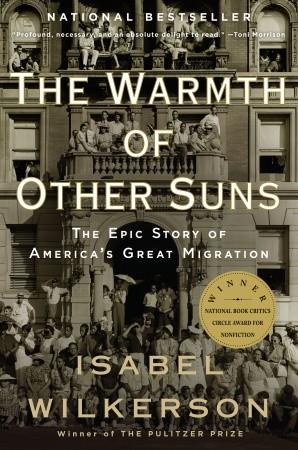
Wilkerson spent fifteen years researching and writing The Warmth of Other Suns: The Epic Story of America’s Great Migration, published in 2010. The book told the story of the Great Migration through three individuals whose journeys she reconstructed from extensive interviews and archival research: Ida Mae Brandon Gladney, a sharecropper’s wife who moved from Mississippi to Chicago; George Swanson Starling, a young man who fled Florida after organizing other citrus workers; and Robert Joseph Pershing Foster, a physician who drove from Louisiana to California seeking the professional recognition denied to him in the South. Through these three lives, Wilkerson illuminated the larger forces—racial terror, economic exclusion, the lure of industrial wages, the promise of anonymity—that drove six million people to remake themselves and their country over six decades.
The book was widely celebrated as a masterwork of narrative nonfiction, praised for the depth of its research, the quality of its prose, and the emotional force of its portraits. It won the National Book Critics Circle Award, the Anisfield-Wolf Book Award, and the Heartland Prize, and was named one of the best books of 2010 by dozens of publications. It has become a foundational text in American history education and remains widely assigned in schools, colleges, and reading groups.
Her second book, Caste: The Origins of Our Discontents, published in 2020, made an even bolder argument: that the subjugation of African Americans in the United States is not best understood as a matter of race—a social fiction—but as a caste system, structurally analogous to the caste systems of India and Nazi Germany. Drawing on anthropology, sociology, and history, and on her own experiences as a Black woman in America, Wilkerson argued that America’s racial hierarchy operates as a rigid, inherited system of social stratification that shapes every aspect of life, often invisibly, for those at the bottom and at the top alike. The book debuted at number one on the New York Times bestseller list and spent months among the most discussed nonfiction titles of that year.
Isabel Wilkerson teaches at Boston University and continues to be one of the most consequential writers working in American nonfiction. Her work demonstrates that the tools of literary journalism—patient observation, deep research, carefully rendered scenes, and the illumination of the general through the particular—can produce history writing of the highest order, work that changes not just what readers know but how they see.