
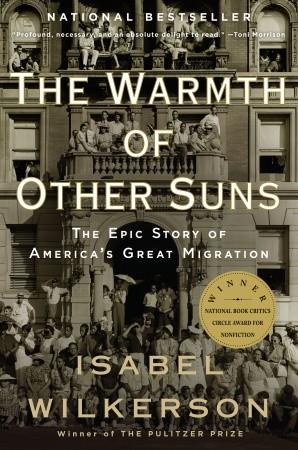
The Warmth of Other Suns
Random House · 2010 · 622 pages
ISBN: 9780679763888
Review Editor
Thomas Calloway
In the late summer of 1937, a sharecropper’s wife named Ida Mae Brandon Gladney packed up her family’s belongings in rural Mississippi and boarded a northbound train. She had no job waiting in Chicago, no savings worth mentioning, and no plan beyond getting out. What she was running from was the rigid, violent architecture of Jim Crow: a social order that told Black Americans they were worth less than the cotton they picked, the tobacco they cured, the kitchens they cleaned. What she was running toward was harder to name. Something like possibility.
Published in 2010, Isabel Wilkerson’s The Warmth of Other Suns is a landmark of American narrative nonfiction that follows three people across five decades of the Great Migration, the mass movement of approximately six million Black Americans who left the Southern United States between 1915 and 1970. Wilkerson spent fifteen years on this book, interviewing more than 1,200 people and combing through census data, sociological studies, and newspaper archives, before settling on Ida Mae; George Swanson Starling, a citrus picker from Florida who fled north to New York in 1945; and Robert Joseph Pershing Foster, a surgeon who drove west from Louisiana to Los Angeles in 1953. Together their stories trace the three great corridors of the migration: the coastal road from the Southeast to New York, the Midwest route from the Deep South to Chicago, and the western road to California.
The book’s full subtitle, “The Epic Story of America’s Great Migration,” is not a publisher’s overreach. This is genuinely an epic, told with the patience and intimacy of a novel. Wilkerson gives us not just history but lives: arguments, ambitions, heartbreaks, and small victories. She chose three people because she understood that numbers, six million, could not do what three people could.
Character Arcs and Development
Ida Mae is the book’s moral center and, for many readers, its most beloved figure. She is practical, stubborn, and deeply rooted in her faith. When a cousin’s husband is beaten nearly to death by white men in Mississippi after being falsely accused of stealing turkeys, her family reaches its reckoning. She and her husband George make the decision to go north in what feels less like ambition than survival. In Chicago she finds work as a hospital aide, becomes a devoted churchgoer, and eventually settles into a long, quiet life on the city’s South Side. The arc of her decades is not dramatic in the conventional sense; there is no single climax, no turning-point speech. But Wilkerson shows, patiently, how a woman who picks cotton becomes a woman who votes, and what that transformation cost.
George Starling carries the book’s most politically charged story. He is smart, angry, and unwilling to accept the role the citrus grove owners in Florida have assigned him. When he begins organizing Black workers and word gets out, he has to leave almost overnight or risk being killed. He lands in Harlem, works the train lines as a porter, and watches the city change around him across the following decades. His story has the sharpest edges of the three. By the time we meet him as an old man, something has not resolved the way it was supposed to, and Wilkerson is honest about that cost.
Robert Pershing Foster is the book’s most unlikely figure: a surgeon, the son of a respected Southern family, who by all measures should have been able to build a life in the South. But Jim Crow recognized no credentials. A Black doctor in Louisiana could not admit patients to the main hospital. Foster drives west with a car full of dreams and watches white motel after white motel turn him away at the edge of the Nevada desert. In Los Angeles he eventually becomes Ray Charles’s personal physician and builds a thriving medical practice. His story is about ambition and reinvention, but also about what gets left behind: a wife who never fully makes the transition with him, a hometown he can never quite go back to.
Pacing
At 622 pages, The Warmth of Other Suns asks something real of its readers, and the effort is worth it. Wilkerson weaves her three narrative threads together with chapters that alternate between the major characters and sections of historical analysis that zoom out to explain the demographic, political, and economic forces at work. The book moves slowly in the best sense: it gives detail time to accumulate, so that when Ida Mae finally votes for the first time or Robert’s marriage begins to fray, the reader understands exactly what each moment weighs.
The historical analysis chapters occasionally interrupt the forward momentum. Wilkerson is an excellent journalist as well as a storyteller, and sometimes the two modes sit in slight tension. A few sections in the book’s middle read more like deeply researched essays than narrative chapters, and readers expecting the kind of propulsive movement they get from the three individual stories may find themselves impatient to return to Ida Mae and the others. This is a small friction in a book of extraordinary scope, but worth knowing before you begin.
Deeper Thematic Exploration
The title comes from a Richard Wright poem, and the book carries Wright’s understanding that the North was never the promised land, even when it was better than what migrants left behind. This tension runs through everything Wilkerson examines: the Great Migration was not a success story or a failure story but something harder to categorize. Black Americans who came north escaped legal segregation and found it replaced by de facto segregation, redlining, discrimination in hiring, and white flight. They lived longer. They voted. They built communities, churches, and newspapers. And they also built lives in cities that would hollow out around them in the following decades, as deindustrialization stripped away the manufacturing jobs that had drawn them north in the first place.
Wilkerson is especially acute on the internal diversity of the migration. Ida Mae, George, and Robert are not interchangeable. They represent different classes, different temperaments, and different relationships to the idea of America. Ida Mae adapts and endures. George carries his anger until it becomes a kind of grief. Robert achieves the material success he drove across the desert for and discovers it does not quite fill what the departure took from him. By following three people rather than constructing an average, Wilkerson resists the temptation to reduce a massively complex human movement to a single meaning.
The book also makes a sustained argument about historiography itself. The Great Migration reshaped American cities, transformed American music, literature, and politics, and altered the country’s demographic map permanently. Wilkerson argues, compellingly, that this story has been treated as a footnote rather than a central chapter because the people who lived it were Black. She positions The Warmth of Other Suns partly as a correction of that record, and on that front the book succeeds completely.
Style and Voice
Wilkerson writes with authority and economy. She has a journalist’s eye for the telling detail: the specific motel name, the price of a train ticket, the name of the street where a family first unpacked their boxes. She does not editorialize often, trusting instead that the accumulated facts will do the work. The prose is clear and unadorned without being cold. There is genuine warmth in how she describes her subjects, earned by the fifteen years she spent researching their lives.
The book’s structure is its most ambitious formal choice. Rather than organizing events strictly by chronology, Wilkerson moves between the three figures across the same historical decades, cutting from Chicago to New York to Los Angeles as each character navigates the same moments from different vantage points. The effect, over hundreds of pages, is something like a chorus. You feel the migration not just as individual stories but as a collective movement: a shared reckoning with a country that had failed and was being given another chance to do better.
Verdict
The Warmth of Other Suns belongs on the shelf with the handful of nonfiction books that have genuinely expanded what is understood about American history: books that fill a gap so large you wonder how it persisted for so long. If you read Erik Larson’s narrative nonfiction and wanted something with greater moral weight, or if you finished Michelle Alexander’s The New Jim Crow and wanted to know the people behind the statistics, this book will hold you completely. Be prepared for it to take time; this is not a book to rush, and rushing it would be a loss.
What it leaves you with is not despair, despite everything it documents, but something more complicated: an enormous respect for the people who made an extraordinary decision with very little to go on, in a country that consistently undervalued them. Wilkerson gives those people back their names, their particularities, their dignity. That turns out to be a profound act, and an essential one.
Frequently Asked Questions about The Warmth of Other Suns
What is The Warmth of Other Suns by Isabel Wilkerson about?
The Warmth of Other Suns tells the story of the Great Migration, the movement of approximately six million Black Americans from the Jim Crow South to cities in the North and West between 1915 and 1970. Wilkerson follows three real individuals across decades of their lives, weaving their personal stories together with historical analysis and original reporting drawn from fifteen years of research and more than 1,200 interviews.
Is The Warmth of Other Suns based on a true story?
Yes. The three main figures, Ida Mae Brandon Gladney, George Swanson Starling, and Robert Joseph Pershing Foster, are real people whom Wilkerson interviewed extensively. The historical events and conditions they navigate are drawn from census records, court documents, sociological studies, and contemporary news sources. Wilkerson has described her approach as treating real lives with the craft of a novelist.
What awards did The Warmth of Other Suns win?
The book won the National Book Critics Circle Award for General Nonfiction in 2011 and the Hurston/Wright Legacy Award for Nonfiction the same year. It was named to more than thirty Best of the Year lists, including the New York Times’s 10 Best Books of the Year. President Obama selected it for his summer reading in 2011, and the New York Times later named it one of the best nonfiction books ever published.
How long is The Warmth of Other Suns and is it a difficult read?
The hardcover edition runs 622 pages. The book is written for a general audience rather than an academic one, and the prose is clear and absorbing throughout. Most readers find it easiest to approach as they would a long novel, reading in extended sessions rather than quick chapters. The length is justified by the scope of the story, and most readers report that the pages pass faster than they expected.
What are the main themes in The Warmth of Other Suns?
The book’s central themes include the search for dignity and self-determination, the persistence of racial hierarchy even in the nominally free North, the psychology of displacement and reinvention, and the gap between the American promise and the American reality. Wilkerson also explores how migration shapes identity: what it means to leave a place permanently and never quite belong to the place you arrive in.
Is there a movie or TV adaptation of The Warmth of Other Suns?
As of this writing, no film or television adaptation has been released, though the project has attracted significant interest from Hollywood producers. The book’s scope, which spans fifty years and three separate narrative strands across multiple American cities, would likely work best as a limited series rather than a feature film.
How does The Warmth of Other Suns compare to Isabel Wilkerson’s other books?
Wilkerson followed this book with Caste: The Origins of Our Discontents (2020), which places American racial hierarchy in a global framework alongside the caste systems of India and Nazi Germany. Where The Warmth of Other Suns is primarily narrative and intimate, Caste is more analytical and structural. Readers who respond to the storytelling here often find Caste equally rewarding but more demanding to read in long stretches.
Should I read The Warmth of Other Suns and is it worth it?
For anyone who wants to understand how the United States became the country it is today, this book makes a strong case for essential reading. It fills a gap in the standard American history narrative with rigor and genuine compassion, and it does so through three lives that are difficult to forget. If you have any interest in American history, race, migration, or narrative nonfiction at its most ambitious, yes: it is absolutely worth it.
Book Details
- Title
- The Warmth of Other Suns
- Author
- Isabel Wilkerson
- Genre
- History
- Publisher
- Random House
- Year Published
- 2010
- Pages
- 622
- ISBN
- 9780679763888
- WritersReview Rating
- 4.8 / 5