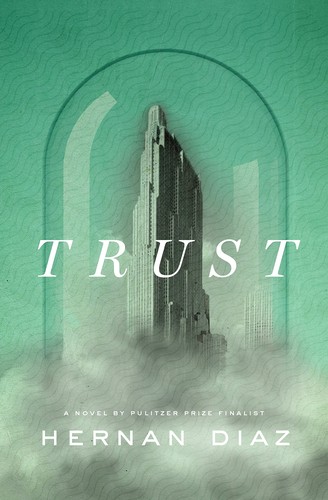
Hernán Díaz
Hernan Diaz was born in 1973 in Buenos Aires, Argentina, and spent part of his childhood in Sweden before his family settled in the United States. This itinerant upbringing informs much of his fiction, which is deeply interested in the unreliability of narrative, the way stories are constructed to serve power, and the silences that official histories work to maintain. He holds a doctorate in Comparative Literature and serves as associate director of the Hispanic Institute at Columbia University.
Diaz’s debut novel, In the Distance (2017), announced him as a writer of unusual formal intelligence. A revisionist Western told from the perspective of a Swedish immigrant crossing nineteenth-century America alone, the novel stripped the genre of its mythologies and replaced them with loneliness, labor, and the bewilderment of the foreign-born. It was a finalist for both the Pulitzer Prize and the PEN/Faulkner Award for Fiction, a remarkable distinction for a debut novel.
Trust (2022), featured on WritersReview, represents an extraordinary leap in formal ambition. The novel is composed of four nested narratives, each claiming to tell the story of an impossibly wealthy New York financier and his wife during the early twentieth century, and each systematically undermining the one before it. The first is a slick novel of wealth; the second is the financier’s unpublished memoir written to correct it; the third is the memoir of the woman hired to ghostwrite his memoir; the fourth is the private diary of the wife herself, erased from every previous account. Trust is a novel about who gets to tell stories, who gets erased, and how capital shapes narrative as surely as it shapes everything else.
Trust won the Pulitzer Prize for Fiction in 2023 and the Kirkus Prize, and was longlisted for the Booker Prize. The response confirmed what In the Distance had suggested: that Diaz is one of the most intellectually rigorous and formally inventive novelists working in American literature. His prose is precise without being cold, historically grounded without being antiquarian, and structurally complex in ways that never feel like mere puzzle-making.
Diaz writes in English, his third language after Spanish and Swedish, a fact that seems inseparable from his persistent interest in translation, misreading, and the ways language both enables and forecloses understanding. His academic work focuses on the intersection of American literature and finance, a preoccupation that suffuses Trust at every level. He is widely regarded as one of the essential voices in contemporary fiction.