
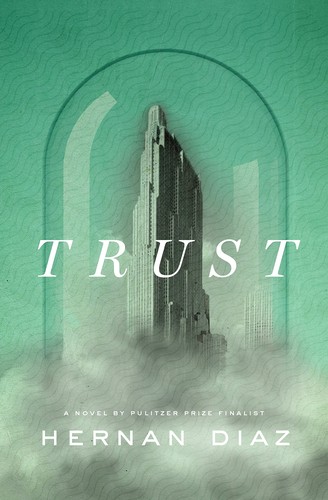
Trust
Riverhead Books · 2022 · 416 pages
ISBN: 9780593420324
🏆 Pulitzer Prize for Fiction (2023)
Kirkus Prize for Fiction (2022)
Booker Prize Longlist (2022)
New York Times 100 Best Books of the 21st Century (#50)
Review Editor
Claire Beaumont
Hernán Díaz’s Trust opens with a familiar kind of story: a novel called “Bonds,” set in 1920s New York, following a brilliant and reclusive financier named Benjamin Rask and his enigmatic wife, Helen. Rask amasses an enormous fortune, predicts the 1929 crash, and profits from the ruin of others. Helen, a pianist and philanthropist of delicate constitution, drifts into illness and obscurity. If you’ve read enough American fiction, you know this shape. The robber baron. The suffering wife. The cost of wealth measured in human wreckage.
But Díaz, an Argentine-born writer and associate professor at Columbia University, has no interest in telling that story straight. Published in 2022 by Riverhead Books, Trust is a novel built from four distinct texts, each one refracting and undermining the one before it. “Bonds” is followed by an unfinished autobiography by a man named Andrew Bevel, who bears a suspicious resemblance to Benjamin Rask and who wants to correct the record. Then comes a memoir by Ida Partenza, the Italian-American woman hired to ghostwrite Bevel’s self-portrait. Finally, we read the private diary of Mildred Bevel, Andrew’s wife, the woman whose inner life every previous narrator has claimed to understand. What emerges is not a story about Wall Street. It is a story about who gets to tell stories, and what happens to the people who don’t.
The novel shared the 2023 Pulitzer Prize for Fiction (alongside Barbara Kingsolver’s Demon Copperhead, the first time the prize was awarded to two books simultaneously), won the Kirkus Prize, and was longlisted for the Booker Prize. That institutional recognition is deserved, but it also risks making Trust sound like homework. It is anything but. This is one of the most intellectually thrilling and emotionally rewarding novels published in the last decade.
Character Arcs and Development
The genius of Trust’s structure is that its central characters keep shapeshifting depending on who is telling their story. Benjamin Rask, in the opening novel “Bonds,” is a cold and calculating figure, a man whose relationship to money has replaced his capacity for human connection. Helen is his fragile counterpart, a woman consumed by charitable impulses and ultimately destroyed by a vague nervous illness. It reads like Edith Wharton by way of Dreiser, and it is convincing enough that you could close the book after 100 pages and feel you’d read a complete, if somewhat conventional, novel.
Then Andrew Bevel’s autobiography begins, and the ground shifts. Bevel insists that “Bonds” distorted his marriage, that his wife was not fragile but formidable, that the novelist Harold Vanner exploited their story for literary gain. Bevel’s version is smoother, more self-serving, and reads like a man constructing his own monument. The prose is flatter, more transactional, and that flatness is the point.
Ida Partenza, the ghostwriter whose memoir forms the third section, is the character who holds the novel together. She arrives at the Bevel household as a young woman with literary ambitions, hired to turn Andrew’s rambling notes into a publishable autobiography. Ida is sharp, observant, and increasingly suspicious. She notices what Andrew leaves out. She finds documents he doesn’t want her to see. Her section has the pace of a detective story, but what she’s investigating is not a crime in any legal sense. It’s something quieter and more devastating: the systematic erasure of a woman from her own life.
Mildred Bevel’s diary, the final section, is the shortest and the most powerful. Here, at last, is the woman that everyone else has been talking about, talking over, and talking for. Mildred is brilliant, self-aware, passionate about music and mathematics, and deeply ambivalent about the fortune her husband is building. She is no one’s victim and no one’s symbol. Her voice, appearing only in private writing never intended for publication, feels like the one honest document in a book full of performances.
Pacing
Trust asks its readers to restart their engines four times, and that is the one real demand it makes. The opening section, “Bonds,” reads quickly and pulls you along with the momentum of conventional literary fiction. The shift to Bevel’s autobiography is jarring by design. His prose is self-congratulatory and occasionally tedious, which is exactly how a financier’s memoir should read. Some readers will find this section slower going, and they are meant to. Díaz is making you feel the difference between a story told for art and a story told for reputation.
Ida’s memoir picks up the pace considerably. Her section has genuine narrative tension because she is piecing together a puzzle and finding that the pieces don’t fit. By the time you reach Mildred’s diary, the book has trained you to read between the lines of every sentence, and those final pages move with a kind of quiet urgency that is hard to put down.
Deeper Thematic Exploration
The central question of Trust is deceptively simple: who owns a story? The novelist Harold Vanner writes “Bonds” and gets it wrong, or gets it right in ways that make the powerful uncomfortable. Andrew Bevel hires a ghostwriter to produce his version, one that restores his wife to her “proper” place in his narrative. Ida watches this process and realizes that the autobiography is not a correction but a second distortion. And Mildred, writing only for herself, produces the one account that has no audience and no agenda.
Díaz connects this question of narrative control directly to the mechanics of capitalism. Money, in this novel, functions exactly like fiction: it creates value out of consensus, it rewards those who control the story, and it punishes those who can’t make themselves heard. Andrew Bevel’s fortune depends on other people believing in his version of events. The 1929 crash was, in Díaz’s telling, a failure of collective storytelling, a moment when the fictions that propped up the market could no longer sustain themselves. The parallel to literature is explicit and earned. Both finance and fiction are systems of trust, and both can be weaponized by those with enough power to shape what others believe.
The novel is also, and perhaps most urgently, about the erasure of women from historical narratives. Mildred Bevel is a polymath whose intellectual gifts are repeatedly attributed to eccentricity or illness by the men who write about her. Her charity work, her mathematical mind, her musical talent: all of these are diminished, sentimentalized, or simply omitted depending on which narrator is in control. Díaz never makes this point through polemic. He makes it through structure. You experience Mildred’s erasure by reading four different versions of her life, each one filtered through someone else’s needs, before you finally hear from her directly. The effect is cumulative and devastating.
There is also a quieter thread about immigration and class. Ida Partenza, the daughter of Italian anarchists, brings a political consciousness to the Bevel household that none of its inhabitants share. She sees the fortune not as an achievement but as an accumulation, built on the labor of people who will never benefit from it. Her perspective doesn’t dominate the novel, but it provides a necessary counterweight to the rarefied world of old money and literary ambition.
Style and Voice
Díaz’s most impressive technical achievement is the way each section sounds genuinely different. “Bonds” has the cadences of early twentieth-century American realism, with long, carefully constructed sentences and a narrator who maintains an ironic distance from his characters. Bevel’s autobiography is clipped and declarative, the prose of a man who is used to issuing instructions. Ida’s memoir is warmer and more digressive, full of sensory detail and self-questioning. Mildred’s diary is spare and precise, each entry a small act of clarity in a life surrounded by obfuscation.
This is not pastiche for its own sake. The different voices serve the novel’s argument: that style is never neutral, that the way a story is told reveals as much about power and motive as the events it describes. Díaz writes beautifully in all four registers, but he is at his best in Ida’s section, where the prose has a searching, restless quality that mirrors her growing unease. You can feel her paying attention in a way that none of the other narrators do, noticing the texture of a room, the weight of a silence, the particular quality of light on a winter afternoon.
Verdict
Trust is a novel for readers who want to be challenged and rewarded in equal measure. If you are drawn to books that play with form and structure (Jennifer Egan’s A Visit from the Goon Squad, David Mitchell’s Cloud Atlas), you will find a kindred spirit here. If you care about the ways that wealth distorts truth and truth distorts memory, this book will stay with you. If you want a novel that takes the interior life of women seriously and demonstrates, through its very architecture, how easily that life can be overwritten by men with louder voices, Trust delivers with precision and feeling.
The book’s one limitation is that its intellectual ambitions occasionally outpace its emotional ones. The first two sections, by design, keep readers at arm’s length, and some will find the accumulation of unreliable narrators more admirable than moving. But the final two sections, Ida’s memoir and Mildred’s diary, carry real emotional weight. The last pages of the novel are among the most quietly powerful things I’ve read in recent years. Trust earns its Pulitzer. More importantly, it earns your time.
Frequently Asked Questions about Trust by Hernán Díaz
What is Trust by Hernán Díaz about?
Trust is a novel composed of four interconnected texts set primarily in 1920s and 1930s New York. It follows the story of a wealthy Wall Street financier and his wife through multiple, conflicting perspectives: a novel, an unfinished autobiography, a ghostwriter’s memoir, and a private diary. At its core, the book explores who gets to control the narrative of a life, and how power and money shape what we accept as truth.
Is Trust by Hernán Díaz based on a true story?
Trust is a work of fiction, but it draws on real historical context. The 1929 stock market crash and the world of Gilded Age New York finance provide the backdrop. Díaz has cited the real-life stories of financiers like Andrew Carnegie and their efforts to control their public legacies as inspiration. The novel is not a roman à clef about any specific person, but its portrayal of wealth and narrative control feels grounded in American financial history.
What are the main themes in Trust by Hernán Díaz?
The novel wrestles with several interlocking themes. Narrative control and unreliable storytelling sit at the center, as each section reframes the same events through a different lens. The relationship between money and truth runs throughout, with Díaz drawing explicit parallels between financial speculation and fiction. The erasure of women from history is a major thread, most powerfully realized in the contrast between how Mildred Bevel is described by others and how she describes herself. Class, immigration, and the nature of American wealth also figure prominently.
How long is Trust and is it a difficult read?
Trust is 416 pages in hardcover. The reading difficulty is moderate. The prose is clear and accessible in all four sections, and the plot is engaging throughout. The main challenge is structural: the novel asks you to restart with a new narrator and style four times, and each section recontextualizes what came before. Readers who enjoy piecing together a puzzle will find this rewarding rather than frustrating. It is best read in longer sittings so the connections between sections stay fresh.
Is there a movie or TV adaptation of Trust by Hernán Díaz?
HBO acquired the rights to adapt Trust as a limited series. Kate Winslet is attached to star in and produce the adaptation, with director Todd Haynes (Carol, May December) set to write and direct. As of mid-2026, the series is in development. No premiere date has been officially announced.
What age group or reading level is Trust appropriate for?
Trust is best suited for adult readers, roughly ages 16 and up. There is no graphic violence or explicit sexual content, but the novel’s themes of financial manipulation, institutional power, and narrative deception require a certain level of reading maturity to fully appreciate. Advanced high school readers who enjoy literary fiction would likely engage with it, but its primary audience is adult readers interested in ambitious, structurally inventive novels.
How does Trust compare to Hernán Díaz’s first novel In the Distance?
In the Distance (2017), Díaz’s debut, is a revisionist Western about a Swedish immigrant crossing nineteenth-century America. It was a finalist for the Pulitzer Prize and the PEN/Faulkner Award. Trust shares its predecessor’s interest in American myths and the stories people tell about wealth and power, but the two books are very different in form. In the Distance is a linear narrative with a single protagonist; Trust is fragmented across four voices and styles. Readers who loved the ambition and historical scope of In the Distance will find Trust even more structurally daring.
Should I read Trust by Hernán Díaz and is it worth it?
If you enjoy novels that reward close attention and play with the conventions of storytelling, Trust is absolutely worth your time. It is one of the strongest American novels of the 2020s, and its central question (who gets to tell the truth about a life?) resonates far beyond its period setting. Readers who prefer straightforward, linear narratives may find the four-part structure demanding, but those who lean into it will discover a book that keeps revealing new layers on reflection. It is the rare novel that is both intellectually rigorous and emotionally affecting.
Book Details
- Title
- Trust
- Author
- Hernan Diaz
- Genre
- Literary Fiction
- Publisher
- Riverhead Books
- Year Published
- 2022
- Pages
- 416
- ISBN
- 9780593420324
- Awards
- 🏆 Pulitzer Prize for Fiction (2023) Kirkus Prize for Fiction (2022) Booker Prize Longlist (2022) New York Times 100 Best Books of the 21st Century (#50)
- WritersReview Rating
- 4.9 / 5