Richard Feynman
Richard Feynman (1918–1988) was born in Far Rockaway, Queens, New York, the son of a uniform salesman who cultivated in his eldest child a love of puzzles, pattern-recognition, and the habit of asking why rather than simply accepting what things are called. Feynman’s father, Melville, told him: “See that bird? It’s a brown-throated thrush. But in Germany it’s called a halzenfugel… You can know the name of that bird in all the languages of the world, but when you’re finished, you’ll know absolutely nothing whatever about the bird.” This distinction between names and understanding — between appearance and mechanism — became the animating principle of Feynman’s physics.
He studied at MIT and completed his doctorate at Princeton under John Wheeler. During World War II he worked at Los Alamos on the Manhattan Project, where he became famous among colleagues for his safe-cracking and his willingness to challenge authority at any level. After the war he joined Cornell’s faculty and then Caltech, where he remained for the rest of his career. In 1965 he shared the Nobel Prize in Physics with Julian Schwinger and Sin-Itiro Tomonaga for fundamental contributions to quantum electrodynamics (QED) — the quantum field theory describing how light and matter interact. His diagrammatic method, Feynman diagrams, gave physicists a visual and computational tool that transformed how calculations in particle physics are done.
Feynman was, by all accounts, a teacher of extraordinary gifts. His undergraduate physics lectures at Caltech (1961–63), transcribed and published as The Feynman Lectures on Physics, are the most widely read and admired physics textbooks ever written. He had the ability — rare even among brilliant scientists — to strip a problem to its essential physics and explain it in terms of mechanisms rather than formalism. The Character of Physical Law (1965), reviewed on WritersReview.com, captures this gift in concentrated form: six lectures delivered at Cornell in 1964, covering the relation of mathematics and physics, the nature of conservation laws, symmetry, probability and uncertainty, and what it means to know something in physics.
Feynman became a household name in 1986 when he served on the Rogers Commission investigating the Challenger shuttle disaster. In a moment of theatrical simplicity that became one of the most famous demonstrations in science communication, he placed a piece of O-ring rubber in a glass of ice water and showed how it lost its resilience at low temperatures — identifying in minutes the failure mode that had destroyed the orbiter. His report’s appendix, submitted over NASA’s objections, ended with the memorable sentence: “For a successful technology, reality must take precedence over public relations, for nature cannot be fooled.”
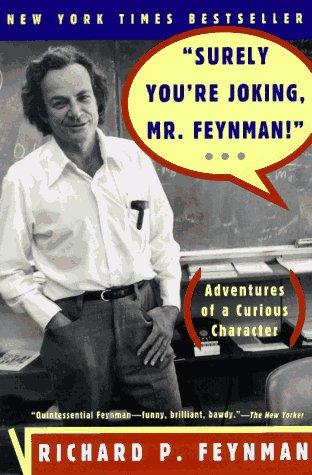
His autobiographical books — Surely You’re Joking, Mr. Feynman! and What Do You Care What Other People Think? — became bestsellers and gave general readers an unusually vivid portrait of a working scientist: playful, irreverent, intensely curious, and completely unwilling to pretend to knowledge he did not have. Feynman died of kidney cancer in 1988. The Character of Physical Law, reviewed on WritersReview.com, remains one of the finest introductions to the deep structure of physical thinking ever written — evidence of why Feynman was, as Freeman Dyson called him, “the most original mind of his generation.”