
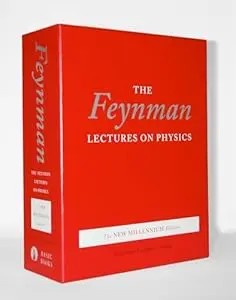
The Feynman Lectures on Physics
Basic Books · 2011 · 1552 pages
ISBN: 9780465023820
Review Editor
Lena Park
In 1961, Richard Feynman stood before a room of Caltech freshmen and began a two-year lecture course in introductory physics that his colleagues had designed to address a specific problem: too many physics students were emerging from their first courses technically competent but fundamentally incurious, able to solve problems on exams but not sure why the problems mattered or what the solutions revealed about the world. Feynman, who had never taught an introductory course before, approached the assignment the way he approached everything: by starting from what he actually understood and building outward from there, rather than following the existing curriculum.
The result, edited and published by Robert Leighton and Matthew Sands as The Feynman Lectures on Physics in three volumes between 1963 and 1965, is the most significant physics textbook of the twentieth century and arguably the most significant work of physics pedagogy ever produced. The New Millennium edition, released by Basic Books in 2011, corrected hundreds of errors that had accumulated in the original printing and is now the standard text. The complete lectures are also available free online at feynmanlectures.caltech.edu, which is either a remarkable act of open educational resource creation or a sign that Caltech has made its peace with the fact that no one can actually prevent people from reading them. Either way, the availability is a gift.
Volume I covers mechanics, radiation, and heat. Volume II covers electromagnetism and matter. Volume III covers quantum mechanics. Together they run to roughly 1,900 pages, though the page count varies by edition, and cover the full undergraduate physics curriculum at a level of depth and conceptual integrity that few curricula match. Feynman does not write down to his students. He assumes they are serious, curious people who want to understand physics rather than just pass a course, and he treats that assumption as both a compliment and a demand.
Feynman as a Physics Teacher
Reading the lectures now, knowing their history and their reputation, the first thing that strikes you is how personal they are. Most physics textbooks sound like they were written by a committee; the Feynman lectures sound like they were written by a specific person who found this subject thrilling and wanted to convey exactly why. Feynman consistently draws attention to what is surprising, counterintuitive, or deeply strange about the physics he is explaining. He points out where the standard analogies break down. He tells you which questions the theory cannot answer. He is never falsely reassuring about the difficulty of the material, and he never leaves you with the impression that everything is understood and physics is just a matter of filling in the details.
The famous first lecture, on “Atoms in Motion,” sets the tone for everything that follows. Feynman starts by asking: if all scientific knowledge were to be destroyed and only one sentence could be passed on to the next generation, what sentence would convey the most information in the fewest words? His answer is the atomic hypothesis: that all things are made of atoms, little particles that move around in perpetual motion, attracting each other when they are a little distance apart but repelling upon being squeezed into one another. From that starting point, he spends the rest of the first lecture showing how much of physics, chemistry, and biology follows from thinking carefully about that single sentence. It is one of the most effective openings in the pedagogical literature.
Feynman’s treatment of quantum mechanics in Volume III is the section most frequently cited by physicists who say the lectures changed how they think. He develops the theory from a few basic postulates about amplitudes and does not rely on the historical scaffolding of wave-particle duality and the development of quantum theory through the 1920s. The result is cleaner than historical approaches and more immediately connected to how quantum mechanics is actually used in calculations. It requires more mathematical confidence than the first two volumes, but for readers who have that confidence, it is the clearest short treatment of quantum mechanics available.
Pacing
The pace of the lectures varies considerably by section, reflecting the nature of the material and the specific audience Feynman was addressing in a given week. Some lectures are deliberately slow and conversational, spending forty pages on a concept that most textbooks cover in five: the extended treatment of oscillators and resonance in Volume I, for example, is not because the mathematics is complicated but because Feynman wants the reader to really understand why oscillating systems are so pervasive in physics. Other sections move quickly through material that Feynman considers secondary, directing the reader to the important insights without much ceremony about the rest.
This unevenness is the only honest criticism to make about the lectures as a self-study resource. As a course, the lectures are paced by the weekly rhythm of a university term; the sections that feel thin in isolation were covered by problem sessions, problem sets, and the student’s active engagement with the material. As a book you read alone, you occasionally hit a passage where Feynman gestures at something important and then moves on, and you have to decide whether to follow the gesture or just keep reading. Most of the time, following the gesture is the right choice. But it requires a reader willing to do supplementary work, which not all readers are.
Deeper Thematic Exploration
The lectures are not just a physics curriculum. They are a sustained argument about what physical understanding is and what it feels like to have it. Feynman returns repeatedly to the distinction between knowing the equations and understanding what the equations mean. He is particularly good on the relationship between mathematical description and physical reality: on why the equations that describe a system are not the same as an explanation of the system, and on the ways that physical intuition should guide mathematical formalism rather than the other way around.
The philosophical content is most explicit in the passages where Feynman discusses the relationship between physics and other sciences, and between science and philosophy. He is dismissive of much academic philosophy of science, which he found too disconnected from the actual practice of physics, and more respectful of mathematics, which he treats as a language that physics has borrowed and continually extends. These passages will irritate some readers, particularly those with a philosophical background, but they reflect a coherent position that Feynman had thought about seriously and that is at least worth engaging even if you ultimately disagree with it.
The lectures also contain a persistent argument about the nature of curiosity and its relationship to scientific progress. Feynman believed that the primary job of a physicist was to be surprised by the world: to notice the things that should not work the way they do, that violate intuition, that suggest something is not being understood properly. This orientation is different from the problem-solving orientation that dominates most physics education, and it produces a different kind of physicist. The graduates of a curriculum organized around Feynman’s lectures tend to be better at asking new questions and sometimes slower at applying established methods efficiently, which is a reasonable trade-off depending on what you want scientists to do.
Style and Voice
The prose retains the rhythms of spoken lectures, which is both its primary charm and its occasional limitation. Feynman explains things by talking through them rather than by writing them down in the most logical order, which means the lectures sometimes circle back to revise an earlier explanation rather than proceeding linearly. This can be frustrating if you are looking for the cleanest formulation of a concept, but it reflects the reality of how understanding develops: you say something approximately right, then see why it’s not quite right, then say something more right, and the revision is part of what makes the thing memorable.
The notation and sign conventions vary from modern standards in a few places, and some of the terminology has been superseded. The New Millennium edition corrected many errors from the original printing but preserved the voice and structure of the lectures without attempting to modernize the physics. A student using these lectures alongside a modern course will need to navigate some differences in convention, but nothing that a few hours of attention cannot resolve.
Verdict
These lectures belong on the shelf of anyone who wants to understand physics rather than just calculate with it. That is a specific audience: students who want to pass exams quickly will likely find the commitment of attention required frustrating. Students who are willing to spend twenty pages understanding why a pendulum behaves the way it does rather than just being told the formula will come away from these lectures with something that most physics courses do not provide: a sense of why physics is one of the most exciting intellectual projects humans have ever undertaken, and what it actually feels like to understand a piece of it.
The complete text is freely available online, which means the barrier to entry is time and attention rather than money. If you have ever been curious about physics and dissatisfied with the quality of the curiosity your education produced, start with the first lecture of Volume I and read as far as your patience and mathematics takes you. Most people who try it find it hard to stop.
Frequently Asked Questions about The Feynman Lectures on Physics
What are The Feynman Lectures on Physics?
They are a three-volume introductory physics course based on lectures Richard Feynman gave to Caltech freshmen and sophomores between 1961 and 1963. Volume I covers mechanics, radiation, and heat; Volume II covers electromagnetism and matter; Volume III covers quantum mechanics. They were edited by Robert Leighton and Matthew Sands and first published between 1963 and 1965. The New Millennium Edition, published by Basic Books in 2011, is the current standard text and corrected hundreds of errors from earlier printings. The complete text is also freely available at feynmanlectures.caltech.edu.
Are The Feynman Lectures suitable for self-study without a course?
Yes, but with realistic expectations about the commitment required. The lectures were designed as part of a course that included problem sets and discussion sections, neither of which are included in the published volumes. Readers studying independently should supplement the lectures with problem sets from a standard physics text, and should expect to work through each chapter actively rather than reading passively. Feynman’s explanations are among the clearest available for the material they cover, but the material itself requires engagement rather than just reading.
What mathematical background do I need for The Feynman Lectures?
Volume I requires calculus at roughly the first-year college level: derivatives, integrals, and differential equations. Volume II requires vector calculus, including div, grad, curl, and line integrals. Volume III requires comfort with complex numbers and linear algebra in addition to the calculus from the earlier volumes. Feynman introduces mathematical tools as needed rather than requiring prior mastery, but the pace of introduction is not generous. Readers who have not yet taken calculus will struggle with most of Volume I from early on.
How do The Feynman Lectures compare to other physics textbooks?
Most introductory physics textbooks, such as Halliday, Resnick, and Krane or Serway and Jewett, are more conventional: organized around problem-solving techniques, with many worked examples and problem sets built into the text. They are more efficient for passing physics exams. The Feynman Lectures prioritize conceptual understanding over problem-solving technique and cover the material at a greater depth than most introductory texts. Most physics students benefit from using both: a conventional text for structured problem practice and the Feynman Lectures for genuine comprehension of what the equations mean.
Is Volume III on quantum mechanics accessible without advanced math?
Volume III requires the mathematical background from the first two volumes plus some comfort with abstract linear algebra (vectors and matrices in a general sense). It does not require the full machinery of Hilbert spaces or operator theory that a graduate quantum mechanics course demands. Feynman’s approach to quantum mechanics is unusually clear and physically motivated, and the text is generally considered the most accessible rigorous treatment of the subject available at the introductory level. Readers who have worked through Volumes I and II seriously will be adequately prepared.
Why are The Feynman Lectures considered so exceptional?
Most experienced physicists point to two things: Feynman’s ability to identify and address the things that students typically misunderstand, and his consistent emphasis on why the physics works rather than just how to apply it. The lectures are full of passages that explain the same concept in multiple ways until the reader understands it rather than just knows the formula. Feynman also connects topics across the curriculum in ways that reveal unifying principles, so the lectures read as a coherent exploration of a subject rather than a collection of separate topics. The result is that readers who work through them carefully come away with a fundamentally different relationship to physics than students who learn from problem-solving-focused textbooks.
Are The Feynman Lectures useful for experienced physicists or just students?
Both. Working physicists regularly report returning to specific sections of the lectures when they want a clear, physical explanation of something outside their specialty. Feynman’s treatment of electromagnetism in Volume II is frequently cited by physicists trained in condensed matter or particle physics as the clearest introduction to the subject available. The quantum mechanics volume is routinely recommended to graduates encountering quantum information or quantum computing for the first time. The lectures are not a reference manual, but they are an exceptionally reliable place to go when you want to understand something rather than just use it.
Should I read The Feynman Lectures if I am not studying physics?
Some sections, particularly the first few chapters of Volume I and selected chapters on topics like gravitation, the relationship between physics and other sciences, and the nature of physical law, are accessible and rewarding for general readers without a technical background. The bulk of the lectures requires the mathematical preparation described above. Readers who want Feynman’s thinking about science and nature without the mathematics should start with The Character of Physical Law or Six Easy Pieces, which were designed for general audiences and do not require technical prerequisites.
Book Details
- Title
- The Feynman Lectures on Physics
- Genre
- Science & Nature
- Publisher
- Basic Books
- Year Published
- 2011
- Pages
- 1552
- ISBN
- 9780465023820
- WritersReview Rating
- 4.7 / 5