
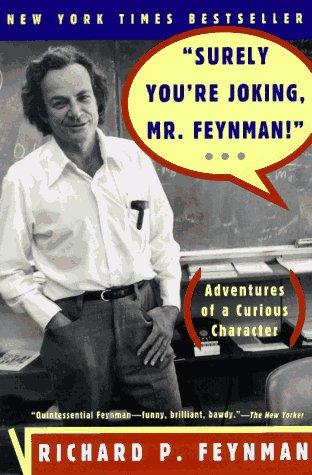
Surely You’re Joking, Mr. Feynman!
W. W. Norton and Company · 1985 · 350 pages
ISBN: 9780393316049
Review Editor
Lena Park
Richard Feynman was one of the twentieth century’s most important physicists, a Nobel laureate who helped develop quantum electrodynamics and whose path integral formulation of quantum mechanics transformed how physicists think about their subject. He was also, by most accounts, one of the most entertaining people who ever sat at a bar or a blackboard. Surely You’re Joking, Mr. Feynman!, published by W. W. Norton in 1985, collects several years of recorded conversations between Feynman and his friend Ralph Leighton into a memoir organized around a simple premise: here is what it was actually like to be Richard Feynman, in his own words, without the cleaned-up version that official biographies produce.
The title comes from an early story. Feynman, newly arrived at Princeton as a graduate student, is at a tea and doesn’t know whether to put cream or lemon in his tea. When he asks for both, the dean’s wife responds: “Surely you’re joking, Mr. Feynman!” The story is offered as a small sample of a pattern that runs through the entire book: Feynman habitually violates social expectations, not from rebelliousness but from genuine puzzlement about why the expectations exist. He is curious about everything, including the unwritten rules of how physicists, academics, and respectable citizens are supposed to behave, and he tends to question rules by breaking them quietly and seeing what happens.
The book proceeds chronologically from Feynman’s childhood in Far Rockaway, New York, through his graduate work at Princeton, his time at Los Alamos working on the Manhattan Project, his years at Cornell and then Caltech, and eventually his receipt of the Nobel Prize in 1965. It is not a comprehensive biography: there is almost nothing about his three marriages, the death of his first wife Arline from tuberculosis while he was at Los Alamos (which he covered more directly in his second collection, What Do You Care What Other People Think?), or the development of the physics itself. The book is almost entirely about adventures: the safe-cracking at Los Alamos, the bongo drumming in Brazil, the time he worked as a bartender in Las Vegas, the business with nude models at Pasadena strip clubs, the Nobel banquet in Stockholm.
The Man Behind the Physics
What makes the book work is that the adventures are genuinely funny and that Feynman is genuinely honest in the telling. He does not flatter himself. The safe-cracking chapter, one of the book’s most famous, is a story about how Feynman figured out a parlor trick and turned it into a minor legend, and he tells it with full awareness that he is a showman who has constructed a reputation for mysteriousness out of nothing more than the fact that most people don’t read combination lock documentation. The story is not humble, exactly, but it is accurate, and accuracy about one’s own foolishness is a form of integrity.
The Los Alamos sections are among the most historically valuable in the book. Feynman arrived at the Manhattan Project as a twenty-four-year-old and immediately started testing everything he could find. He tested the security by finding holes in the fences and noting that the guards never actually checked for the passes they demanded. He tested the censors by writing coded letters back and forth with Arline to see what they would and wouldn’t let through. He figured out how to crack every safe in the facility, not because he needed anything inside them but because it seemed like a solvable problem. The portrait of Los Alamos is vivid and specific: a place full of extraordinary minds under enormous pressure, where the particular combination of urgency, secrecy, and intellectual intensity produced something that Feynman experienced partly as high adventure.
The sections on Brazil are equally vivid. Feynman spent a year in Rio de Janeiro in the early 1950s teaching physics and studying Portuguese and playing in a samba band. His description of Brazilian physics education at the time, which he concluded consisted entirely of students memorizing words without understanding the physical content behind them, is a small masterpiece of diagnostic observation. He describes asking the class about a specific optical effect and realizing gradually that the students could recite the relevant formula but had no idea it applied to the light they were seeing with their own eyes. The critique is sharp, but Feynman applies it to American education too, and the underlying question, what does it mean to actually understand something rather than just being able to state it correctly – runs through the entire book.
Pacing
The book is organized as a series of short to medium anecdotes, each largely self-contained, which means you can read it straight through or dip in anywhere. The episodic structure creates a very readable pace: each chapter sets up a situation, Feynman does something unexpected, and the chapter ends with a punch line or a reflection. The accumulation of episodes builds a fuller portrait than any single story could provide, but the individual stories work independently, which is unusual for a memoir and makes the book easy to return to.
A few sections sag slightly under the weight of too much technical detail, particularly a chapter about Feynman’s work on the Challenger commission, which is interesting but belongs more properly to the second book of Feynman anecdotes. The chapters about his painting practice and his time drumming in strip clubs are among the best-paced in the book: they illustrate something central about Feynman’s character, his genuine pleasure in learning things for their own sake regardless of their social prestige, without overstaying their welcome. The Nobel Prize chapter, placed at the end, is perfect: it is a story about Feynman’s discomfort with the pomp and ceremony of the occasion, his inability to play the role of Nobel laureate without pointing out that the role is a little absurd, and it leaves the book on exactly the right note.
Deeper Thematic Exploration
The book is, underneath its entertainment value, a sustained argument about the nature of curiosity. Feynman treats curiosity as a moral position as much as a cognitive style. He is suspicious of authority, especially authority that cannot explain itself, not because he is a rebel but because unexplained authority is a sign that someone has stopped thinking. His famous story about learning the name of a bird illustrates this directly: his father taught him that knowing the name of a bird in every language tells you nothing about the bird itself; understanding the bird requires watching it, which is a different and more important kind of knowledge.
This philosophy produces a specific kind of person: someone who is very good at noticing things that specialists miss because they are too inside the paradigm to see them, and who is sometimes maddening to colleagues who need the project to proceed without someone questioning the foundation. The Los Alamos security episode is an example: Feynman’s habit of testing everything, which was charming and productive in physics, became a genuine institutional problem when it involved demonstrating that nuclear secrets were poorly protected. The book is honest about both aspects of the trait.
The sections on education are the most serious in the book and the ones where Feynman is most explicitly making an argument rather than just telling stories. He returns repeatedly to the distinction between knowing words and understanding things, and he is unsparing about the ways that educational systems reward the first while pretending to cultivate the second. These passages have not dated. The specific institutions Feynman criticizes in 1985 are still recognizable, and the underlying problem he identifies, the substitution of symbol manipulation for genuine understanding – is still present in physics education everywhere.
Style and Voice
The book is transcribed from recordings, and the transcription preserves the rhythms of Feynman’s speech: direct, colloquial, emphatic, and very funny. The voice is unmistakable from the first paragraph. Feynman talks the way he thinks: fast, with digressions and self-corrections, circling around to the point from unexpected directions, and landing the punch line with precision. Reading the book, you hear him. This is not a common quality in transcribed speech; most published oral history sounds flat on the page. Feynman sounds alive.
The humor is earned rather than performed. Feynman is not trying to be funny in the way a stand-up comedian is trying to be funny; he is telling you what actually happened and the situations turn out to be funny because reality is genuinely absurd when you look at it carefully enough. The safe-cracking chapter is funny because Feynman’s behavior was genuinely ridiculous and he knows it. The Brazil chapter is funny because the situation he describes, students memorizing formulas about polarized light without realizing that the sunlight they can see from the window is polarized – is both absurd and exactly right as a description of how physics is often taught.
Verdict
This is one of the best books about a scientist ever written, not because it is the most thorough or the most technically accurate, but because it is the most honest. Feynman tells you what it was actually like to be him, including the parts that are not flattering, and the result is a portrait of a specific kind of intellectual life: curious, anarchic, productive, and deeply suspicious of prestige for its own sake. The book is also very funny, which matters: a lot of science writing asks you to find beauty in the universe through the voice of someone who clearly never enjoyed a disreputable evening in his life. Feynman enjoyed many, and the book is the better for it.
You do not need to be interested in physics to enjoy the book, which is part of what makes it unusual. You need to be interested in a person who approached the world as a series of problems worth solving and who had the energy and irreverence to actually try. There is almost no one who would not enjoy this book, with the small exception of people who prefer their scientists dignified and their physics kept safely in the laboratory. Feynman had no time for either preference, and the book is a standing argument that he was right.
Frequently Asked Questions about Surely You’re Joking, Mr. Feynman!
What is Surely You’re Joking, Mr. Feynman! about?
The book is a collection of autobiographical anecdotes by Nobel Prize-winning physicist Richard Feynman, transcribed from conversations with his friend Ralph Leighton. It covers Feynman’s life from childhood in Far Rockaway through his work on the Manhattan Project at Los Alamos, his year in Brazil, his career at Caltech, and the Nobel Prize ceremony. The stories focus not on the physics itself but on Feynman’s adventures, his approach to problems, his education philosophy, and his consistent inability to take social conventions at face value.
Do I need a physics background to enjoy Surely You’re Joking, Mr. Feynman?
No. The book contains very little technical physics. The stories are about Feynman as a person, not about the content of his scientific work. Readers with a physics background will catch a few additional references and jokes, but the book is entirely accessible to general readers. It has been popular since its publication in 1985 precisely because it reads as a very entertaining memoir rather than a popular science book requiring scientific literacy.
Is Surely You’re Joking, Mr. Feynman! a true story?
The anecdotes are based on Feynman’s own accounts of his life and have been broadly confirmed by people who knew him. Some details in the book have been disputed by colleagues and by members of Feynman’s family, and he was known to sometimes improve a story in the telling. The essential portrait of Feynman’s character and intellectual approach is consistent with other accounts. The book is best read as an authorized self-portrait rather than a strict factual record: Feynman is presenting himself as he saw himself, which is both its strength and its limitation as biography.
How does Surely You’re Joking compare to Feynman’s other books?
His follow-up memoir, What Do You Care What Other People Think?, covers more emotionally serious material including his first wife Arline’s death from tuberculosis and his work on the Challenger disaster investigation. The Pleasure of Finding Things Out collects his more reflective essays and interviews. Of the three, Surely You’re Joking is the most entertaining and the most accessible. What Do You Care is the most moving, and The Pleasure of Finding Things Out is the most substantive on questions of science, education, and the nature of knowledge.
What are the most famous anecdotes in Surely You’re Joking, Mr. Feynman?
The most frequently cited stories include the safe-cracking at Los Alamos, where Feynman figured out combinations by deduction and observation rather than any technical skill; the Brazil chapter, which includes his critique of physics education and his time playing in a samba band; his experiments with sensory deprivation tanks; his description of decoding Mayan hieroglyphics for fun; and the chapter about working as a bartender and artist’s model in a strip club in Pasadena, which he undertook partly to observe human behavior and partly because it seemed interesting. The Nobel Prize chapter is also widely quoted.
What age group is Surely You’re Joking, Mr. Feynman! appropriate for?
The book is written for adults and contains frank descriptions of Feynman’s visits to strip clubs and his attitudes toward women, which reflect the norms of mid-twentieth-century American academia and have been criticized as sexist by some readers. Mature high school students interested in physics or in science careers will benefit from the book, but parents may want to read it themselves first and consider whether those passages are appropriate for a particular young reader. The physics-related content and the broader intellectual autobiography are excellent for teenagers interested in science.
How does Feynman’s personality come through in the book?
Very clearly. The book is essentially a portrait of Feynman’s character: his combination of intellectual confidence and genuine modesty about things he does not know, his tendency to test social rules by breaking them, his impatience with expertise that cannot explain itself, his genuine pleasure in learning skills that have no professional value (bongo drumming, picking locks, drawing), and his ability to find something worth investigating in almost any situation. Readers tend either to find this portrait enormously appealing or slightly exhausting, and both reactions make sense as responses to the same accurate portrait.
Should I read Surely You’re Joking, Mr. Feynman! even if I am not interested in physics?
Yes. The book is primarily a memoir about a curious person living a very full life, and the physics is rarely central to the stories. What carries the book is Feynman’s voice and his approach to experience: the consistent refusal to accept things on authority, the pleasure in figuring things out from first principles, and the honesty about his own limitations and errors. Those qualities are interesting regardless of whether you care about quantum electrodynamics. If you are generally interested in how very good thinkers actually work, this is one of the best primary sources available.
Book Details
- Title
- Surely You’re Joking, Mr. Feynman!
- Author
- Richard P. Feynman
- Genre
- Science & Nature
- Publisher
- W. W. Norton and Company
- Year Published
- 1985
- Pages
- 350
- ISBN
- 9780393316049
- WritersReview Rating
- 4.4 / 5