
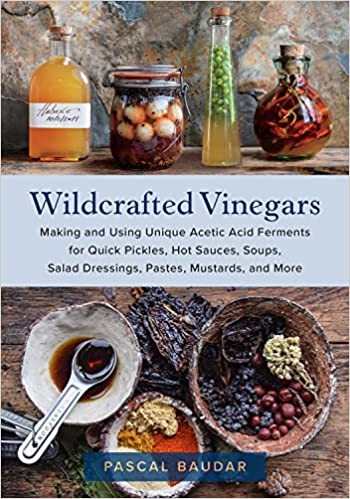
Wildcrafted Vinegars: Making and Using Artisanal Vinegars for Cooking, Medicine, Beauty, and More
Chelsea Green Publishing · 2022 · 304 pages
ISBN: 9781645021148
Review Editor
Lena Park
Pascal Baudar has spent years exploring the intersection of wild food, fermentation, and culinary creativity in the chaparral and mountains outside Los Angeles. His earlier books, including The New Wildcrafted Cuisine and Wildcrafted Fermentation, established him as one of the most inventive practitioners working at the edges of food culture: foragers who actually cook, fermenters who think seriously about flavor and terroir, cooks who treat their local landscape as a primary ingredient. Wildcrafted Vinegars, published by Chelsea Green in January 2022, takes that approach and focuses it entirely on one of food’s most underappreciated condiments. The result is a book that is simultaneously a practical fermentation manual, a guide to wild ingredient sourcing, a culinary history of vinegar, and a very good argument that most commercially available vinegar is a pale shadow of what vinegar can be.
The book begins with the case for making your own vinegar from wild or foraged materials. Baudar argues, convincingly, that the acetic acid fermentation that turns alcohol into vinegar is one of the most accessible and forgiving fermentation processes available to a home cook. You do not need specialized equipment, precise temperature control, or a carefully maintained starter culture. You need juice or liquid with some sugar, a mother of vinegar or some raw unpasteurized vinegar to inoculate it, a jar with a cloth cover, and patience. The wild and foraged ingredients he focuses on are not exotic to most regions of North America: he works with pine needles, mugwort, elderberries, wild blackberries, nettles, mustard flowers, acorns, and dozens of other plants that occur in various combinations across most of the continent.
The structure of the book is practical throughout. Baudar begins with the basic science of vinegar-making, covering alcoholic and acetic fermentation clearly enough that a reader with no fermentation background can understand what is happening chemically without getting bogged down in microbiology. He then moves through a series of vinegar types organized roughly by their base: fruit vinegars, herbal infusion vinegars, seed and bark vinegars, and vinegars made from wild greens and aromatic plants. Each section includes detailed recipes and variations, as well as notes on how the resulting vinegar can be used, stored, and combined with other ingredients.
The Forager as Teacher
Baudar’s approach to teaching is rooted in his own process of discovery. He does not present himself as an authority dispensing correct technique but as a practitioner who has tried a great many things and is reporting what worked, what surprised him, and what he is still figuring out. This is a specific kind of intellectual honesty that is rare in food writing and valuable in a subject where the right answer depends heavily on local climate, local flora, and individual taste. A reader in coastal Oregon and a reader in central Texas will make different vinegars from the same recipe, because they have access to different plants in different seasons, and Baudar writes in a way that prepares you for that variation rather than treating it as a problem to be solved.
He is also unusually candid about foraging ethics and safety. Baudar includes clear guidance on plant identification, notes which plants have potentially toxic lookalikes, and consistently advocates for sustainable harvest practices: taking small amounts from large populations, avoiding protected areas, leaving enough for the ecosystem and for wildlife. For readers new to foraging, these passages are genuinely useful and not preachy. For experienced foragers, they serve as a useful reminder that the author’s primary orientation is toward the landscape as a partner in the project rather than a resource to be extracted.
The book’s treatment of vinegar in cooking, medicine, and personal care extends considerably beyond the fermentation chapters. Baudar provides detailed recipes for fire cider (the traditional spicy medicinal vinegar tonic), vinegar-based shrubs and drinking vinegars, skin tonics, hair rinses, cleaning products, and culinary applications from simple salad dressings to complex braises and fermented condiments. The range is wide enough that a reader who has no interest in, say, making a nettle hair rinse can skip that section without losing the thread, while someone interested in the full spectrum of vinegar’s traditional uses will find the coverage unusually comprehensive.
Pacing
The book reads more like a collection of related essays than a traditional how-to manual, which suits the subject well. Baudar moves from recipe to personal reflection to historical context to practical safety guidance without losing momentum, because all of those registers feel like part of the same conversation about what vinegar is and what you can do with it. The chapters vary in length depending on how much there is to say about each ingredient or technique, which means the book never lingers on a topic that has been covered and never rushes through one that deserves space.
The photography, by Pascal Baudar and Pascale Baudar, is excellent. Full-color images of the finished vinegars, the raw ingredients in their natural settings, and the preparation process make the book physically appealing as well as informative. For a book in which half the challenge is identifying and sourcing unfamiliar plants, good photography is not decorative but functional: you need to see what mugwort looks like in late summer to harvest it confidently. The visual presentation is one of Chelsea Green’s consistent strengths, and it is put to good use here.
Deeper Thematic Exploration
Running through the entire book is an argument about the relationship between local knowledge and food quality. Baudar believes, and demonstrates through recipe after recipe, that the best vinegars come from the plants that grow near you: that a vinegar made from wild blackberries picked on a specific hillside in a specific season captures something about that place that no commercial product can replicate. This is the same argument that has animated the best natural wine, cheese, and bread movements, and Baudar applies it to a category of condiment that most cooks have never thought to question.
The historical sections embedded throughout the book support this argument with a different kind of evidence. Baudar traces the role of herb and fruit vinegars in traditional food cultures across Europe, the Americas, and East Asia, showing that the reduction of vinegar to a single standardized commodity is a recent industrial development rather than the natural state of the substance. Medieval European households kept a dozen different vinegars for different purposes. Japanese rice vinegar culture developed dozens of regional varieties. The monotony of modern supermarket vinegar shelves reflects supply chain economics, not the limits of what vinegar can be. This historical context makes the practical instructions feel like recovery as much as innovation.
There is also a quieter argument about attention and place-making running through the book. Baudar writes with evident pleasure about specific locations: a particular hillside where elderflowers bloom reliably in late spring, a creek drainage where watercress grows in the shade of willows, an abandoned orchard where wild apples drop in September. Making vinegar from these places requires noticing them carefully and returning to them seasonally. The book argues, not very loudly but persistently, that this kind of attentiveness to a specific landscape is its own reward, separate from the vinegar that results from it. For a book organized as a recipe collection, that is a surprisingly generous philosophical claim.
Style and Voice
Baudar writes in a relaxed, enthusiastic voice that conveys genuine pleasure in the subject without becoming breathless. He is helpful without being instructional in a way that implies the reader needs managing. The technical passages are clear and precise; the reflective passages are specific rather than vague. He occasionally slips into the kind of earnest enthusiasm common in food writing that can feel slightly breathless, but the book’s overall register is grounded and trustworthy. You believe that he has made all these vinegars and that they taste the way he says they taste.
The book assumes a certain tolerance for uncertainty and improvisation in the reader. Baudar’s recipes include ranges and approximations rather than exact quantities in many places, and he consistently tells you that the right amount of something is the amount that tastes right to you. This is appropriate for fermentation work, where exact replication is neither possible nor necessarily desirable, but readers who want precise instructions and predictable outcomes may find the style unsatisfying. This is an honest difference in temperament rather than a flaw in the book.
Verdict
This is one of the most interesting food books published in recent years, and not just for readers who already forage or ferment. Anyone who cooks seriously and has been curious about what food can be when it is made from ingredients with a specific provenance will find something to learn here. The basic techniques are genuinely accessible: you do not need a homestead or a deep knowledge of botany to make a good elderflower vinegar or a pine needle fire cider. You need some ability to identify common plants, a willingness to experiment, and a few weeks of patience.
Readers who want a more straightforward vinegar-making manual without the foraging component may find the book’s emphasis on wild ingredients limiting, though the techniques are broadly applicable to cultivated ingredients as well. And readers in urban environments without easy access to wild landscapes will need to adapt some of the sourcing suggestions to farmers’ market or garden materials. But the book never pretends to be something other than what it is: a deeply personal guide to making something extraordinary from the specific landscape you happen to live in. That specificity is exactly what makes it worth reading.
Frequently Asked Questions about Wildcrafted Vinegars
What is Wildcrafted Vinegars by Pascal Baudar about?
The book is a comprehensive guide to making fermented vinegars from wild and foraged ingredients: plants, berries, herbs, bark, seeds, and other materials gathered from natural landscapes. It covers the basic science of vinegar fermentation, detailed recipes for dozens of different vinegar types, and instructions for using the finished vinegars in cooking, medicinal tonics, shrubs, skin care, and household products. Author Pascal Baudar is a professional forager and food educator based in southern California, and the book reflects years of hands-on experimentation with the wild plants of that region and others.
Do I need foraging experience to use Wildcrafted Vinegars?
Some basic foraging knowledge is helpful, but the book includes enough plant identification guidance and safety information that motivated beginners can work with it. Baudar recommends starting with easily identified, commonly available plants like elderberries, blackberries, and nettles rather than jumping immediately to less familiar ingredients. He also includes clear warnings about toxic lookalikes and sustainable harvest practices. Readers who want to go deeper into plant identification should supplement this book with a regional field guide for their area.
What equipment do I need to make wildcrafted vinegars?
Very little. The basic setup is a jar with a breathable cloth cover, some form of alcohol base (juice, wine, beer, or infused liquid), and a mother of vinegar or unpasteurized raw vinegar as a starter. Baudar emphasizes that vinegar-making is one of the most accessible fermentation projects precisely because it does not require specialized equipment, precise temperature control, or a maintained starter culture. A standard mason jar, a piece of cheesecloth, and a warm spot in your kitchen are enough to get started.
How long does it take to make vinegar from wild plants?
The timeline varies significantly by base material, temperature, and the strength of your acetic acid bacteria. Most raw vinegars take between four weeks and several months to fully ferment and develop flavor. The alcoholic fermentation of the base liquid, if you are starting from fresh juice or an infusion, happens first over one to three weeks; acetic fermentation follows and can take another four to eight weeks. Baudar includes detailed guidance on how to taste for progress and recognize when fermentation is complete.
Can I make the recipes in Wildcrafted Vinegars if I live in a city?
Many recipes are adaptable to urban or suburban settings, particularly those that use cultivated fruits, herbs from farmers’ markets, or ingredients that grow as common urban weeds (dandelion, plantain, and nettles are present in most cities, for example). Baudar’s primary frame of reference is the wild landscape, but the techniques apply equally to cultivated or market-sourced ingredients. Readers in dense urban areas may find roughly a third of the recipes directly accessible, another third adaptable, and the rest dependent on having access to specific wild habitats.
What are the main uses for wildcrafted vinegars beyond cooking?
Baudar covers medicinal uses extensively, including fire cider (a spicy, stimulating tonic traditionally used for immune support and digestion), shrubs and drinking vinegars for cocktails and mocktails, and vinegar-based infusions used in herbal medicine traditions. He also covers personal care applications including hair rinses, skin toners, and facial treatments using botanically-infused vinegars. And he discusses household uses for cleaning and preservation. The range reflects vinegar’s long history as a multi-purpose substance before it was reduced to a kitchen condiment.
How does Wildcrafted Vinegars compare to Pascal Baudar’s other books?
Baudar’s earlier books, particularly The New Wildcrafted Cuisine and Wildcrafted Fermentation, cover a broader range of wild food preparation including fermented beverages, cooked dishes, and preserved foods. Wildcrafted Vinegars is more focused and more technical within its specific subject. Readers who enjoyed the earlier books and want to go deeper on one fermentation technique will find this the most detailed and comprehensive of his works. Readers new to Baudar might start with Wildcrafted Fermentation for a broader introduction before focusing on vinegar specifically.
Is Wildcrafted Vinegars worth buying for someone who already makes kombucha or kefir?
Yes, if the foraging component appeals to you. The microbiology of acetic acid fermentation is different from the cultures involved in kombucha or kefir, and the sourcing from wild ingredients adds a dimension that other fermentation projects do not have. Experienced fermenters will move through the basic technique sections quickly and get to the more distinctive material, the specific wild ingredient combinations and culinary applications, without much difficulty. The book offers something genuinely different from most fermentation guides precisely because it is as much about foraging and place-based cooking as it is about the fermentation process itself.
Book Details
- Title
- Wildcrafted Vinegars: Making and Using Artisanal Vinegars for Cooking, Medicine, Beauty, and More
- Author
- Pascal Baudar
- Genre
- Science & Nature
- Publisher
- Chelsea Green Publishing
- Year Published
- 2022
- Pages
- 304
- ISBN
- 9781645021148
- WritersReview Rating
- 4.2 / 5