
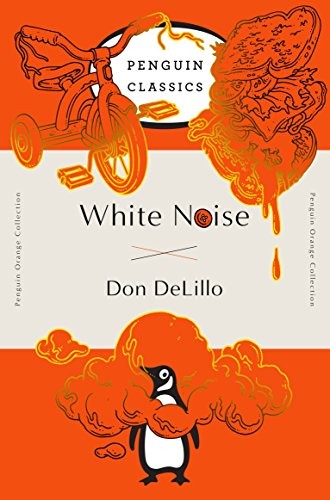
White Noise
Penguin Books · 1985 · 326 pages
ISBN: 9780143129554
Review Editor
Eleanor Marsh
Don DeLillo published White Noise in 1985 and it feels, from the vantage of the twenty-first century, both period piece and prophecy. Its subject-the oversaturation of consumer culture, the management of death-anxiety through media and medication, the terror lurking beneath the surfaces of American middle-class life-has only grown more relevant. The supermarket, DeLillo’s central symbol, feels more accurate as metaphor than it did when he invented it.
Jack Gladney, chairman of Hitler Studies at the College-on-the-Hill, lives with his wife Babette, their assorted children from various marriages, and a background hum of anxiety about death that neither can quite admit to. When an “airborne toxic event”-a train derailment releasing a lethal chemical cloud-invades their comfortable world, it both literalizes the threat they have been avoiding and fails to be as terrible as anticipated. In the aftermath, Jack discovers that Babette has been taking an experimental drug called Dylar in an attempt to eliminate her fear of death, and his response to this discovery-jealousy, betrayal, the desire to kill-constitutes the novel’s final section.
DeLillo’s prose is one of American fiction’s most distinctive registers: flat, deadpan, charged with a peculiar comedy that arises from rendering ordinary experience with slightly too much precision. His dialogue-clipped, repetitive, often disconnected from the social context in which it occurs-creates an effect of alienation that is both comic and unsettling.
White Noise is not a warm novel, but it is an illuminating one. DeLillo diagnoses an American pathology with precision, and if his cure is only diagnosis, the diagnosis itself has value.
Book Details
- Title
- White Noise
- Author
- Don DeLillo
- Genre
- Literary Fiction
- Publisher
- Penguin Books
- Year Published
- 1985
- Pages
- 326
- ISBN
- 9780143129554
- WritersReview Rating
- 4.0 / 5