
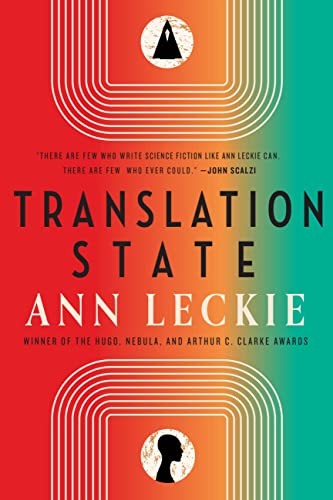
Translation State
Orbit · 2023 · 432 pages
ISBN: 9780316289719
🏆 Finalist, 2024 Hugo Award for Best Novel
Review Editor
Marcus Webb
Ann Leckie’s Translation State is the fifth book set in her Imperial Radch universe, and the first to put new protagonists at the center. Published by Orbit in June 2023, it runs 432 pages and arrives about seven years after Ancillary Mercy closed out the original trilogy. The setup, once Leckie has established her three viewpoint characters, is essentially a political thriller: humanity and several other species are renegotiating a treaty with the Presger, an alien race of almost unfathomable power that agreed to stop eating sentient life only because they were persuaded the treaty was interesting. That renegotiation is in delicate shape when the book opens. The question of whether artificial intelligences count as a separate sentient species is unresolved. The question of what, exactly, makes something human has become politically urgent.
Enae Athtur (pronouns sie/hir) is nearly sixty and has spent most of hir life managing hir powerful family’s household, largely invisible to everyone including hirself. When the family matriarch dies, the new head of household finds Enae a task: officially reopen an old case involving a Presger Translator who disappeared in human space two hundred years ago. Nobody expects results. Enae, with nothing else to do, decides to actually do the job.
Reet is a man in his thirties with a stable life, a decent job, and a very uncomfortable interior. He has urges he works hard to suppress: the desire to take apart living things, to consume. When a diaspora community called the Hikipi tell him he might be descended from their lost royalty, he grasps the community they offer. What he does not know is that Enae’s investigation will eventually find him, and that his DNA will reveal something far more complicated than royal ancestry.
Qven is a juvenile Presger Translator, created from reverse-engineered human biology to serve as a diplomatic interface between the Presger and other species. Juvenile Translators must undergo a process called “matching,” a merge that produces an adult body. After surviving a traumatic forced partial merge, Qven faces a deadline: match willingly with someone, or die young. All three storylines converge at the Presger’s Treaty Administration Facility, where a hearing before multispecies representatives will decide who counts as human, who gets legal protections, and what humanity’s relationship with the Presger will look like for the next century.
Character Arcs and Development
Enae is one of the novel’s quiet pleasures. The opening chapters have the feel of a Jane Austen novel set in space: an aging unmarried relation with no clear social function, dispatched on an errand her superiors don’t believe in, navigating a world that has never quite had a place for hir. Leckie gives this setup real warmth rather than pathos. Enae turns out to be thorough and curious and genuinely good at noticing things that others miss. Sie never becomes a hero in any conventional sense. What sie becomes, over the course of the novel, is someone who has figured out what sie is actually good at, and has stopped apologizing for it. The arc is modest in scale and entirely satisfying.
Reet’s journey is harder to discuss without giving too much away. The core of it is fear: the fear that what is inside you might be what you actually are, rather than an aberration you can manage. When Reet learns the truth of his ancestry, it does not simplify his situation. It complicates it. The novel builds toward a moment when Reet must stand before a committee of species representatives and claim an identity, knowing that many of the parties in the room have strong political reasons to classify him as something other than human. Watching him do it, and watching Leckie write the mechanics of that hearing with the same dry precision she brings to everything else, is the best kind of late-stage payoff.
Qven is the character who changes most dramatically, and also the one whose chapters are most stylistically distinctive. Written in first person, Qven’s sections begin detached and somewhat alien, with a particular flatness of tone that gradually gives way to something much warmer. The hinge of Qven’s arc is a friendship: Reet teaching em about human culture via a lurid pulp adventure series called Pirate Exiles of the Death Moons. Those scenes are funny and small, and Leckie uses them to do something that good science fiction does well: she smuggles the genuinely serious in under the cover of something silly. Qven choosing a pronoun based on a fictional space pirate is one of the most moving moments in the book.
Pacing
The first half of Translation State asks for patience. Three entirely separate storylines don’t begin to converge until roughly the midpoint, and the novel doesn’t stop to provide a detailed glossary of the universe’s history. Readers coming to Leckie for the first time will need to be comfortable not understanding everything immediately. Who are the Radchaai? What was the original treaty? The answers come, but not all at once and not in neat explanations. Some readers will find this immersive; others will find the opening disorienting.
Once the storylines merge at the Treaty Administration Facility, the book finds its rhythm and keeps it. The final quarter moves with real momentum. There is also a sustained section in the middle, when Reet and Qven first begin to understand each other, that is the emotional heart of the novel. The pacing overall follows a slow build toward a concentrated end, which is characteristic of Leckie’s work and not a flaw, though it is a feature you should know about before you start.
Deeper Thematic Exploration
Translation State is, at its core, about who gets to say what you are. The novel stages this question on several levels at once. There is the legal question of Reet’s status as a recognized human under the treaty. There is the political question of why the Radchaai want to define humanity as narrowly as possible (the answer involves AI rights and imperial self-interest). And there is the personal question, the one Leckie cares about most, of whether Reet and Qven can insist on their own identities regardless of what anyone with a political agenda wants to call them.
This connects to themes Leckie has been developing since Ancillary Justice: the tension between the self you know yourself to be and the identity others impose on you. The hearing at the end is not just a dramatic set piece. It is the novel’s argument, made concrete: the way societies decide who counts, what tools they use to make those decisions, and who benefits when the definitions stay narrow.
The Presger themselves are central to the thematic work. They are genuinely alien in a way that many science fiction aliens are not. They don’t understand individuality. Adult Presger Translators are single minds spread across multiple bodies. Juvenile Translators must merge because that is what they are, biologically, supposed to do. The novel uses this not as horror but as contrast: by putting a being for whom individual identity is culturally and biologically foreign at the center of a story about self-determination, Leckie makes the human (and human-adjacent) characters’ insistence on their own selfhood feel both very specific and very fragile.
There is also a thread about community and the stories communities tell about themselves. The Hikipi are a diaspora group whose entire mythology is built in part around explaining and honoring what they do not understand about their possible ancestors. They are capable of real solidarity and real harm, and their relationship to Reet is genuinely complicated. Leckie gives them that complexity rather than flattening them into a symbol.
Style and Voice
Leckie’s prose is clean and precise, with a dry satirical edge that comes through most clearly when she is writing about social hierarchy, bureaucracy, or political jockeying. The Athtur family scenes in the opening section have a drawing-room quality that is entirely deliberate: small humiliations, managed expectations, the quiet indignity of being nobody’s first thought. This register, contrasted with the scale of what the Presger represent, is part of how the novel creates its effects.
The three POV voices are genuinely distinct. Enae’s chapters are observational and methodical. Reet’s are more anxious and internal, shaped by a man who has spent years monitoring himself. Qven’s are the most unusual: first-person, at first stiff and oddly formal, loosening gradually as Qven develops a sense of self. The novel’s pronoun system (sie/hir for Enae, e/em for Qven) adds texture without becoming a distraction, and Leckie handles it with the same matter-of-fact confidence she brought to the Radchaai use of “she” for everyone in the original trilogy.
Verdict
If you have read the Imperial Radch trilogy and you have been waiting for a reason to return to that universe, this is it. Translation State has smaller stakes than the original trilogy in one sense (no galactic empire collapsing), but it has larger personal stakes, and those stakes are well-earned. Reet, Qven, and Enae are three of the most fully realized characters Leckie has written, and the novel’s central question, about who decides what you are and whether you can insist on answering that question yourself, is the kind that stays with you.
If you haven’t read Leckie before, this is a more difficult starting point than Ancillary Justice. The novel assumes some familiarity with the universe’s political landscape. Readers who want their science fiction to come with a lot of action from page one will also find the build challenging. What Translation State offers instead is slow-burn satisfaction, a set of characters worth following through 432 pages, and the particular pleasure of watching a writer do something new and personal with a universe she has been developing across multiple books.
Frequently Asked Questions about Translation State
What is Translation State by Ann Leckie about?
Translation State follows three characters whose lives converge on a political crisis: Enae, a person nearly sixty sent to investigate a cold case involving a missing alien diplomat; Reet, a man whose strange urges turn out to be connected to non-human ancestry; and Qven, a juvenile Presger Translator who must find a way to survive and remain hirself. The novel takes place during a renegotiation of the treaty between humanity and the Presger, an enormously powerful alien race, and centers on the question of who legally counts as human and who gets to decide.
Do I need to read the Ancillary Justice trilogy before Translation State?
You don’t strictly need to, but it helps. Translation State is set in the same universe as Leckie’s Imperial Radch trilogy and the standalone Provenance, and it assumes some familiarity with the political landscape. New readers can follow the story, but they will likely be catching up on context throughout the first half of the book. Starting with Ancillary Justice will give you a much richer experience.
What are the main themes in Translation State?
The novel’s central concern is identity and self-determination: who gets to define what you are, and whether you can insist on your own answer regardless of what institutions or political factions want to call you. Related themes include the politics of legal personhood, gender identity and the relationship between language and selfhood, and the way communities construct myths about themselves to explain things they don’t understand.
How long is Translation State and is it a difficult read?
The hardcover edition runs 432 pages. The reading experience is moderately demanding: Leckie does not provide a lot of expository hand-holding about the universe’s history, and the first half runs three separate storylines that don’t converge until the midpoint. Readers who are patient with slow builds will find the payoff worthwhile. The prose itself is clean and accessible; the challenge is contextual rather than stylistic.
Was Translation State nominated for any awards?
Yes. Translation State was a finalist for the 2024 Hugo Award for Best Novel. It also received starred reviews from both Kirkus Reviews and Publishers Weekly on publication in June 2023, and appeared on numerous best-of-year lists for science fiction.
What pronouns are used in Translation State and why does it matter?
The novel uses sie/hir for Enae, e/em for Qven (who chooses these pronouns partway through the story), and they/them for genderless characters. In Translation State specifically, the choice of pronouns becomes a plot point: Qven’s decision to adopt e/em pronouns is an act of self-determination that directly connects to the novel’s central argument about the right to define your own identity.
How does Translation State compare to Ann Leckie’s Ancillary Justice?
Ancillary Justice is a bigger, faster novel with a more traditional epic structure. Translation State is quieter and more personal, focused on three new characters rather than a single driving protagonist. The philosophical concerns overlap significantly (what makes someone a person, how institutions shape and constrain identity), but Translation State is more interested in the intimate scale of those questions. Fans of the trilogy will recognize the universe and find the novel a rich addition.
Should I read Translation State?
If you like character-driven science fiction that takes ideas seriously without becoming a lecture, yes. Come prepared for a slow build and some tolerance for unfamiliar terminology, and you will find Translation State one of the more thoughtful science fiction novels of 2023.
Book Details
- Title
- Translation State
- Author
- Ann Leckie
- Genre
- Science Fiction
- Publisher
- Orbit
- Year Published
- 2023
- Pages
- 432
- ISBN
- 9780316289719
- Awards
- 🏆 Finalist, 2024 Hugo Award for Best Novel
- WritersReview Rating
- 4.9 / 5