
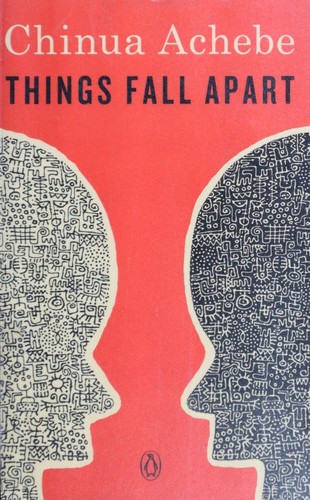
Things Fall Apart
Penguin Books · 1958 · 209 pages
ISBN: 9780385474542
Review Editor
Eleanor Marsh
Summary
Things Fall Apart, published in 1958 by the Nigerian writer Chinua Achebe, arrived at a particular moment in literary history. African fiction in English barely existed as a recognized category. Western readers who knew anything about Nigeria knew it through the lens of colonial administration and missionary memoir, accounts written by outsiders who treated the people they described as either exotic or in need of rescue. Achebe grew up in colonial Nigeria, the son of a Church Missionary Society teacher, and he had read those books. He set out to write something different: a story about Igbo village life in the pre-colonial and early colonial period, told from the inside, by someone who knew the world being described as a living thing rather than an object of study.
The novel is set in Umuofia, a cluster of nine villages in southeastern Nigeria, in the late 19th century. The protagonist is Okonkwo, a man who has built himself from nothing. His father, Unoka, was a debtor, a dreamer, a man who preferred music and palm wine to work and died leaving nothing behind but shame. Okonkwo has spent his entire life running from that shadow. He is a champion wrestler, a successful yam farmer, a warrior who has taken multiple titles. In Umuofia, he is exactly the kind of man other men measure themselves against.
The story follows Okonkwo across three phases: his life in Umuofia before a catastrophic act of bad luck forces him into exile, the seven years he spends in his mother’s village of Mbanta, and his return to Umuofia to find it transformed by colonial administration and Christian missionaries. Around this personal arc, Achebe builds an entire world: its agricultural rhythms, its religious ceremonies, its systems of justice and social standing, its proverbs and folk stories. This is not decoration. The richness of Umuofia’s life is precisely what gives the novel’s final movement its weight.
Character Arcs and Development
Okonkwo is one of the most fully realized tragic figures in the African literary tradition. He is not a villain and not quite a hero, but something more interesting: a man whose defining quality is fear. Not physical fear but existential terror, the dread of becoming his father. Every decision he makes flows from this source. He works harder than anyone around him because idleness was his father’s ruin. He holds his emotions in check because sentiment was his father’s weakness. He beats his wife during the Week of Peace. He participates in the killing of Ikemefuna, the boy from another village who had lived with his family for three years and who called him father, because he cannot afford to be seen flinching. These acts are not the actions of a cruel person. They are the actions of someone who has spent thirty years trying to be the opposite of what he came from, and who has, in the process, made himself into something he would not otherwise have chosen to be.
Nwoye, Okonkwo’s eldest son, is the character who most directly reflects Okonkwo’s failure. He has exactly the qualities his father has tried to extinguish in himself: a love of his mother’s folk tales, a sensitivity to suffering, a disinclination toward violence. When Ikemefuna is killed, Nwoye feels something go cold inside him that does not warm back up. When Christian missionaries arrive, the religion they bring is less a theological proposition than an emotional permission: here is a world that does not require him to be his father’s son. His conversion breaks Okonkwo’s heart, and Achebe renders this with economy and care, neither endorsing Nwoye’s choice uncritically nor dismissing Okonkwo’s grief over it.
Ezinma, Okonkwo’s daughter, is the figure he has the most natural affection for, and she comes through as the most quietly compelling of his children. He repeatedly wishes she had been born a boy, what he means is that she alone among his children has fire and judgment in equal measure, the qualities he wanted to pass on. The novel doesn’t give her as long an arc as Nwoye, but her relationship with her father is one of its emotional centers, and her scenes with her mother Ekwefi, who has lost nine children before her, carry a quiet weight of their own.
Pacing
Things Fall Apart is a short novel of around 200 pages that nonetheless covers a great deal of ground, and Achebe’s pacing reflects the shape of its argument. The first section, set in Umuofia before exile, is the most expansive. Achebe takes real time with the village: its wrestling festivals and harvest celebrations, its procedures for adjudicating disputes, the rhythms of daily life, the stories told around fires at night. This is deliberate. You have to understand what Umuofia is, how fully it functions as a human world, before the novel’s final movement can land. The detailed early sections are not preamble; they are the point.
The middle section, set in Mbanta during exile, is quieter. Okonkwo spends seven years in a kind of enforced waiting, and the narrative reflects this. The arrival of Christianity and the first colonial administrators feel more distant here, experienced as rumors and irritants rather than immediate threats. The final section accelerates sharply. The return to Umuofia, the transformed landscape, the escalating confrontation between village authority and colonial administration: Achebe compresses this into relatively few pages, and some readers have found the compression abrupt. I’d argue it is precise. The speed of the ending is part of what it means. The world doesn’t break slowly; it breaks faster than you expected it to.
Deeper Thematic Exploration
The novel’s central subject is colonialism, but Achebe approaches it from an angle that was unusual in 1958 and remains distinctive today. He does not write a story about oppression observed from outside. He writes a story about a society in full, with its own internal logic, its own disputes and ceremonies and moral complexity, and then shows what colonialism does to it. This matters enormously. Western representations of colonial Africa had typically either romanticized pre-colonial life or used its difficulties to justify the colonial project. Achebe refuses both moves.
Umuofia is not an innocent paradise. Achebe does not pretend otherwise. The killing of twins, the treatment of osu outcasts, the violence of Okonkwo himself: these are real things, and the novel does not explain them away. But Achebe also refuses to let them function as justification. The colonial administration does not arrive as a corrective; it arrives as a replacement, displacing an entire world with another. The Igbo people are not asked whether they want this. They are informed, incrementally and then all at once, that the rules have changed.
There is a sustained meditation running through the book on what masculinity costs. Okonkwo’s vision of manhood, the one he has built his entire identity around, is presented as both genuinely admirable and genuinely destructive. It has given him real strength and real standing. It has also isolated him from his children, from his capacity for love, from any possibility of adapting when adaptation becomes necessary. The novel asks whether a man built entirely for one kind of world can survive when that world changes. The answer it gives is no, but it gives it without contempt. Okonkwo’s tragedy is not that he was wrong to want what he wanted. It is that the world did not hold still long enough for his version of rightness to mean anything.
Achebe draws on the Yeats poem “The Second Coming” for his title, and the image is exact. Things fall apart; the center cannot hold. But unlike Yeats, Achebe is not mourning a civilization from the outside. He is narrating its loss from within, in the language of the people who lost it, which gives the elegy a quality that no outside observer could have achieved. And there is something worth noting about that language. Achebe writes in English, but he fills that English with Igbo proverbs and cadences and ways of thinking. “Proverbs are the palm-oil with which words are eaten.” The novel performs, at the sentence level, a kind of reclamation of the very language it is written in.
Style and Voice
Achebe’s prose is spare, precise, and deceptively plain. He does not reach for grandeur; he achieves something better, which is authority. The narrative voice has the quality of oral storytelling: it addresses the reader directly at moments, it explains Igbo customs and terms as if to someone unfamiliar with them, without ever being condescending. This is a careful choice. Achebe is writing for a global readership while insisting on the particularity of the world he is describing. He will not let you hold it at arm’s length.
The novel’s structure mirrors the collapse it depicts. The first part is the most expansive and detailed, full of digressions and ceremonies and folk tales within the main narrative. The second part is narrower. The third is almost breathlessly brief. Reading the book, you feel the world contracting, the space available to Okonkwo shrinking, which is the right sensation to have. There are passages of real beauty in the descriptions of ceremonial life, the egwugwu masquerades, the Feast of the New Yam, the listening to spirits at night. Achebe renders these not as ethnographic spectacle but as things that matter to the people participating in them, which is the difference between a good writer and a tourist.
Verdict
Things Fall Apart belongs on any serious reading list, not because it has been assigned in schools for sixty years (though it has) but because it does something very difficult very well. It builds a complete world, gives you time to understand it, and then shows that world breaking apart. It makes you feel the loss without telling you how to feel. That is harder than it sounds, and rarer than it should be.
This is not a comfortable book, and it does not intend to be. Okonkwo is not easy to like, and Achebe makes no effort to make him so. But he is impossible to dismiss, and his tragedy lands with full weight because Achebe has taken the time to show you exactly the forces that made him. The reader who will get the most from this book is someone willing to sit with complexity: to see Okonkwo’s flaws clearly and still feel his loss, to understand Umuofia’s imperfections and still mourn what colonialism did to it. If you have not yet read it, there is no better place to start.
Frequently Asked Questions about Things Fall Apart
What is Things Fall Apart by Chinua Achebe about?
Things Fall Apart follows Okonkwo, a proud and powerful Igbo warrior in late 19th-century Nigeria, as his world is upended first by a personal catastrophe that sends him into exile and then by the arrival of British colonialism and Christian missionaries. The novel traces his struggle to hold onto his identity, his traditions, and his standing in a community that is changing faster than he can accept. It is both an intimate character study and a portrait of an entire civilization under pressure.
Is Things Fall Apart based on a true story?
No, it is a work of fiction. Okonkwo and the village of Umuofia are invented. However, Achebe drew extensively on his knowledge of Igbo culture, history, and oral traditions when writing the novel. The colonial events it depicts, including the imposition of British administration and Christian missions on southeastern Nigeria in the late 19th and early 20th centuries, are grounded in real historical processes that affected communities like the one Achebe grew up in.
What are the main themes in Things Fall Apart?
The four central themes are colonialism and cultural destruction, masculinity and its costs, tradition versus change, and the relationship between personal identity and social order. Achebe examines how colonialism dismantles not just political structures but entire ways of understanding the world, while simultaneously exploring how Okonkwo’s rigid idea of manhood isolates him and makes adaptation impossible. The novel also asks hard questions about which aspects of Igbo tradition deserve preservation and which do not, without letting those questions become a colonial argument.
How long is Things Fall Apart and is it a difficult read?
The novel is around 200 pages, making it one of the shorter classics in any language. Achebe’s prose is clear and direct, not stylistically demanding in the way that, say, Faulkner or Joyce can be. Some readers may find the Igbo words and proverbs require a small amount of adjustment, but Achebe explains most of them in context. Most adult readers can finish the book in a few sittings. The difficulty, if any, is emotional rather than linguistic: it is a book that stays with you.
Is there a movie or TV adaptation of Things Fall Apart?
There have been two notable film adaptations. The first was a 1971 Nigerian film directed by Hans Jurgen Pohland, though it received limited distribution. A more widely seen adaptation was a 1987 Nigerian television miniseries produced by the Nigerian Television Authority, directed by David Orere. As of 2026, a major Hollywood or streaming adaptation has long been discussed but not produced, though interest from various studios has been reported over the years.
What age group or reading level is Things Fall Apart for?
The novel is commonly taught in high school (grades 9-12 in the United States) and is appropriate for readers from about age 14 or 15 upward. There is some violence, including the killing of a child, which can be disturbing and is worth knowing about in advance. The prose itself is accessible to strong middle school readers, but the thematic complexity around colonialism, masculinity, and cultural loss tends to reward older readers who can bring more context to it. Adults reading it for the first time often find it hits harder than they expected.
How does Things Fall Apart compare to Chinua Achebe’s other books?
Achebe wrote four other novels: No Longer at Ease (1960), Arrow of God (1964), A Man of the People (1966), and Anthills of the Savannah (1987). No Longer at Ease is a direct sequel, following Okonkwo’s grandson Obi in 1950s Lagos as he navigates colonial bureaucracy and corruption. Arrow of God is often considered Achebe’s most technically accomplished work, a denser and more complex novel about a chief priest’s conflict with colonial authority. Things Fall Apart remains the most widely read and emotionally accessible of the five, and is the best place to start.
Should I read Things Fall Apart and is it worth it?
Yes, without hesitation. It is one of the few novels that genuinely changed what literature in English could look like, and reading it makes you understand why that mattered. If you have read mostly European and American fiction, Things Fall Apart will expand your sense of what a novel can do and whose story is worth telling. It is short enough to read in a weekend and substantial enough to think about for years afterward. The readers who tend to get the least from it are those who approach it as an obligation; those who come to it willing to be surprised generally find it to be one of the most rewarding books they have ever read.
Book Details
- Title
- Things Fall Apart
- Author
- Chinua Achebe
- Genre
- Literary Fiction
- Publisher
- Penguin Books
- Year Published
- 1958
- Pages
- 209
- ISBN
- 9780385474542
- WritersReview Rating
- 5.0 / 5