
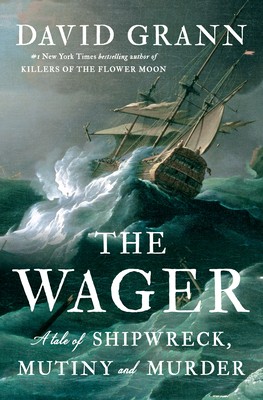
In April of 1741, a British warship called HMS Wager ran aground on a desolate, storm-lashed island off the coast of Patagonia. The ship had been part of Commodore George Anson’s squadron, dispatched by the Royal Navy to harass Spanish settlements in the Pacific during the War of Austrian Succession. The Wager never reached those waters. What followed the wreck was something more savage than battle: a slow unraveling of order, authority, and finally humanity itself, as a group of stranded sailors decided who among them had the right to command and who had the right to live.
David Grann’s The Wager: A Tale of Shipwreck, Mutiny and Murder, published by Doubleday in April 2023, reconstructs these events with the same obsessive precision that made his earlier book Killers of the Flower Moon a landmark of American narrative nonfiction. The book draws on court-martial records, firsthand accounts, journals, and survivor testimonies to tell a story that is simultaneously an adventure, a legal proceeding, a meditation on empire, and a reckoning with the nature of truth. It spent 66 weeks on the New York Times hardcover nonfiction bestseller list, and when you read it, you understand why: the material is extraordinary, and Grann handles it with a sure, unhurried hand.
The central question of the book is deceptively simple: what actually happened on that island? From the wreck of the Wager, two groups of survivors eventually made it back to England by different routes, years apart. The bosun John Bulkeley led a faction that escaped south through the Strait of Magellan in a battered longboat, enduring conditions that killed many of them before they reached Brazil. Captain David Cheap, the ship’s commander, survived separately with a small group and was eventually repatriated through Spanish captivity. Both men wrote accounts of what had happened. Their versions of events were mutually damning. Grann uses this contradiction as the spine of the book, building toward a court-martial that could resolve nothing and a historical record that refuses to settle into a clean verdict.
Character Arcs and Development
Captain David Cheap is the book’s most complicated figure, and Grann treats him with the seriousness that complication demands. Cheap was a man whose entire identity rested on naval discipline and the absolute authority of command. When the Wager struck the rocks, his authority was the first casualty. He becomes, in Grann’s telling, a figure of almost classical tragedy: rigid where flexibility was needed, commanding when circumstances demanded negotiation, and capable of sudden, shocking violence. He shot and killed a midshipman named Henry Cozens during a confrontation on the island, a killing that becomes one of the book’s most morally contested moments. Was it an act of necessary discipline or cold-blooded murder? Grann does not offer a verdict but trusts the reader to sit with the difficulty.
John Bulkeley, the bosun who led the mutiny, is equally well-drawn. He is practical, religiously certain of his own righteousness, and deeply skilled at the art of survival narrative. When he eventually published his journal in London, he understood that whoever controlled the story controlled the judgment of history. Grann watches Bulkeley shape his account the way a lawyer shapes a case, and he does so without condemnation. Survival in situations this extreme requires a kind of ruthlessness about the truth, and Bulkeley possessed that ruthlessness in abundance. The supporting cast of officers, sailors, and marines is rendered with genuine care. The surgeon Elliot, the midshipman Byron (grandfather of the poet), the marine lieutenant Hamilton: each man’s response to the collapse of authority reveals something different about what holds people together and what breaks them apart.
What distinguishes Grann’s character work from a simpler adventure narrative is his insistence on context. Before the wreck, he gives you enough of each man’s background and naval life to understand why they behaved as they did under pressure. The hierarchy of the eighteenth-century British Navy was not just organizational; it was moral, metaphysical almost, a structure that claimed to be the natural order of things. When it shattered on that Patagonian island, the men aboard the Wager had to construct new orders or collapse into violence. Some did both.
Pacing
Grann is one of the best pacers in contemporary nonfiction, and The Wager demonstrates why. The book opens in the middle of catastrophe, pulling you immediately into the wreck before stepping back to lay out the expedition’s context, the ship’s voyage, and the slow deterioration of conditions aboard. This structural choice works well: you know disaster is coming, which gives the preceding chapters a sense of dread that enriches rather than deflates the eventual crisis. The island chapters, covering the months of starvation, violence, and fragmentation among the castaways, are the book’s densest section and carry the most weight. Grann moves through them at a pace that is relentless without being rushed.
The book’s final third, covering the survivors’ separate returns to England and the subsequent court-martial, is necessarily quieter than what precedes it. Some readers may feel the energy drops here. But Grann earns the slower tempo because the legal and historiographical questions he raises in this section are where the book’s deepest concerns live. The question of what really happened on the island is also a question about how power structures protect themselves, how stories get written and by whom, and what “truth” means when the only witnesses have every reason to lie. A book that ended with the rescue and skipped the aftermath would be exciting but shallow. Grann’s willingness to follow the story into its uncomfortable, ambiguous conclusion is what separates The Wager from adventure writing.
Deeper Thematic Exploration
The most obvious theme in The Wager is survival: what people do, and what they become, when the structures that govern ordinary life are stripped away. Grann is interested in this in a very specific sense, not the wilderness-skills sense, but the social sense. What holds a community together when the authority that organized it has collapsed? On the island, the men of the Wager tried several answers. Military hierarchy, until it became untenable. Democratic consensus, briefly. Personal loyalty, intermittently. Violence, repeatedly. None of these arrangements lasted. The book suggests, without sentimentality, that human communities under extreme conditions are fragile in exactly the ways that comfortable societies prefer not to notice.
Running beneath the survival narrative is a sustained examination of empire and the stories it tells about itself. The Wager’s expedition was a project of British imperial expansion, dressed up in the rhetoric of national glory. The men who sailed on it were promised prize money and adventure; many of them got scurvy, starvation, and an unmarked grave on the coast of Patagonia. Grann draws a clear line between the grandiose ambitions of those who sent the fleet out and the catastrophic reality experienced by those who sailed in it. He is not heavy-handed about this; the irony speaks for itself. But he makes sure you notice it.
The book’s most resonant theme, the one that stays with you after you put it down, is the question of narrative authority. Who gets to tell the story? Bulkeley published his account first, in London, before Cheap returned, and that early narrative shaped how the court-martial was framed and what questions it could even ask. Cheap’s later account pushed back, but he was working against a story already in circulation. Grann is keenly aware that he himself is another narrator in this chain: reconstructing events from sources that were themselves strategic constructions. He makes this awareness explicit at several points in the text, acknowledging the limits of what the historical record can tell us. This historiographical honesty is one of the book’s most sophisticated qualities, and it elevates what might have been a straightforward adventure into something closer to a philosophical inquiry about history itself.
Style and Voice
Grann writes in a style that is lean without being spare, atmospheric without tipping into purple. His sentences tend toward the short and declarative when he is inside action sequences, lengthening and becoming more ruminative when he steps back to reflect. The prose never calls attention to itself, which is the right choice for material this inherently dramatic: the story does not need stylistic flourishes to hold your attention. What it needs is clarity and rhythm, and Grann delivers both. There is a particular skill in his ability to render suffering without either sensationalizing it or flattening it. The deaths on the island feel real because they are specific: these named men, in these conditions, with this particular combination of hunger and cold and despair.
The voice is confident without being self-important. Grann appears in the book in a limited way, mostly as an investigator explaining what sources he is drawing on and what they cannot tell him. This first-person presence is lighter here than in some of his earlier work, and the book is not weakened by its absence. The material is so commanding that it requires no authorial intermediary to make it vivid. When Grann does step forward, it is always to acknowledge uncertainty rather than to assert authority, which is exactly the right instinct for a story where authority itself is the central problem.
Verdict
If you read one work of narrative nonfiction this year, make it The Wager. It belongs on the same shelf as In the Heart of the Sea, Endurance, and the best of Sebastian Junger: books that use extreme survival stories as lenses for examining what holds human societies together. Grann’s achievement here is not just the research, though the research is formidable. It is the architecture: the way he has taken a story with no clean resolution and built from it a book that is both propulsive and genuinely thought-provoking.
Readers who want tidy moral verdicts may find the ending unsatisfying. Grann arrives at no conclusion about who was right on that island, because there is no honest conclusion to arrive at. If that ambiguity bothers you, this is probably not your book. But if you are willing to sit with the discomfort of not knowing, the payoff is substantial. The Wager is the kind of history that reminds you why the past still matters: not because it offers answers, but because the questions it raises about power, truth, and survival are the same ones we are still failing to settle.
Frequently Asked Questions about The Wager by David Grann
What is The Wager by David Grann about?
The Wager is a narrative nonfiction account of the 1741 shipwreck of HMS Wager, a British Royal Navy vessel that ran aground off the coast of Patagonia during a wartime expedition. After the wreck, the surviving crew fractured into competing factions, culminating in a mutiny against Captain David Cheap. The book follows both the harrowing survival story and the subsequent legal reckoning when the survivors returned to England with conflicting accounts of what had happened.
Is The Wager by David Grann based on a true story?
Yes, entirely. Grann reconstructed the events from primary sources including survivors’ published journals, court-martial records, naval documents, and period correspondence. The main figures (Captain David Cheap, bosun John Bulkeley, Midshipman John Byron, and others) were all real people, and the mutiny and subsequent court-martial are documented historical events. Grann is careful throughout the book to note where the historical record runs out and certainty ends.
What are the main themes in The Wager by David Grann?
The book works on several thematic levels at once. At its core it is about survival and the collapse of social order when authority structures fail. It is also about empire and the brutal gap between the glory promised by colonial expeditions and the reality experienced by the men sent on them. Perhaps most originally, it is about narrative authority: who gets to tell the story of what happened, and how the first account shapes all the judgments that follow.
How long is The Wager and is it a hard read?
The hardcover edition runs 352 pages. Grann writes in an accessible, propulsive style designed for general readers rather than academic historians, and the book moves at a pace that makes those pages go quickly. No prior knowledge of eighteenth-century naval history is required. Readers who enjoy works like Erik Larson’s narrative histories or Sebastian Junger’s survival journalism will feel immediately at home here.
Is there a movie or TV adaptation of The Wager by David Grann?
A film adaptation is in development, with director Martin Scorsese and actor Leonardo DiCaprio both attached to the project, set up at Apple TV+. This would reunite the creative team behind the acclaimed 2023 adaptation of Grann’s previous book, Killers of the Flower Moon. As of the time of this review, no release date has been announced.
Who was Captain David Cheap and what happened to him?
David Cheap was the commander of HMS Wager when it wrecked in 1741. After the mutiny led by bosun John Bulkeley, Cheap and a small group of loyalists were left behind on the island while Bulkeley’s faction escaped north. Cheap eventually made his way to a Spanish settlement, spent time as a prisoner of war, and was ultimately repatriated to England years after Bulkeley had already returned and published his version of events. A subsequent court-martial largely cleared Cheap, but the question of his culpability in the shooting of Midshipman Cozens remained contested.
How does The Wager compare to Killers of the Flower Moon by David Grann?
Both books share Grann’s signature approach: meticulous archival research transformed into taut, character-driven narrative with a moral question at the center. Killers of the Flower Moon, which examined the Osage Indian murders and the founding of the FBI, has a more overtly American subject and a more personal final act where Grann himself appears as a researcher tracing his own investigation. The Wager is more purely historical and keeps Grann further in the background. It may be the more elegant book, even if Killers of the Flower Moon is the more emotionally devastating one.
Should I read The Wager and is it worth the time?
If you enjoy narrative nonfiction that takes a historical event seriously both as a story and as a set of ideas, yes, without hesitation. The book rewards you twice: once for the sheer drama of what happened to these men, and again for the way it forces you to think about truth, authority, and how history gets written. Readers who prefer straightforward adventure without the philosophical dimension may find the final third slower than they would like, but for everyone else, The Wager is one of the best-constructed works of nonfiction published in recent years.
Book Details
- Title
- The Wager
- Author
- David Grann
- Genre
- History
- Publisher
- Doubleday
- Year Published
- 2023
- Pages
- 352
- ISBN
- 9780385534260
- WritersReview Rating
- 4.7 / 5