
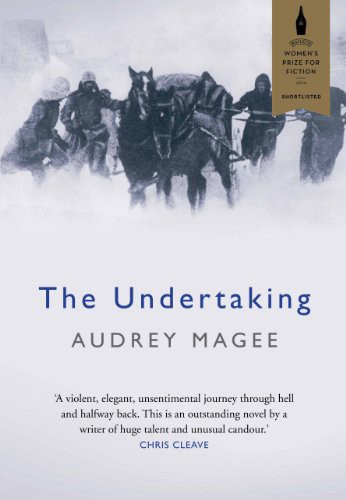
The Undertaking
Atlantic Books · 2014 · 302 pages
ISBN: 9781782391029
Review Editor
Eleanor Marsh
Summary
Audrey Magee’s debut novel, published in 2014, opens with a transaction: two strangers, a German soldier named Peter Faber and a young Berliner named Katharina Spinell, agree to marry by proxy. They have never met. The marriage is a legal arrangement permitted under a wartime Nazi scheme that grants financial benefits to wives and a period of home leave to soldiers at the front. Both parties want something practical out of it, not love. Peter wants to get away from the Eastern Front for a few weeks. Katharina wants a larger apartment than her family can currently afford. Neither expects anything more.
What neither has anticipated is what happens during the short leave itself: a tentative, unexpected intimacy grows between them. Magee builds this encounter with extraordinary restraint, and the novel’s emotional power comes largely from what is held back rather than what is shown. Chapters alternate between Peter’s experience at the front and Katharina’s life in Berlin, and both halves of the novel carry the same quality of controlled menace. The Eastern Front material is brutal without being lurid; the Berlin chapters are quieter but haunted by a different kind of dread, the dread of people who know something is wrong but choose not to look directly at it.
At 302 pages, the novel covers roughly two years, from the period just before Stalingrad through the deterioration of Germany’s position in the east. Magee never lets the reader forget the historical stakes. The private story of Peter and Katharina is embedded in one of the defining catastrophes of the twentieth century, and the novel is partly about how ordinary domestic life, ordinary marriage, ordinary desire, continued alongside that catastrophe in ways that implicated everyone.
Character Arcs and Development
Peter Faber starts the novel as a relatively unremarkable young German man: not a fanatic, not a hero, just someone who has been conscripted into an army he did not choose and placed in conditions that would test any person’s humanity. His arc across the novel is not one of dramatic conversion but of slow erosion. The front asks things of him that he does, and the doing of them changes him. Magee shows this process quietly, through accumulation of detail rather than through confrontation scenes or confessions. By the time Peter returns from leave the second time, something fundamental has shifted in him, though Magee does not underline or explain what. The reader feels it before Peter can name it.
Katharina is in some ways the more interesting study. She is not a villain, but she is not innocent either. She lives in a Berlin that is performing normalcy while the structures of civilized life decay around it, and she participates in that performance. She benefits from arrangements that she chooses not to examine too closely. Her relationship with Peter over the course of the novel is one of gradual opening, and Magee handles this with care, allowing the reader to see how genuine feeling can coexist with complicity in ways that are not easily resolved.
The secondary characters, including Katharina’s parents and her neighbor Lotte, serve primarily to establish the texture of civilian wartime Berlin, but Magee gives them enough specificity to avoid caricature. Her father in particular is drawn with uncomfortable clarity: a man who has made his accommodation with the regime and who will not, under any circumstances, look directly at what that accommodation has cost.
Pacing
The alternating structure, moving between Peter on the front and Katharina in Berlin, gives the novel a natural rhythm that prevents either thread from overpowering the other. The two worlds are kept in counterpoint throughout: scenes of physical violence and cold on the Eastern Front cut against the domestic pressures and small treacheries of Berlin life. This parallelism is not mechanical; Magee times the cuts to create ironic resonance rather than simple contrast.
The pacing accelerates toward the novel’s final third as the historical situation deteriorates and both characters come under increasing pressure. A few sections in the middle sag slightly, as the Berlin chapters occasionally feel more like accumulation of atmosphere than forward movement. But the overall rhythm holds, and the novel’s relatively short length (for the scope of its subject) keeps the reader moving through it without the kind of exhaustion that some WWII fiction can produce.
Deeper Thematic Exploration
The novel’s central preoccupation is with complicity, specifically with the question of how ordinary people become participants in historical atrocities without necessarily having chosen to be. The Kriegsehe scheme itself is the perfect structural vehicle for this inquiry: it is a mechanism that allowed ordinary Germans to benefit from the regime while keeping the moral cost at arm’s length. Katharina does not participate in murder or persecution. She simply takes an apartment. She simply accepts money. She simply does not ask too many questions about where it comes from. Magee is interested in how these small accommodations accumulate into something that is not neutral at all.
There is also a sustained meditation on marriage itself as an institution: what it means to bind your life to someone under duress, what kind of intimacy can grow from circumstance rather than free choice, and whether the distinction between chosen and unchosen love means as much as people tend to assume. Peter and Katharina did not choose each other in any meaningful sense. Their relationship is a product of the war’s distortions. And yet something real grows between them, and the novel refuses to dismiss it.
Perhaps most powerfully, the novel engages with the question of what ordinary German civilians knew about what was happening in the east. Magee does not give a simple answer. She shows instead the mechanisms of not-knowing: the deliberate incuriosity, the careful looking away, the social consensus around certain kinds of silence. Katharina and her family are not ignorant, exactly. They are practiced in a particular form of selective attention that the novel understands as itself a moral choice, even when it does not feel like one.
Style and Voice
Magee’s prose is spare and precise in a way that recalls the German and Austrian modernist tradition, particularly writers like Peter Handke and Bernhard, though her sentences are more accessible than either. She favors short declarative statements and parataxis, placing events next to each other without explicit causal connection and letting the reader do the connective work. This restraint means that moments of beauty or violence land harder than they would if the prose were more openly emotional.
The alternating point of view structure is handled with assurance. Both Peter and Katharina have distinct interiorities, different habits of attention, different things they notice and things they choose not to notice. The third-person limited narration stays close to each character without merging into stream of consciousness, maintaining a slight observational distance that suits the novel’s concerns. You read it feeling slightly cold, slightly held at arm’s length, and then you realize that this is exactly the right feeling for this subject.
Verdict
The Undertaking is an impressive debut: formally controlled, historically grounded, and genuinely disturbing in ways that linger after the last page. It is not a comfortable novel, but it is not trying to be. It takes seriously the question of how human beings live inside historical catastrophes, how love persists alongside atrocity, and how the small choices of daily life add up to something large. Readers who come to it looking for redemption or catharsis may find it unsatisfying; readers who can sit with ambiguity will find it deeply rewarding.
Comparable in approach to Sebastian Faulks’s Birdsong or Hans Fallada’s Alone in Berlin, though Magee’s tone is cooler than either. It belongs on the shelf of serious WWII literary fiction alongside those works, and its 2014 Baileys Prize shortlisting was well deserved. For a debut, it is remarkably assured.
Frequently Asked Questions about The Undertaking
What is The Undertaking by Audrey Magee about?
The Undertaking follows two Germans who marry by proxy under a wartime Nazi scheme: Peter Faber, a soldier on the Eastern Front who wants home leave, and Katharina Spinell, a young Berliner who wants financial benefits and a better apartment. The novel alternates between Peter’s experience of the war and Katharina’s life in wartime Berlin, tracing how their unexpected intimacy develops alongside the historical catastrophe surrounding them.
Is The Undertaking based on a true story?
It is historical fiction, not based on specific real people, but the Kriegsehe (wartime marriage by proxy) scheme the novel depicts was a real Nazi program. The military events and civilian conditions Magee describes are drawn from careful historical research. The novel’s portrait of the Eastern Front and wartime Berlin has been widely praised for its historical accuracy.
Who is Audrey Magee and what else has she written?
Audrey Magee is an Irish novelist and former journalist. The Undertaking, published in 2014, was her debut novel and was shortlisted for the Baileys Women’s Prize for Fiction. Her second novel, The Colony (2022), was longlisted for the Booker Prize and confirmed her as one of the more significant voices in contemporary Irish literary fiction.
What are the main themes in The Undertaking?
The novel explores complicity and how ordinary people participate in historical atrocities through small accommodations rather than dramatic choices. It also examines what marriage means when it grows from circumstance and wartime need rather than free choice, and how ordinary domestic life continued alongside catastrophe in ways that implicated everyone living through it.
Is The Undertaking difficult to read and how long is it?
The novel runs about 300 pages, depending on the edition. It is not difficult to read in terms of style (the prose is clear and controlled), but it is emotionally demanding. The subject matter (Eastern Front combat, civilian complicity in Nazi Germany) requires engagement with genuinely disturbing historical territory. Readers who prefer wartime fiction that offers easy moral positions may find it challenging.
Was The Undertaking shortlisted for any awards?
Yes. The Undertaking was shortlisted for the Baileys Women’s Prize for Fiction in 2014, which is one of the most prestigious literary prizes in the English-speaking world. The shortlisting brought the novel significant attention and established Magee as a writer to watch.
How does The Undertaking compare to other World War II literary fiction?
It sits closer to the morally serious European tradition of WWII fiction (Fallada’s Alone in Berlin, Sebald’s Austerlitz) than to the more emotionally accessible British tradition (Faulks, Boyne). The tone is cooler and more restrained than most English-language WWII novels, and it focuses more on complicity than on heroism or resistance. Readers who found Suite Francaise by Irene Nemirovsky compelling will likely respond to The Undertaking.
Should I read The Undertaking and is it worth it?
Yes, if you are interested in serious literary fiction dealing with World War II and are willing to sit with moral ambiguity. It does not offer the comfort of clear heroes and villains. What it offers instead is a finely observed portrait of how ordinary people lived inside an extraordinary historical crime, and that is a harder and more honest thing. Readers who want emotional warmth or resolution may prefer other books; readers who want precision and depth will find this one worthwhile.
Book Details
- Title
- The Undertaking
- Author
- Audrey Magee
- Genre
- Literary Fiction
- Publisher
- Atlantic Books
- Year Published
- 2014
- Pages
- 302
- ISBN
- 9781782391029
- WritersReview Rating
- 4.0 / 5