
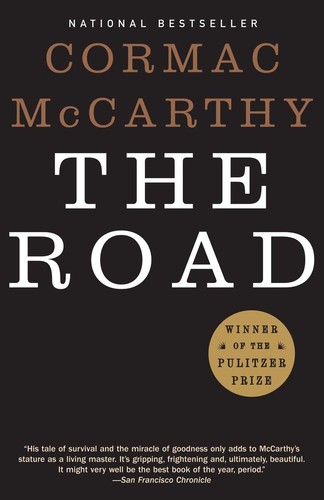
The Road
Vintage International · 2006 · 287 pages
ISBN: 9780307387899
🏆 Pulitzer Prize for Fiction (2007)
James Tait Black Memorial Prize for Fiction (2006)
Review Editor
Marcus Webb
Cormac McCarthy published The Road in 2006, near the end of a career that had already reshaped American fiction. The novel follows two unnamed characters, a father and his young son, as they push a shopping cart south through an ashen, post-apocalyptic America. The catastrophe that destroyed civilization is never named or explained. Cities are burned husks. Forests are dead. The sky is perpetually overcast with grey particulate, and temperatures are dropping. Almost all plant and animal life is gone. The few surviving humans are, with rare exceptions, desperate and dangerous. Against this backdrop, a man tries to keep his child alive, fed, warm, and, in some fundamental sense, good.
The story is simple in the way that myths are simple. Each day presents the same problem: find food, find shelter, avoid other people. McCarthy strips the narrative to its essentials. There is no backstory beyond fragments. The mother appears only in brief, devastating flashbacks. The world before the disaster exists as fading memory, nothing more. What remains is movement, hunger, cold, and the conversation between a father who knows what the world was and a boy who knows only what it is.
That conversation, and the moral weight it carries, is what elevates The Road from survival fiction into something far more permanent. McCarthy has written a book about what we owe each other when every structure, institution, and comfort has been stripped away. It is also, without sentimentality, one of the most moving portraits of parenthood in modern literature.
Character Arcs and Development
The father is driven by a single imperative: keep the boy alive. He is resourceful, vigilant, and increasingly worn down. His cough worsens throughout the novel. He scavenges with the efficiency of someone who has been doing it for years and the desperation of someone who knows he cannot do it much longer. McCarthy gives us just enough of the man’s interior life to understand his terror, his grief for the world his son will never know, and his fierce, sometimes brutal protectiveness.
The boy is the moral center of the book. He is young enough that the ruined world is all he has ever known, and yet he possesses an instinctive compassion that his father sometimes finds impractical. He repeatedly asks his father whether they are “the good guys,” and his father tells him yes, they are. They carry “the fire.” This metaphor, never fully defined, functions as the book’s moral compass.
The tension between father and son is quiet but real. The father’s pragmatism and the boy’s compassion pull in different directions, and McCarthy never resolves the tension cheaply. The man is not wrong to be cautious. The boy is not wrong to insist on kindness. Both positions are survival strategies, and the novel asks which one is worth surviving for.
Pacing
The Road moves in episodic waves. Long stretches of walking, foraging, and huddling under tarps are punctuated by moments of sudden danger or unexpected grace. McCarthy controls this rhythm with precision. A scene in which the pair discovers an intact underground bunker stocked with canned food is as emotionally charged as any action sequence. The discovery of a can of Coca-Cola becomes, in context, a scene of almost unbearable tenderness.
Some readers may find the repetitive structure monotonous. That monotony is deliberate. It replicates the experience of the characters. But the pacing never truly drags because McCarthy varies the emotional register from one episode to the next. The novel is short, barely 300 pages, and reads faster than its subject matter would suggest.
Deeper Thematic Exploration
At its core, The Road is a book about whether goodness can survive when every incentive for goodness has been removed. There are no laws, no social contracts, no consequences for cruelty beyond the practical. In this world, the father’s decision to protect his son and remain one of “the good guys” is not just a parental instinct; it is a philosophical stance.
McCarthy complicates this by showing us the cost. The father’s goodness is selective. He will share food with his son but not with strangers. The boy, by contrast, wants to help everyone. Their disagreement is the novel’s central ethical argument, and McCarthy does not declare a winner.
There is also a meditation on language and memory. The father carries the old world in his head: the names of things, the way seasons used to work. The boy has none of this. The spare, biblical prose reflects a world in which most words have lost their referents.
The religious undertones are unmistakable but never preachy. “Carrying the fire” echoes Prometheus. The father-son dynamic invites comparisons to Abraham and Isaac. The novel’s final paragraphs gesture toward something like grace, though McCarthy, characteristically, refuses to confirm it.
Style and Voice
McCarthy’s prose in The Road is the most restrained of his career. Gone are the baroque, Faulknerian sentences of Blood Meridian and Suttree. In their place: short declarative statements, sentence fragments, dialogue with no quotation marks. The effect is immediate and hypnotic. The lack of punctuation markers creates a strange intimacy, as though you are overhearing the characters rather than reading a novel.
The landscape descriptions, despite their bleakness, contain moments of stark beauty. Ash-covered fields, melted highways, skeletal trees against a grey sky: these images accumulate into something that feels less like fiction and more like witness testimony.
Verdict
The Road is a book that earns every ounce of its reputation. It is harrowing, yes, but it is also surprisingly tender. The love between the father and son is never sentimental because McCarthy never lets you forget what it costs. If you have children, this book will rearrange something inside you. If you do not, it will still leave you thinking about what you would carry, and what you would become, if everything else were taken away.
Readers who need plot complexity or detailed world-building may find it too spare. Those who dislike ambiguity will be frustrated by the unnamed catastrophe. But for anyone drawn to fiction that operates at the level of parable, that uses the simplest possible story to ask the largest possible questions, The Road is essential.
Frequently Asked Questions about The Road
What is The Road by Cormac McCarthy about?
The Road follows an unnamed father and his young son as they travel south through a destroyed, post-apocalyptic America, pushing a shopping cart and scavenging for food. The cause of the disaster is never explained. The novel focuses on their daily struggle to survive while maintaining their humanity. It won the 2007 Pulitzer Prize for Fiction.
Is The Road based on a true story?
The Road is not based on a true story. McCarthy has said the novel was partly inspired by a trip to El Paso, Texas, with his young son, during which he imagined what the city might look like in 50 or 100 years. The emotional core draws on his experience as a father.
What are the main themes in The Road?
The central themes include the endurance of love in extreme circumstances, the question of whether morality has meaning without society to enforce it, the tension between survival instinct and compassion, and the role of memory and language in preserving what it means to be human.
How long is The Road and is it a difficult read?
The Road is approximately 287 pages. Despite its heavy subject matter, it reads quickly because McCarthy uses short sentences, minimal punctuation, and no chapter breaks. The difficulty is emotional rather than technical.
Is there a movie adaptation of The Road?
Yes. The Road was adapted into a 2009 film directed by John Hillcoat, starring Viggo Mortensen as the father and Kodi Smit-McPhee as the son. The film holds a 74% approval rating on Rotten Tomatoes and is widely considered a faithful adaptation.
What age group is The Road appropriate for?
The Road is written for adults. The prose is straightforward enough for strong high school readers (ages 16 and up), but the content includes graphic violence, cannibalism, starvation, and a suicide. It is frequently taught in college literature courses.
How does The Road compare to McCarthy’s other novels?
The Road is more accessible than Blood Meridian or Suttree, which feature denser prose. It shares thematic DNA with No Country for Old Men in its examination of violence and morality. Many readers consider it McCarthy’s most emotionally powerful work.
Should I read The Road and is it worth it?
If you value fiction that stays with you long after you finish, yes. The Road is a short, intense reading experience that asks big questions about love, survival, and what makes life worth living. It is particularly resonant for parents.
Book Details
- Title
- The Road
- Author
- Cormac McCarthy
- Genre
- Science Fiction
- Publisher
- Vintage International
- Year Published
- 2006
- Pages
- 287
- ISBN
- 9780307387899
- Awards
- 🏆 Pulitzer Prize for Fiction (2007) James Tait Black Memorial Prize for Fiction (2006)
- WritersReview Rating
- 5.0 / 5