
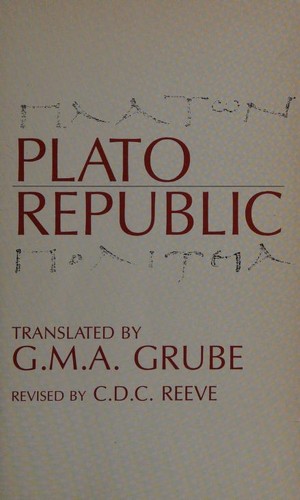
The Republic
Hackett Publishing · 1992 · 311 pages
ISBN: 9780872201361
Review Editor
Owen Strand
Plato’s Republic is the book that Western philosophy never stopped answering. Written around 380 BCE as a dialogue led by Socrates, it opens with a deceptively simple question – what is justice? – and then refuses to stop. By the time Plato is done, he has proposed a blueprint for an ideal city, a theory of knowledge, a metaphysics of forms, a psychology of the soul, an argument against democracy, and the most influential educational philosophy in history. The Republic is not just a foundational text; it is the text against which every subsequent political philosopher has had to define themselves.
The Question That Won’t Sit Still
The dialogue begins at the house of Cephalus in Piraeus, where Socrates encounters the aging patriarch’s comfortable definition of justice – telling the truth and paying one’s debts. Socrates dismantles this in minutes, and the real battle begins when the sophist Thrasymachus enters to argue that justice is simply whatever benefits the stronger. This is the challenge Plato spends the rest of the book defeating: the idea that morality is just power dressed up in respectable clothing.
Glaucon and Adeimantus, Plato’s brothers, then sharpen the challenge. They ask Socrates to prove that justice is worth having for its own sake – not because it leads to rewards, reputation, or divine favor, but intrinsically. This is the wager the whole book rides on. Plato’s strategy is audacious: to understand justice in the soul, he will first build a just city from scratch, finding justice writ large before looking for it in the smaller letters of individual character.
The Architecture of the Ideal City
The construction of Kallipolis – the beautiful city – is one of the great intellectual set pieces in all of philosophy. Plato begins with a city of basic necessities, then adds luxuries and the military, then arrives at the question of governance. His answer: philosophers must rule. Not because power is good, but because only those who have genuinely seen the Good – who have ascended out of the famous cave – can govern without being corrupted by the desire for personal gain.
The city will have three classes: the producers, the auxiliaries (soldiers), and the guardians (philosopher-rulers). Each class corresponds to a part of the soul – appetite, spirit, and reason – and justice in both city and soul consists in each part performing its proper function without overreaching. This tripartite psychology is one of Plato’s most enduring contributions, anticipating psychoanalytic models of the mind by two millennia.
The Allegory of the Cave
Book VII contains the allegory of the cave, the most famous image in Western philosophy. Prisoners chained since birth in an underground cave, seeing only shadows of objects cast on the wall before them, take the shadows for reality. The philosopher is the prisoner who breaks free, turns toward the fire, emerges into sunlight, and eventually looks directly at the sun – the Form of the Good, the source of all truth and being.
This allegory drives home Plato’s epistemological argument: ordinary perception gives us only shadows of the real. The objects of mathematical reasoning are closer to truth but still not the highest. Only philosophical contemplation of the Forms – eternal, unchanging, perfect archetypes of which all particular things are imperfect copies – reaches genuine knowledge. The philosopher’s reluctance to return to the cave and govern is not selfishness but the pain of readjustment to darkness, and yet return is obligatory.
The Critique of Democracy
Books VIII and IX contain Plato’s account of the decline of political regimes – timocracy, oligarchy, democracy, tyranny – each degenerating from the last as a different element of the soul gains dominance. His portrait of democracy is one of the most searching and troubling critiques ever written. In a democratic city, Plato argues, freedom becomes an absolute value that dissolves all authority, discipline, and hierarchy. The democratic man lives without order or necessity, treating all desires as equal, his life a festival of undisciplined pleasure.
From democracy comes tyranny. The demagogue who flatters the people, once given power, must continue to satisfy their appetites and eventually turns the city into a slave to his own. Plato’s analysis of tyranny as the condition of a soul enslaved to its worst desires remains a penetrating psychological and political insight, one that modern readers recognize with uneasy familiarity.
Form, Knowledge, and the Good
Underlying everything in the Republic is the Theory of Forms, Plato’s metaphysics. Particulars – this beautiful person, this just action, this equal stick – are beautiful, just, or equal by participating in the Forms of Beauty, Justice, and Equality. The Forms are not abstractions but are more real than particulars; they are what makes particulars what they are. The Form of the Good stands above all other Forms as the sun stands above the visible world, giving them both being and intelligibility.
This has profound consequences for education. The purpose of education is not to put knowledge into students but to turn the whole soul – to redirect its capacity for vision from the shadows to the light. The curriculum of the guardians – mathematics, geometry, astronomy, harmonics, and finally dialectic – is designed to wean the mind from sense perception and train it in the apprehension of eternal truths.
Verdict: The Book That Defines the Conversation
The Republic has no perfect successor because it raises too many questions at once. Its political prescriptions have disturbed readers from antiquity onward – Aristotle disagreed with most of them, and Karl Popper famously accused Plato of being the founding father of totalitarianism. But these critiques presuppose the book’s power: no one argues at such length with a text that has nothing to say.
What makes the Republic inexhaustible is its seriousness about the question it begins with. Plato genuinely wants to know whether a just life is better than an unjust one even when injustice pays better. His answer – that justice is the health of the soul, that the tyrant is the most miserable of men despite his apparent power – may not convince every reader, but the honesty of the inquiry is unmistakable. This is a book that cares about getting it right. That seriousness, sustained across ten books and 2,400 years, is what makes the Republic still essential.
Frequently Asked Questions
What is The Republic mainly about?
On the surface it is about justice – what justice is and whether it is worth having for its own sake. To answer this, Plato builds an ideal city (Kallipolis) from scratch, develops a tripartite theory of the soul, argues that philosophers should rule, and offers a metaphysics of Forms grounding all knowledge and value. It is simultaneously a work of political philosophy, ethics, epistemology, and metaphysics.
What is the allegory of the cave?
In Book VII, Plato describes prisoners chained in an underground cave who see only shadows cast on a wall and mistake them for reality. The philosopher is the prisoner who escapes, turns toward the fire, and eventually ascends into sunlight – representing the ascent from opinion and sense perception to genuine philosophical knowledge of the Forms.
Why does Plato argue that philosophers should rule?
Because rulers motivated by love of power, wealth, or honor will inevitably use governance to serve their own interests. Only those who have genuinely apprehended the Good have both the knowledge and the motivation to govern justly. Plato sees philosopher-rule as the solution to the corruption inherent in political ambition.
Is Plato’s Republic anti-democratic?
Explicitly so. Plato views democracy as the penultimate stage of political decay, preceding tyranny. He argues that absolute freedom destroys the structures of authority necessary for a well-ordered city, and that the democratic soul – treating all desires as equally valid – is incapable of the self-discipline that virtue requires.
What is the Theory of Forms?
Plato argues that particulars are what they are by participating in eternal, perfect, unchanging archetypes – the Forms. The Form of Beauty is not any particular beautiful thing but the standard by which all beautiful things are beautiful. The Form of the Good is the highest Form, the source of being and intelligibility for all others.
Which translation of The Republic should I read?
G.M.A. Grube’s Hackett translation (revised by C.D.C. Reeve) is the scholarly standard – accurate, readable, and well-annotated. Allan Bloom’s translation is more literal and philosophically rigorous, with a substantial interpretive essay. For most readers, the Grube/Reeve Hackett edition is the best starting point.
How long does it take to read The Republic?
The Hackett edition is about 300 pages in translation. A careful first reading – engaging with the arguments rather than skimming – typically takes 8-12 hours. Books I, II, VI, and VII repay especially close reading. The central books (V-VII) are philosophically the most demanding.
What is the lasting influence of The Republic?
Virtually every subsequent tradition in Western philosophy has defined itself in relation to the Republic: Aristotle criticized its abolition of private property; Augustine adapted its tripartite soul for Christian theology; modern liberals have argued against its authoritarianism; Popper accused it of laying the groundwork for totalitarianism. No book in the Western tradition has provoked more sustained philosophical argument.
Book Details
- Title
- The Republic
- Author
- Plato
- Genre
- Philosophy
- Publisher
- Hackett Publishing
- Year Published
- 1992
- Pages
- 311
- ISBN
- 9780872201361
- WritersReview Rating
- 5.0 / 5