
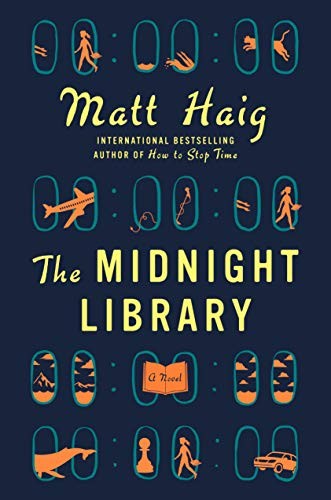
The Midnight Library
Viking · 2020 · 288 pages
ISBN: 9780525559474
Review Editor
James Voss
Matt Haig published The Midnight Library in September 2020, near the end of a year when many people were already living with a heightened awareness of time slipping away and of roads not taken. The timing amplified what was already in the book. Haig is a British author best known for Reasons to Stay Alive, his memoir about recovering from depression, and Notes on a Nervous Planet, a collection of essays about anxiety and modern life. The Midnight Library represents his most fully realized attempt to take those personal themes and run them through the engine of genre fiction: a speculative novel that uses the premise of parallel lives to ask one of the oldest questions in literature. What if you had made different choices?
The protagonist is Nora Seed, 35 years old and in spectacular free fall when we meet her. In the span of a single day, she loses her job at a record shop, receives a message canceling her piano lessons, gets word that her cat has died, and absorbs the full weight of years of estrangement from her brother, her former best friend, and her ex-fiancé. Her failures feel both mundane and crushing, which is exactly right. Haig is skilled at rendering the particular texture of ordinary disappointment, the way a person can arrive at a breaking point not through a single catastrophe but through the quiet erosion of hope over years. On the worst night of her life, Nora finds herself in a limbo library, a vast, calming room between life and death, where every book on the shelves contains the story of a life she could have lived if she had made different choices.
The librarian is Mrs. Elm, who was Nora’s school librarian years ago. She explains the rules and steps back. Nora can open any book. She can try on the life inside it and stay as long as she needs. Then she decides whether to remain or return. That is the premise, and it is both the book’s greatest strength and the source of its primary vulnerability. The Midnight Library is built on a conceit that can sustain as much philosophical weight as Haig wants to give it, but it can also bear nothing more than the weight of a good yarn. He chooses something in between, which will satisfy many readers and frustrate others.
Character Arcs and Development
Nora is not likable in the traditional sense, at least not at the start. She is shut down and disconnected, and she has the kind of low-grade cruelty toward herself that makes it hard to see what she was like before life wore her down. Haig does the necessary work of building her up slowly. Her years of competitive swimming, her talent for the piano, the band she was in with her brother Joe, the trip to Australia she never made with her best friend Izzy: these fragments accumulate into a picture of a person who was capable of enthusiasm and genuine connection, but who kept withdrawing from her own life at the moments when it would have cost the most to stay.
Mrs. Elm is the more interesting character with the less showy role. She appears at the library entrance and again whenever Nora returns between lives, and there is something watchful and careful about her that Haig renders with real precision. She does not push Nora toward any particular life. She does not comment on Nora’s choices or celebrate when a visit goes wrong. She lets the library do its work. When she does speak with feeling, the effect is outsized, which is a testament to Haig’s economy with her in the rest of the book.
The alternate-life characters are sketched rather than fully drawn, which is appropriate given that Nora visits each life for only a short stretch. The Dan of the pub-life (Nora’s ex-fiancé in a world where she said yes to the wedding) is not a villain. He is simply a person she does not fit with, and she can see this within days of arrival. The glaciologist version of her life in the Svalbard archipelago brings her into contact with Hugo Lefevre, another person navigating the library from his own root life, and their brief encounter gestures at what community between two people in transition might look like. Secondary figures like Ash, who appears in one of the later lives, take on weight not through their own development but through what Nora’s reaction to them reveals about what she actually wants.
Pacing
The novel moves fast, which is both appropriate to its structure and the source of its mid-book drag. Each alternate-life visit is self-contained: a new setting, a new supporting cast, and a new version of what Nora’s choices could have produced. Haig has a gift for compression. He can establish a convincing social world in a few pages, drop Nora into it, and extract her before the reader has time to need more. This works superbly in the first third of the book.
By the fifth or sixth alternate life, the repetition becomes audible. The rhythm of each visit follows the same arc: disorientation, discovery of what has been gained and lost, some form of disappointment, then return. Haig addresses this through escalating pressure on the library itself and through Mrs. Elm’s increasingly pointed responses to Nora’s choices. But the mid-book pacing dip is real, and readers who need narrative momentum to stay engaged may find the structure working against the story at precisely the moment it should be tightening. Patience pays off. The second half finds its footing.
Deeper Thematic Exploration
The book’s central question is not really about physics. It is about regret and whether regret is rational. Nora has built her unhappiness on a catalog of decisions she believes were wrong, and the library is a device for testing those beliefs against reality. What Haig argues, with real subtlety, is that “better” is not a fixed address. Every life Nora visits carries its own texture of loss. The Olympic swimmer has family complications she never wanted. The rock star she imagined herself becoming has a form of professional success that turns out to feel like watching yourself from a great distance. This is not a new observation, but Haig earns it by making Nora experience it in specific, embodied ways rather than simply stating it.
Beneath the accessible surface, the book wrestles with identity in ways that do not fully resolve. Each version of Nora has the same memories up to the point of divergence but has become a genuinely different person. The Nora who became a glaciologist is not the same person as the one who ran a pub in the English countryside. The novel holds this question open longer than you might expect before edging toward an answer, and the way it approaches that answer is more interesting than the resolution itself.
Haig’s treatment of mental health is careful without being clinical. He depicts exhaustion and disconnection with fidelity to the actual experience of those conditions, drawing on his own documented history with depression. The Midnight Library takes Nora’s suffering seriously and then spends 288 pages arguing, through the specific evidence of her alternate lives, that the suffering is neither the whole truth about her nor the inevitable conclusion of her story. Some critics have found this approach too comforting, too tidy in its emotional resolution. That critique has merit. But there is a real difference between being accessible and being simplistic, and Haig knows where that line is more often than his harshest reviewers acknowledge.
Style and Voice
Haig writes in close third person, a point of view that keeps the reader pressed against Nora’s perception without sealing her inside it entirely. The prose is clean and spare, with a preference for direct statement over elaboration. He is particularly good at the physical reality of discomfort: the specific awkwardness of being in a life that does not quite fit, the way a strange bedroom at night feels different from a familiar one, the particular silence of a relationship that has stopped trying. These small sensory accuracies give the more abstract philosophical content something real to rest on.
The novel’s stylistic weak point is its philosophical ornamentation. Every few chapters, Haig weaves in a quotation or reference: Sylvia Plath on living and writing, Thoreau on regret, Voltaire’s injunction to cultivate one’s own garden. These feel genuine in some places and decorative in others. They do not slow the reading experience, but they occasionally signal an ambition the prose itself does not fully deliver. When the writing takes direct responsibility for its ideas, as it does in the best exchanges between Nora and Mrs. Elm, the novel rises noticeably above its premise.
Verdict
If you have sat with a choice you cannot unmake and measured yourself against the person you might have become, this book will feel like it was written with your specific situation in mind. Haig is not promising that your original life is your best life. He is asking you to examine that assumption with more specific evidence than regret usually allows, and to notice what you actually want when you stand inside the version of life you thought you wanted.
The weaknesses are real: the mid-book pacing sags, the philosophy stays in the accessible lane, and the resolution wraps things up with a tidiness the questions raised do not quite deserve. None of this is fatal. The emotional core is sound, and there are scenes here that will stay with you longer than the premise suggests. Read it if you want a novel about mental health that treats its subject with warmth and without condescension. Give it a pass if you need speculative fiction to take its own implications seriously at depth, or if structural repetition in the middle of a book breaks your momentum for good. The Midnight Library is not the most intellectually demanding novel about parallel lives. But it may be the most humane one available.
Frequently Asked Questions about The Midnight Library
What is The Midnight Library by Matt Haig about?
The Midnight Library follows Nora Seed, a 35-year-old woman who finds herself in a mysterious library existing between life and death. Every book on the shelves contains the story of a life she could have lived if she had made different choices. Guided by her former school librarian, Mrs. Elm, Nora moves between possible versions of herself (an Olympic swimmer, a glaciologist in the Arctic, a rock star) searching for the one life she can actually inhabit. The novel is a meditation on regret, identity, and what makes a life worth living.
Is The Midnight Library by Matt Haig based on a true story?
The novel is fiction, but Matt Haig has written openly about his own struggles with depression and anxiety in other books, most directly in his memoir Reasons to Stay Alive. Readers familiar with his nonfiction will recognize themes drawn from personal experience in The Midnight Library: the weight of regret, the distorted lens depression places on memory, and the long work of finding reasons to continue. Nora Seed is not Matt Haig, but she clearly shares his preoccupations.
What are the main themes in The Midnight Library?
The four central themes are regret, identity, mental health, and the idea that a perfect life does not exist. Haig uses the parallel-lives framework to argue that regret is often irrational: every life Nora visits has its own losses, and the versions of herself she imagined would have been happier rarely are. Identity runs underneath everything: each alternate Nora is the same person up to a point of divergence but becomes someone genuinely different afterward. The treatment of mental health throughout is consistent and careful, depicting the condition as real and serious without making it permanent or inevitable.
How long is The Midnight Library and is it a difficult read?
The novel is 288 pages and reads quickly. The prose is spare and accessible, with short chapters and no demanding stylistic experiments. Most readers finish it in two to four sittings. It deals with depression and a protagonist facing serious challenges, which some readers will find emotionally heavy, but it is not linguistically or structurally demanding. If you can engage with the subject matter, the reading experience itself is genuinely fast.
Is there a movie or TV adaptation of The Midnight Library?
A BBC Radio 4 adaptation aired in December 2020, dramatized across ten episodes. A film adaptation is in active development with Florence Pugh set to star as Nora Seed and Garth Davis directing. The script is by Laura Wade and Nick Payne, with StudioCanal and Blueprint Pictures co-producing. As of 2026, the film has not been released.
What age group or reading level is The Midnight Library for?
The novel is written for adults, but older teenagers from around age 15 or 16 will find it both accessible and resonant. The subject matter connects particularly well with late adolescence and early adulthood, when questions of identity and the paths not taken feel most immediate. There is no explicit content. The reading level is straightforward: clear sentences, no demanding vocabulary, and chapters that move quickly.
How does The Midnight Library compare to Matt Haig’s other books?
Reasons to Stay Alive, Haig’s memoir about depression, covers similar emotional territory from a direct, first-person nonfiction perspective. Readers who valued the memoir for its honesty will find The Midnight Library adds a fictional architecture that gives those themes more room to develop. The Humans and How to Stop Time are also Haig novels that blend speculative premises with emotional realism; The Midnight Library is the most commercially successful of these and, for most readers, the best entry point into his fiction.
Should I read The Midnight Library and is it worth it?
Yes, with one honest caveat: if repetitive structure frustrates you, the middle third of the novel will test your patience. But if you want fiction that takes seriously the question of how to live with the life you actually have, and does so with warmth and without lecturing, The Midnight Library delivers. It became a global bestseller because it addresses real feelings in accessible language and treats readers as capable of holding difficult emotions. Give it 50 pages before you decide.
Book Details
- Title
- The Midnight Library
- Author
- Matt Haig
- Genre
- Mystery & Thriller
- Publisher
- Viking
- Year Published
- 2020
- Pages
- 288
- ISBN
- 9780525559474
- WritersReview Rating
- 4.1 / 5