
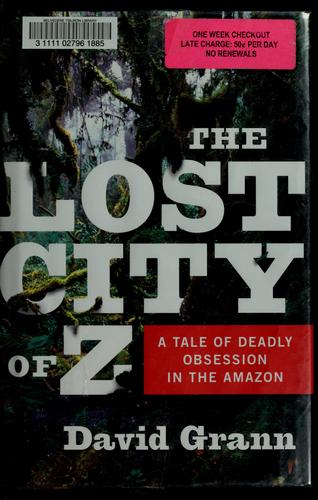
The Lost City of Z
Doubleday · 2009 · 352 pages
ISBN: 9780385513531
Review Editor
Thomas Calloway
In 1925, British explorer Percy Harrison Fawcett walked into the Amazon rainforest with his son Jack and his son’s friend Raleigh Rimell and never came back. He had told almost no one his route. He left behind a wife who would spend the next three decades refusing to believe he was dead, a son who had sacrificed everything to follow his father on one last expedition, and a mystery that would send dozens of subsequent searchers into the jungle, some of whom also died. What Fawcett was looking for, the thing he had spent years preparing to find, was a lost city he called Z: an ancient civilization he believed lay hidden somewhere in the Mato Grosso of central Brazil, a place that would prove the Amazon basin had once supported a complex, sophisticated human society.
David Grann is a staff writer for The New Yorker, a man who describes himself as physically unsuited to the jungle and who had not gone looking for a book when he first stumbled across Fawcett’s story while researching something else entirely. The Lost City of Z, published in 2009, is his account of what happened when he let himself get pulled into the current that had already swallowed Fawcett and so many others. The book reconstructs Fawcett’s remarkable career as a surveyor and explorer across South America, follows the expeditions that went in looking for him after he disappeared, and eventually describes Grann’s own journey into the Amazon in search of answers.
The structure is dual timeline: one narrative tracks Fawcett across three decades of increasingly obsessive exploration, drawing heavily from his diaries, letters, and the accounts of people who knew or worked with him; the other follows Grann himself as he digs through archives in London, interviews Fawcett’s descendants, makes contact with members of the Kalapalo tribe who may have been among the last people to see Fawcett alive, and finally makes his own trek into the forest. These two stories braid together with a precision that feels effortless but clearly isn’t. The book reads with the pace of a thriller and the authority of a work of serious historical journalism.
Character Arcs and Development
Percy Fawcett is the kind of historical subject that could easily become a cartoon in less careful hands. He was physically formidable, intellectually arrogant, almost frighteningly determined, and possessed of a Victorian confidence in his own judgment that led him to dismiss most of the scientific establishment of his time. He also had a serious interest in mysticism and the occult, kept a pet snake, and once survived a bout of illness that killed most of his expedition party through what his colleagues described as sheer refusal to die. Grann resists the temptation to turn all of this into a colorful eccentricity parade. Instead he shows us how Fawcett’s specific combination of qualities made him genuinely exceptional as a jungle surveyor: where other men gave up or died, Fawcett’s stubbornness kept him moving, and his observational abilities were real. His surveys of the Bolivia-Brazil border were serious scientific work.
The relationship between Percy and his son Jack is the emotional center of the book, and Grann handles it with considerable care. Jack Fawcett wanted to accompany his father on the final expedition partly out of genuine adventure hunger and partly, it seems, out of a lifelong need to reach a man who had spent most of his children’s early years in the jungle. When Jack joins the party, there is something almost unbearable in watching a father’s dream become a son’s fate. Jack’s friend Raleigh Rimell comes along too, barely mentioned in most accounts but present throughout Grann’s narrative as a reminder that obsession has a way of pulling in bystanders.
Grann himself is the other central character, and his self-portrait is the book’s most disarming move. He does not romanticize his own participation. He describes his early research with the awkwardness of someone who has never done anything remotely like this, very nearly backs out of the Amazon trip multiple times, and arrives in Brazil as a clear outsider: nervous, physically unprepared, and aware enough of his limitations to be honest about them on the page. Nina Fawcett, Percy’s wife, also comes through as a fully realized figure rather than a supporting detail: a woman of genuine strength and genuine delusion, who kept writing letters to her husband for decades after he disappeared, certain that he would come home.
Pacing
Grann learned how to move a story in magazine writing, and The Lost City of Z benefits from that training throughout. The alternating timelines do most of the pacing work: whenever one narrative builds to a moment of tension, the book cuts to the other, carrying that tension forward into a different scene. You never get a chance to settle into passivity. The book is around 340 pages, and most of those pages go quickly.
There is a section roughly in the middle where Grann steps back from both narratives to survey the broader history of Amazon exploration and the long tradition of European obsession with the idea of El Dorado. This context is genuinely necessary: without understanding why Fawcett’s theories were taken seriously by serious people, his quest looks like pure delusion, and the book cannot afford that. But the detour does slow the immediate forward motion. Once the context has been established and the book returns to Fawcett’s preparations for his final expedition, the pace picks back up and never really lets go through to the end.
Deeper Thematic Exploration
The most surprising thing The Lost City of Z argues is that Fawcett may not have been entirely wrong. One of the genuine reveals of the final third of the book is Grann’s encounter with archaeologist Michael Heckenberger, whose excavations in the Xingu region of the Amazon have uncovered evidence of a sophisticated pre-Columbian civilization: ring-shaped settlements connected by roads, managed agriculture, evidence of large populations living in organized communities. The Amazon does not just hide things. It erases them. The gap between what the basin contained five hundred years ago and what it looks like today is so vast that the entire history of the region has had to be reconsidered in recent decades. The jungle that colonizers and explorers described as empty wilderness was in fact a recovering landscape, its original inhabitants having been devastated by disease long before most Europeans arrived.
This raises the question the book keeps returning to without ever fully answering: what is obsession worth? Fawcett was wrong about the specifics of Z. The city he imagined, with its palaces and temples, almost certainly did not exist in the form he described. And yet something was there. His insistence that the Amazon had once supported a great civilization looked eccentric for most of the twentieth century; now it looks broadly correct. The cost of that insistence was his own life, his son’s life, and the lives of many of the people who went in looking for him afterward. Grann does not quite let Fawcett off the hook for this, but he also refuses to issue the simple verdict that the explorer was a foolish obsessive who got what he deserved.
Running under the adventure narrative is a quieter theme that the book handles with real restraint: the destruction of the Amazon’s indigenous peoples. The civilizations that built whatever Z actually was had largely ceased to exist by the time anyone European went looking for them. They were killed mostly by disease carried through trade networks before direct European contact, a devastation so rapid and so complete that the forest had time to grow back over their cities and roads before most explorers arrived. The people who might have told the story of what the Amazon once was were gone. Fawcett understood, better than most of his contemporaries, that something had happened there. What he could not know was that he was looking at absence rather than emptiness.
Style and Voice
Grann writes with the compression and clarity that magazine journalism demands. Sentences do what they need to do and stop. He has a good instinct for the detail that makes a person real without stopping the story to explain why it matters: Percy Fawcett carried a lucky charm given to him by H. Rider Haggard, the adventure novelist; he corresponded with Arthur Conan Doyle, who used Fawcett’s Amazon experiences as partial inspiration for The Lost World; he was surrounded, in other words, by the literary imagination of imperial adventure even as he attempted to transcend it. These details accumulate into a portrait without ever feeling arranged.
The prose never calls attention to itself, which is the right call for a book with this much story to carry. Grann knows when to step back and let events speak. In the Amazonian sections, when he is writing from direct experience, the writing warms a little and a few passages achieve something genuinely beautiful in their description of the forest’s density and strangeness. The rest of the book is precise, not stylistically plain: there is a difference, and Grann understands it. He is a writer who has thought carefully about how to tell a story without getting in the way of it.
Verdict
The Lost City of Z belongs to a tradition of narrative non-fiction that takes history seriously without making it feel like homework: books that use the tools of journalism and biography to get at something true about human obsession and ambition and the cost of both. If you have read and liked Killers of the Flower Moon, Into Thin Air, or The Devil in the White City, this belongs in the same company. Grann is a reliable guide: curious, honest about what he does not know, disciplined enough not to oversell the drama when it does not need selling.
Its weaknesses are real but minor. The middle section slows. Some of the secondary expedition accounts feel compressed when they might deserve fuller treatment. A reader who wants deep psychological excavation rather than narrative momentum will occasionally find the book rushing past material that could bear more examination. But these are the usual trade-offs of the genre. What The Lost City of Z does, it does very well: it makes you care about a man who died in the jungle a century ago, and it makes the question of what was actually there feel urgent and unresolved in the best possible way. You will finish it wanting to know more about Fawcett, about the Amazon, and about what it means to bet everything on an idea.
Frequently Asked Questions about The Lost City of Z
What is The Lost City of Z by David Grann about?
The Lost City of Z tells the true story of British explorer Percy Fawcett, who vanished in 1925 while searching for an ancient lost city in the Amazon rainforest that he called Z. David Grann, a staff writer for The New Yorker, reconstructs Fawcett’s extraordinary career and then retraces his final journey himself, interweaving a century of obsession, failed rescue expeditions, and new archaeological discoveries that suggest Fawcett may have been onto something real.
What happened to Percy Fawcett in the Amazon?
Percy Fawcett disappeared in the Mato Grosso region of Brazil in 1925 along with his son Jack and Jack’s friend Raleigh Rimell. Their exact fate was never confirmed. The Kalapalo tribe, one of the last groups to see them alive, reported that the party had continued east into territory controlled by hostile tribes despite warnings, and that their campfire smoke was visible for five days before it disappeared. Over the following decades, more than a hundred people joined expeditions to find them; many of those searchers also died or went missing.
Was there actually a Lost City of Z in the Amazon?
Archaeological evidence uncovered in the decades after Fawcett’s disappearance suggests the Amazon basin did once support a large, complex civilization, although probably not the city Fawcett specifically imagined. Excavations in the Xingu region by archaeologist Michael Heckenberger revealed ring-shaped settlements, connected roads, and evidence of managed agriculture, suggesting a pre-Columbian civilization far more sophisticated than was once believed. This civilization was largely destroyed by European diseases before most explorers arrived, which is why the jungle had already reclaimed the evidence by the time people started looking.
Is The Lost City of Z a true story?
Yes. The book is narrative non-fiction. Percy Fawcett was a real British explorer who genuinely disappeared in the Amazon in 1925 while searching for what he believed to be an ancient lost city. David Grann drew on Fawcett’s own diaries, letters, and unpublished manuscripts, as well as his own reporting in Brazil, to reconstruct the events. All central figures in the book, including Jack Fawcett, Nina Fawcett, and the various searchers who went in after them, were real people.
Is there a movie adaptation of The Lost City of Z?
Yes. The Lost City of Z was adapted into a film by director James Gray, released in 2016. The film stars Charlie Hunnam as Percy Fawcett, Sienna Miller as his wife Nina, Tom Holland as Jack Fawcett, and Robert Pattinson as explorer Henry Costin. The film was produced by Brad Pitt’s Plan B Entertainment and premiered at the New York Film Festival in October 2016. It received positive reviews from critics, though it was less commercially successful than some had expected.
How long is The Lost City of Z and is it a difficult read?
The hardcover edition runs to around 352 pages. It is not a difficult read at all. Grann writes with the pace and accessibility of a magazine journalist, and the book reads more like a thriller than a conventional history. Most readers report finishing it quickly because the alternating timelines keep the momentum going throughout. Some familiarity with the geography of South America helps, but the book provides enough context that no prior knowledge is required.
What are the main themes in The Lost City of Z by David Grann?
The book explores obsession and the price it extracts, not just from the obsessed person but from everyone around them. It also wrestles with the history of European exploration in the Amazon and what that exploration cost the indigenous peoples who already lived there. A quieter theme is scientific revisionism: the idea that the Amazon, long treated as a pristine wilderness, was actually a heavily modified landscape whose original inhabitants were wiped out before Europeans fully arrived. And throughout, the book asks what it means to pursue an idea so completely that no evidence against it can penetrate.
Should I read The Lost City of Z by David Grann?
If you enjoy narrative non-fiction, adventure writing, or stories of historical obsession, yes, without much hesitation. It stands alongside books like Killers of the Flower Moon and Into Thin Air as the kind of non-fiction that makes you forget you are reading about things that actually happened, because the story is so well constructed. Readers who prefer slower, more contemplative history writing, or who want deeper psychological analysis than journalism typically provides, may occasionally find it moving too fast. But for most people who pick it up, it is the kind of book that gets finished in a few sittings.
Book Details
- Title
- The Lost City of Z
- Author
- David Grann
- Genre
- History
- Publisher
- Doubleday
- Year Published
- 2009
- Pages
- 352
- ISBN
- 9780385513531
- WritersReview Rating
- 4.3 / 5