
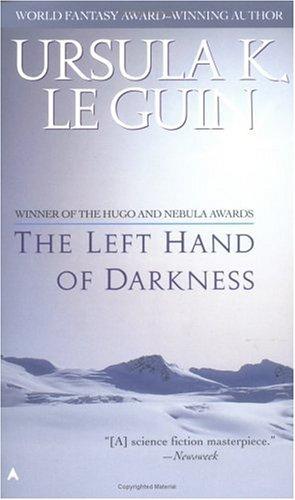
The Left Hand of Darkness
Ace Books · 1969 · 304 pages
ISBN: 9780441478125
Review Editor
Marcus Webb
Published in 1969, The Left Hand of Darkness is Ursula K. Le Guin’s fifth novel and the one that established her as a major literary force in science fiction. It takes place on Gethen, a planet locked in permanent winter, where Le Guin runs a thought experiment that still feels radical more than fifty years later: what would human society look like if no one had a fixed sex? The question sounds abstract. The novel is not. It is a book about two people who learn, slowly and at great cost, to trust each other across a gap that neither of them initially knows how to cross.
Genly Ai is a young envoy from Earth, sent alone to Gethen by the Ekumen, a loose confederation of eighty-three worlds. His job is simple in theory: convince the planet’s two major nations, the feudal kingdom of Karhide and the bureaucratic state of Orgoreyn, to join the Ekumen. In practice, he spends two years in Karhide without achieving much, partly because of Gethenian politics and partly because his own assumptions about people keep getting in the way. He is courteous, intelligent, and deeply limited by what he expects to find.
The novel sits within Le Guin’s Hainish Cycle, a loose future history in which all human worlds share a common biological origin. You don’t need to know the other books. The Left Hand of Darkness stands alone, and it works as a political novel, a survival narrative, a meditation on gender, and a slow-burning story about what friendship requires. What you get out of it depends on what you bring.
Character Arcs and Development
Genly Ai begins the novel as an observer with blind spots he doesn’t recognize. He watches the Gethenians around him with something close to anthropological patience, but he keeps reading femininity into the people he finds most persuasive and trustworthy, and he finds that quality suspicious. He’s particularly troubled by Estraven, the Prime Minister of Karhide, whose manner he describes at various points as effeminate, indirect, and therefore untrustworthy. Ai thinks he’s an open-minded traveler from a more advanced civilization. He isn’t, and Le Guin makes sure you notice without rubbing your face in it.
Estraven is harder to know, partly because we experience most of the novel through Ai’s unreliable perspective. What Le Guin gives us, piece by piece, is a portrait of someone whose loyalty runs deeper than any institution. Estraven has pledged himself to an idea rather than a king or a nation, and he’s willing to pay the full price for that. He’s exiled from Karhide in the first quarter of the book. He loses everything he had. When the narrative shifts to Estraven’s personal diary during the ice crossing, the prose becomes quieter and more interior, and the full weight of what this character has sacrificed comes into focus. The diary chapters are among the finest things Le Guin ever wrote.
The arc between Ai and Estraven is the emotional center of the novel. At the start, Ai distrusts Estraven, and Estraven can’t communicate directly with Ai because shifgrethor, the Gethenian code of indirect social respect, makes bluntness almost impossible. They talk past each other for most of the book. The eighty-day ice trek across the Gobrin ice sheet, which takes up the novel’s second half, strips all of that away. They depend on each other for survival, for warmth, for navigation, for every practical decision. Trust earned under those conditions is a different thing from trust earned in comfort. By the time the journey ends, Ai genuinely loves Estraven. The moment he finally perceives Estraven whole, without the filter of gendered expectation, is one of the most quietly devastating scenes in science fiction.
Pacing
This is a slow novel, and it knows it. Le Guin wrote in the afterword that she worried about exactly that. The opening third, set in Karhide as Ai tries to navigate court politics and rural Gethenian customs, takes its time. Several chapters are Gethenian folk tales, ethnographic reports from an earlier investigator, and the Handdara foretelling scene, which is one of the most inventive sequences in the book but asks for patience from readers who want forward momentum. The middle section in Orgoreyn moves faster but not always in a satisfying direction. Ai makes a serious mistake of judgment there, and Le Guin doesn’t soften the consequences.
Then the book pivots completely. The ice trek is everything the first half has been building toward: survival logistics, brutal cold, the constant calculus of food and fuel and distance, and underneath all of it, two people who no longer have any defense against each other. The pace becomes almost urgent. Readers who commit to the slow first act find the payoff proportional to the investment. Those who want propulsive storytelling from page one will struggle. The novel earns the response it wants from you, but it won’t rush for anyone.
Deeper Thematic Exploration
The central thought experiment of The Left Hand of Darkness is not a political argument about gender. Le Guin was careful about that distinction. The ambisexual Gethenians are a lens, not a conclusion. By imagining a world where no one is permanently male or female, where everyone cycles through kemmer (a monthly period of sexual receptiveness) and spends most of their time as a sexless androgyne, Le Guin poses a genuinely open question: what changes when you remove fixed sex from social life, and what doesn’t?
Some things change considerably. Gethen has no rape to speak of, no conception of women’s work versus men’s work, no permanent sexual hierarchy running through every relationship. Every person bears children; none bears them exclusively. Argaven, the paranoid and unstable king of Karhide, becomes pregnant during the course of the novel, and Le Guin delivers this as a simple fact, unremarked by anyone except the reader who stops for a moment. But the Gethenians also have war, political scheming, exile, cruelty, and treachery. Ambisexuality doesn’t produce utopia. It removes one category of division without eliminating the human talent for division in general.
The title comes from the first line of a traditional Gethenian poem: “Light is the left hand of darkness / and darkness the right hand of light. Two are one, life and death, lying together.” The Taoist thinking that shaped Le Guin runs through the entire novel. Opposites define each other; light and dark, loyalty and betrayal, male and female are not in opposition but in relationship. Estraven embodies this better than any other character. When Ai finally perceives him whole, as neither male nor female but as both and neither, Le Guin’s argument arrives not as an intellectual position but as a felt experience. That’s the rarer and harder achievement.
The political layer is equally developed. Karhide and Orgoreyn are recognizable human societies: one nationalist, proud, and feudal, one bureaucratic and quietly totalitarian. Neither is a cartoonish villain. The Sarf, Orgoreyn’s secret police, is frightening in the way that real political repression is frightening, through documentation and isolation and the slow withdrawal of food. And the question of what the Ekumen itself represents, whether Ai’s mission is genuinely benevolent or whether it’s a form of imperialism dressed in diplomatic language, stays productively unresolved. Le Guin doesn’t let you be comfortable about whose side you’re on.
Style and Voice
Le Guin’s prose here is spare and exact. She doesn’t reach for effect; she waits for it. The sentences are short, the descriptions precise, and the worldbuilding inserted so naturally that you rarely feel the seams. The Gethenian terms (shifgrethor, kemmer, the Fastness, the ansible) accumulate meaning gradually rather than arriving with explanatory footnotes. The cold of the ice trek is almost tactile: she describes temperatures in numbers that don’t mean anything at first, and then you’re in the tent and it means everything.
The structure is deliberately complex. Ai narrates in the first person for most chapters, but the novel also includes Estraven’s diary, Gethenian myths and legends, and reports from an earlier Ekumen investigator. These chapters were controversial when the book was published; some readers find them intrusive. They aren’t. The myths reframe the novel’s themes in fable terms without stating them explicitly. The ethnographic reports give the reader information Ai doesn’t have, which is a subtle way of showing the gap between what Ai knows and what a reader paying close attention can understand about his situation. The structure is itself an argument about multiple perspectives and the limits of any single one.
Verdict
Read The Left Hand of Darkness if you’ve ever wanted science fiction to think as carefully as it imagines. Le Guin is not using gender as a novelty. She’s using the full resources of speculative fiction to do what the form does at its best: strip away the familiar enough that you can finally see it. The slow pacing in the first half is real, and some readers genuinely won’t engage with the court politics of Karhide or the ethnographic chapter breaks. The use of masculine pronouns for all Gethenians, which Le Guin herself later revisited with ambivalence, can grate on contemporary readers, though it’s worth sitting with the discomfort, since Ai’s pronoun choices are a symptom of his own limitations, not Le Guin’s endorsement of them.
But the ice trek is stunning, the relationship between Ai and Estraven is among the most genuinely moving in the genre, and the questions the novel raises don’t resolve tidily after you close it. It won both the Hugo and the Nebula Awards in 1970, has sold more than a million copies in English, and was ranked second on Locus magazine’s all-time list of science fiction novels. Those honors are deserved. If you read one science fiction novel from the twentieth century that isn’t about spaceships and weapons, make it this one.
Frequently Asked Questions about The Left Hand of Darkness
What is The Left Hand of Darkness by Ursula K. Le Guin about?
The Left Hand of Darkness follows Genly Ai, a human envoy from Earth sent alone to the icy planet Gethen to persuade its nations to join an interstellar confederation called the Ekumen. The inhabitants of Gethen are ambisexual, with no fixed sex, and Ai struggles to understand their culture, politics, and a key ally named Estraven. The novel is as much about the relationship between Ai and Estraven, and the slow building of trust across difference, as it is about the sci-fi premise.
What are the main themes in The Left Hand of Darkness?
The four central themes are gender and androgyny (what would society look like without fixed sex), trust and loyalty (what it costs to understand someone fundamentally unlike yourself), political power (the contrast between Karhide’s feudalism and Orgoreyn’s bureaucratic authoritarianism), and the Taoist idea of complementary opposites, summed up in the title’s imagery of light and darkness as two halves of one whole.
Did The Left Hand of Darkness win any awards?
Yes. The novel won both the Hugo Award for Best Novel and the Nebula Award for Best Novel in 1970, making Le Guin one of the few authors to win both in the same year for the same book. It was later ranked second on Locus magazine’s all-time list of science fiction novels and has sold more than a million copies in English.
Is The Left Hand of Darkness part of a series?
Yes, it’s part of Le Guin’s Hainish Cycle, a loose future history in which all human civilizations share a common biological origin from the planet Hain. The Left Hand of Darkness is the fourth Hainish novel in writing order, preceded by City of Illusions and followed by The Word for World Is Forest. However, it stands completely alone and requires no knowledge of the other books.
How long is The Left Hand of Darkness and is it difficult to read?
Most editions run around 280 to 304 pages, making it a relatively short novel. The difficulty is not in the prose, which is clear and precise, but in the pacing. The first half is deliberately slow, with chapters devoted to Gethenian folk tales and ethnographic reports that interrupt the main narrative. Readers who stay with it through the first half are rewarded by a propulsive and emotionally intense second half.
Is there a movie or TV adaptation of The Left Hand of Darkness?
As of 2026, there is no major film or television adaptation of The Left Hand of Darkness, though it has been discussed and optioned several times over the decades. The novel’s nonlinear structure, its interior emotional focus, and its unconventional approach to gender have made adaptation challenging. An audio drama exists, and the book is frequently taught in university courses in the United States and the United Kingdom.
How does The Left Hand of Darkness compare to Le Guin’s other books?
Among Le Guin’s science fiction, The Left Hand of Darkness and The Dispossessed (1974) are considered her two most important novels. The Dispossessed is similarly political and similarly patient, exploring anarchism and capitalism through a dual-world setting. Le Guin’s Earthsea fantasy series, beginning with A Wizard of Earthsea (1968), shares her precise prose and interest in ethical complexity but has a warmer, more mythological tone. Readers who love Left Hand tend to also love The Dispossessed; the two books make an excellent pair.
Should I read The Left Hand of Darkness and is it worth it?
If you’re willing to invest in a slow first half, yes, absolutely. The novel asks more of you than most science fiction, but it gives back more too. The ice trek in the second half is one of the great survival sequences in the genre, and the relationship at the center of the book is written with a subtlety and emotional honesty that few novels in any genre match. Readers who prefer fast-paced action or who need plot momentum from the first page will struggle. Readers who want to be genuinely moved and genuinely challenged will find The Left Hand of Darkness stays with them.
Book Details
- Title
- The Left Hand of Darkness
- Author
- Ursula K. Le Guin
- Genre
- Science Fiction
- Publisher
- Ace Books
- Year Published
- 1969
- Pages
- 304
- ISBN
- 9780441478125
- WritersReview Rating
- 4.7 / 5