
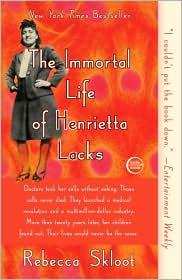
The Immortal Life of Henrietta Lacks
Crown · 2010 · 381 pages
ISBN: 9781400052189
Review Editor
Thomas Calloway
In 1951, a young Black woman named Henrietta Lacks walked into Johns Hopkins Hospital in Baltimore complaining of vaginal bleeding. Doctors found a malignant tumor on her cervix, treated her with radium, and sent her home. They also sent a small tissue sample from her tumor to a researcher named George Gey, without telling her and without asking permission. Henrietta died that October, at thirty-one years old, leaving behind a husband and five children who ranged in age from one to twenty.
Her cells did not die.
Published in February 2010, Rebecca Skloot’s first book tells the story of what happened next. The cells, labeled HeLa after the first two letters of Henrietta’s first and last names, turned out to be the first human cell line that could survive and reproduce indefinitely outside the body. Over the following decades, HeLa cells traveled to labs in dozens of countries. They helped Jonas Salk develop the polio vaccine. They went to space on early NASA missions. Researchers used them to study cancer, viruses, radiation, and the effects of hundreds of drugs. Meanwhile, the Lacks family lived in poverty in Baltimore, without health insurance, largely unaware that any of this had happened. Most of them did not learn about HeLa until a journalist contacted them in 1975.
Skloot spent a decade writing this book. She traveled to Clover, Virginia, where Henrietta grew up picking tobacco. She sat in kitchens and living rooms in Baltimore, earning trust slowly from a family that had excellent reasons to distrust journalists, scientists, and strangers in general. The result is a book that operates on at least three levels at once: a biography of Henrietta Lacks, a history of cell biology and the commercialization of medical research, and a deeply reported account of what it felt like to be that family, to be told that your dead mother’s cells were alive in labs around the world, and to receive nothing.
Character Arcs and Development
The most fully realized character in this book is not Henrietta herself, though Skloot works hard to bring her to life. It is Deborah Lacks, Henrietta’s youngest daughter. Deborah was barely two years old when her mother died and grew up knowing almost nothing about her. The book traces Deborah’s decades-long obsession with understanding who her mother was, what happened to her cells, and what it might mean that pieces of her mother are alive in labs to this day. Deborah is brilliant, suspicious, erratic, funny, and capable of enormous generosity. Watching her and Skloot navigate the space between them, across lines of race and class and education and grief, is one of the book’s most sustained pleasures. Deborah is not a type or a symbol. She is a specific person who wanted specific answers, and Skloot is honest about how complicated it was to help her find them.
Henrietta herself is harder to reach. She died before Skloot could interview anyone who remembered her well, and memories have faded across sixty years. But Skloot gathers fragments and assembles them carefully. Henrietta loved to dance. She cooked large meals and kept her door open to anyone who was hungry. She married her first cousin, David Lacks, known as Day, and they moved north from Virginia to Baltimore when the tobacco economy could no longer sustain them. She was, by every account, generous and vivid and entirely unprepared for what her body would encounter at Johns Hopkins. Skloot gives her that dignity on the page.
The other Lacks children are drawn with care but with less depth, partly because they are less central and partly because some of them remained more guarded with Skloot. Lawrence, the oldest, carries a pragmatic anger about what was taken from the family. Zakariyya (born Joe) carries something harder: a volatile fury rooted in a childhood that fell apart after Henrietta died. He is the most damaged of the children, and Skloot treats him without softening. His rage is real, its sources are real, and the book is better for not sentimentalizing it.
Pacing
The book moves between three interwoven timelines: Henrietta’s life in the 1940s and early 1950s, the scientific and commercial history of HeLa cells from the 1950s through the 2000s, and Skloot’s own experience researching the book during the early 2000s. This structure works well in the first half, but it shows some strain in the middle section, where Skloot covers decades of cell biology business and politics in a way that can feel more like survey than story. Readers without a prior interest in the science may find themselves working harder through those chapters than through the biographical and reportorial sections.
The book recovers momentum sharply in the second half. Once Skloot begins traveling with Deborah to visit Johns Hopkins and other sites connected to Henrietta’s story, the narrative tightens considerably. That section is among the most emotionally precise writing in American nonfiction of the last twenty years. The earlier slower passages are necessary. They just ask more of you than the rest of the book does.
Deeper Thematic Exploration
At its center, this book asks who gets to profit from the human body. George Gey gave HeLa cells freely to other scientists because he believed open sharing was how science advanced. But as cell culture became industrialized, HeLa cells moved into commercial production. By the 1980s, biotechnology companies were growing and selling them. Researchers built careers on HeLa-based discoveries. Corporations earned revenue from products that HeLa cells helped test or develop. At no point did the Lacks family consent to any of this. At no point did they receive money. The Supreme Court ruled in 1990, in a case involving a different patient, that people have no property rights over tissue removed from their bodies. The cells are yours until they leave you. After that, they belong to whoever cultures them.
Race runs through every part of this story. Henrietta Lacks was treated at Johns Hopkins partly because it was one of the only hospitals in Baltimore that accepted Black patients, and she was treated in the segregated ward. The researchers who took her cells did not believe they were doing anything wrong by the standards of their time. Skloot’s deeper question is why the standards of that time were what they were, and what it meant to practice medicine in a country where certain bodies had historically been available for research without consent. She covers that history carefully, including specific experiments conducted on Black patients, without turning the book into a polemic. She trusts the facts to carry the argument.
The book also takes faith seriously, which distinguishes it from a lot of science writing. The Lacks family is devoutly Christian, and Deborah comes to understand HeLa cells as evidence that her mother is still present in the world, in a form Deborah can almost touch. Skloot does not explain this away or treat it as charming naivety. The science of immortal cells and Deborah’s belief in her mother’s ongoing spiritual life are not presented as contradictions. They sit beside each other, and the book is more honest for letting them. Henrietta Lacks can be simultaneously a woman whose cells were taken without consent, a scientific resource that changed medicine, and a mother whose presence is still felt by her children. The book holds all three at once.
Style and Voice
Skloot writes clean, plainspoken prose that trusts its material to carry the weight. She does not reach for poetic effects when the facts are striking enough on their own. When she explains how cell division works, or how the business of biotech developed over fifty years, she does it with precision and without condescension. The shifts between past and present are handled through tense changes that are clear enough that the reader rarely gets disoriented, even across a structure that is doing a lot of work.
The passages involving Deborah are written with particular care. Skloot captures how Deborah speaks without mockery, conveys her intelligence and her fragility simultaneously, and stays honest about her own position as a white journalist who wanted something from this family and knew it. The scene in which Deborah collapses in Skloot’s car, overwhelmed by stress and grief after a difficult day, is written without theatrics. It is devastating because of what Skloot leaves out rather than what she puts in. That kind of restraint is harder to achieve than it looks.
Verdict
If you have any interest in medicine, race, American history, or the ethics of scientific research, you should read this book. It belongs beside the strongest narrative nonfiction of the last several decades: books that find in a specific, particular story a way into something much larger. The science is accessible, the Lacks family’s experience is affecting and specific, and the ethical questions Skloot raises are ones that only grow more urgent as genomic medicine and biotechnology advance. Informed consent, tissue ownership, and the distribution of benefits from medical research are not abstract problems. They are active policy questions today, and this book gives you the history you need to think about them.
The middle section covering the HeLa business history is slower than the rest of the book, and some readers will feel it. That is a real limitation, not a reason to skip the book. Readers who care primarily about biography and reporting will find exactly what they came for. Readers interested in science and medicine will find more than they expected. You might want to keep a highlighter handy. There is a lot here worth returning to.
Frequently Asked Questions about The Immortal Life of Henrietta Lacks
What is The Immortal Life of Henrietta Lacks about?
The Immortal Life of Henrietta Lacks by Rebecca Skloot tells the story of a Black woman from Baltimore whose cancer cells were taken without her consent in 1951 and became the first immortal human cell line in history. The book follows the scientific history of those HeLa cells across six decades of research and the parallel story of the Lacks family, who lived in poverty while those cells contributed to medical advances worth billions of dollars. It combines science journalism, biography, and reported memoir into a single narrative.
Who was Henrietta Lacks and why are her cells so important to science?
Henrietta Lacks was a Black woman from Clover, Virginia, who died of cervical cancer at Johns Hopkins Hospital in Baltimore in October 1951. Before she died, researchers there cultured cells from her tumor and discovered they could survive and reproduce indefinitely in a laboratory, something no human cell line had done before. Her cells, called HeLa, became an essential research tool used to develop the polio vaccine, study cancer and viruses, test drugs, and conduct hundreds of thousands of scientific experiments around the world. They are still in use today.
What are the main themes in The Immortal Life of Henrietta Lacks?
The book explores several interlocking themes. Medical ethics and informed consent are central: Henrietta’s cells were taken without her knowledge, and her family was never asked for permission. Race and medicine form a second major strand, examining why certain bodies have historically been available to researchers without consent. The book also addresses poverty and healthcare access, the commercialization of scientific research, faith and science coexisting rather than competing, and the question of what we owe to people whose biological material becomes commercially valuable.
How long is The Immortal Life of Henrietta Lacks and is it a difficult read?
The book is 381 pages, plus notes and bibliography. It is written for a general audience and requires no scientific background. Skloot explains the cell biology clearly and in plain language. The middle section, which covers the commercial history of HeLa cells over several decades, is denser than the biographical and narrative portions and may slow some readers down. The opening and closing sections are immediate and propulsive. Most readers with a serious interest in the subject finish it in a few days.
Is there a movie or TV adaptation of The Immortal Life of Henrietta Lacks?
Yes. HBO released a film adaptation in 2017, directed by George C. Wolfe. Oprah Winfrey starred as Deborah Lacks and also served as executive producer. The film focuses primarily on Skloot’s relationship with Deborah rather than covering the full scope of the book. It received generally favorable reviews and is available through HBO. Winfrey had been attached to the project since 2010, the year the book was published.
What age group or reading level is The Immortal Life of Henrietta Lacks for?
The book is written for adult readers but is widely taught in high school classrooms, particularly in biology, ethics, and American history courses. Skloot also wrote a young adult adaptation with a simplified scientific explanation. The adult version is appropriate for strong high school readers and above. It has been adopted as a common reading text at more than 125 universities, covering everything from pre-medical programs to humanities courses, which gives you a sense of its intended range.
Did Henrietta Lacks’s family ever receive compensation for HeLa cells?
The Lacks family has not received financial compensation from the research community or the biotechnology industry. In 2013, after the National Institutes of Health published the HeLa genome without consulting the family, a negotiated agreement gave family members two seats on a committee that reviews requests to access the genome. Rebecca Skloot established the Henrietta Lacks Foundation using proceeds from the book to provide scholarships and health assistance to the family. The broader legal question of whether tissue donors have property rights over their cells was resolved against donors by the Supreme Court in 1990, and that ruling has not changed.
Should I read The Immortal Life of Henrietta Lacks?
If you are interested in medicine, race, American history, or investigative journalism, yes, without much hesitation. The book is an essential work of science writing that manages to be deeply moving without sacrificing rigor. If your primary interest is action-driven narrative, you may find the middle section slow. If you come in wanting to understand how a woman’s cells changed medicine and what that cost her family, you will find exactly what you are looking for, and probably more.
Book Details
- Title
- The Immortal Life of Henrietta Lacks
- Author
- Rebecca Skloot
- Genre
- History
- Publisher
- Crown
- Year Published
- 2010
- Pages
- 381
- ISBN
- 9781400052189
- WritersReview Rating
- 4.4 / 5