
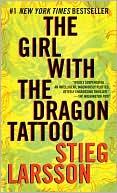
The Girl with the Dragon Tattoo
Vintage Crime/Black Lizard · 2008 · 672 pages
ISBN: 9780307473479
Review Editor
James Voss
A disgraced financial journalist is hired by an elderly industrialist to investigate a family mystery that has remained unsolved for forty years — the apparent murder of a teenage girl on an island where the bridge was closed for a parade, making the killer impossible to have left and impossible to identify among those who stayed. While Mikael Blomkvist works the cold case from a cottage in rural Sweden, Lisbeth Salander — a state-ward investigator whose methods are unconventional and whose personal history is a catalog of institutional violence against the vulnerable — is hired to investigate him. Stieg Larsson’s posthumously published novel was a global phenomenon that introduced one of the most compelling protagonists in contemporary crime fiction and launched a trilogy that has sold over 100 million copies worldwide.
Character Arcs
Lisbeth Salander is the trilogy’s defining creation. She is small, tattooed, brilliant, asocial, and the product of a Swedish welfare system that failed her systematically. Her particular genius — eidetic memory, exceptional hacking skills, and a capacity for violence that emerges from lived necessity — is matched by her inability to perform the social compliance that institutions require. The novel is partly a study of what happens to people the system designates as problems rather than citizens. Blomkvist is competent, principled, and somewhat bland by comparison, functioning largely as the reader’s access point to a world Salander inhabits more intensely. The novel is most alive when Salander is at its center.
Pacing
The Girl with the Dragon Tattoo is a long novel — over 600 pages — and its first third is deliberately slow, establishing the financial corruption case that precedes the main mystery and orienting the reader in Swedish media, business culture, and the Vanger family’s complicated history. Readers who persist past this setup are rewarded: the investigation accelerates into a genuinely absorbing mystery, and Larsson cross-cuts between Blomkvist and Salander’s parallel investigations with increasing urgency. The novel’s climax resolves the Vanger mystery somewhat abruptly, and the financial corruption thread that opened the book returns in the final pages in ways that can feel like a different novel attached to the end. Larsson reportedly wrote the trilogy as continuous material rather than discrete books, and the seams sometimes show.
Thematic Depth
The novel’s Swedish title is Men Who Hate Women, and that is a more accurate description of its project. Larsson is systematically interested in violence against women — not as thriller content but as institutional and personal failure. Each major crime in the novel is an act of male violence; the systems that failed to prevent or punish it are Swedish institutions presented in unflattering detail. Salander’s history is the most concentrated version of this theme: she has been abused, institutionalized, and assigned a guardian whose power over her has been systematically abused. The novel’s treatment of this history is frank without being exploitative, and Salander’s response — comprehensive, patient, and devastating — is one of the most satisfying acts of justice in contemporary crime fiction.
Style and Voice
Larsson’s prose, in the original Swedish and in the English translation, is functional rather than literary — it gets the job done without drawing attention to itself, which suits the procedural material but can feel flat in sequences that want more. The novel’s strength is in its architecture: the layered mysteries, the patient accumulation of detail, the way Larsson plants information that pays off chapters later. The translation (by Reg Keeland in the US edition) is fluid without feeling domesticated. The novel reads as the work of a journalist with a large story to tell and the organizational discipline to tell it across a very long canvas.
Verdict
The Girl with the Dragon Tattoo is a superior thriller with one extraordinary character at its center. Lisbeth Salander earns the phenomenon she became — she is specific, complex, and generated from a coherent set of ideas about institutional failure and individual resilience. The novel around her is uneven: the first third drags, the ending is abrupt, and Blomkvist is thin company. But for the hundreds of pages where the mystery is fully alive and Salander is at its center, it delivers exactly what the best crime fiction promises and rarely achieves.
Rating: 4.0 out of 5
Book Details
- Title
- The Girl with the Dragon Tattoo
- Author
- Stieg Larsson
- Genre
- Mystery & Thriller
- Publisher
- Vintage Crime/Black Lizard
- Year Published
- 2008
- Pages
- 672
- ISBN
- 9780307473479
- WritersReview Rating
- 4.0 / 5