
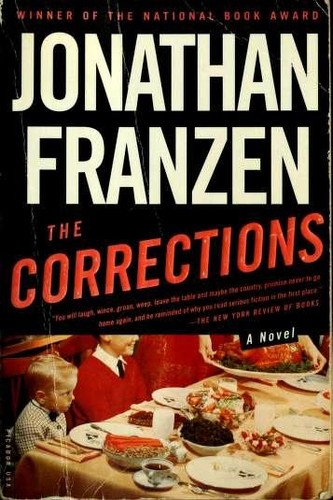
The Corrections
Picador · 2001 · 568 pages
ISBN: 9780312421274
🏆 National Book Award for Fiction (2001)
James Tait Black Memorial Prize (2002)
Pulitzer Prize for Fiction finalist (2002)
National Book Critics Circle Award finalist (2001)
PEN/Faulkner Award finalist (2002)
Review Editor
Eleanor Marsh
Jonathan Franzen’s The Corrections, published in 2001 by Farrar, Straus and Giroux, tells the story of the Lambert family as they spiral toward what matriarch Enid Lambert hopes will be “one last Christmas” together in their fictional Midwestern hometown of St. Jude. Alfred Lambert, Enid’s husband and a retired railroad engineer, is losing ground to Parkinson’s disease, dementia, and a lifetime of repressed feeling. Their three adult children, each wrecked in their own particular way, have scattered to the coasts. What follows is a 576-page examination of a family trying, and mostly failing, to hold itself together as the American century winds down.
The novel is structured around alternating sections that follow each family member through their private disasters while circling back to Enid’s increasingly desperate campaign to get everyone home for the holidays. Franzen moves between the suburban Midwest of the 1950s and 1960s, the financial euphoria of 1990s Philadelphia, the post-Soviet chaos of Lithuania, and the restaurant kitchens of Philadelphia, building a portrait of a family that is both achingly specific and broadly recognizable.
The Corrections won the 2001 National Book Award for Fiction, was a finalist for the Pulitzer Prize, and became one of those rare literary novels that also spent months on the bestseller lists. It remains, more than two decades later, a book people argue about.
Character Arcs and Development
Alfred Lambert is the novel’s gravitational center, even when he’s offstage. A man who believed in discipline, silence, and the railroad, Alfred spent his working life developing a metallurgical patent and suppressing every emotion that threatened his self-image. Now, as his mind deteriorates, the control he spent decades perfecting is crumbling. Franzen captures Alfred’s confusion with a specificity that feels almost medical. There is a scene on a cruise ship where Alfred hallucinates that his feces are speaking to him; it would be grotesque if it weren’t so deeply rooted in the character’s psychology. Alfred’s decline is not just physical. It is the slow, humiliating dismantling of the identity he built his entire life around. By the novel’s end, you understand that the stoicism his children found so suffocating was itself a kind of suffering.
Enid is the other pillar, and Franzen treats her with a complicated mixture of sympathy and exasperation. She is a woman who has organized her entire existence around appearances, and now the appearances are collapsing. Her obsession with the Christmas gathering is not, Franzen makes clear, simple nostalgia. It is a last attempt to prove that her sacrifices meant something. She is maddening, she is manipulative, and she is also someone who deserves better than the emotional starvation Alfred has given her for fifty years. The novel earns real tenderness for Enid by its final pages, when she begins, cautiously, to build a life that does not depend on anyone else’s approval.
The three children are drawn with equal precision. Gary, the eldest, is a Philadelphia investment banker locked in a cold war with his wife Caroline over whether his mother is manipulative (she is) and whether he is depressed (he is). His sections are darkly comic, a portrait of a man who insists he is fine while every paragraph makes clear he is not. Chip, the middle child, is an academic who loses his professorship after an affair with a student, maxes out his credit cards, and flees to Lithuania to work for a corrupt politician. Chip’s storyline is the most overtly satirical, and occasionally the broadest, but Franzen uses it to explore what happens when intellectual pretension collides with actual desperation. Denise, the youngest, is a gifted chef whose affairs with her boss and then his wife cost her a career and force her to reckon with a sexuality she has spent years avoiding. Denise’s section may be the most emotionally complex, because Franzen lets her be genuinely talented and genuinely destructive without simplifying either quality.
Pacing
The Corrections is not a short book, and it does not always feel urgent. The middle sections, particularly Chip’s Lithuanian adventure, run long. There are passages where the satire becomes a set piece, where Franzen is clearly enjoying himself at the expense of forward momentum. The corporate subplot involving Alfred’s former employer and a dubious biotech investment could lose thirty pages and the novel would only gain. If you are the kind of reader who needs plot pressure on every page, you will find stretches where the book tests your patience.
That said, the novel’s structure works because each section builds emotional information that pays off in the final Christmas sequence. The last hundred pages, when the family finally converges in St. Jude, move with real velocity. Scenes that might have felt melodramatic in isolation land with force because Franzen has spent four hundred pages earning them. The pacing is uneven, but the architecture is sound.
Deeper Thematic Exploration
The title is the first clue. “Corrections” operates on at least three levels: the stock market correction that looms over Gary’s investment anxiety, the pharmaceutical correction that Enid hopes will fix Alfred’s brain, and the moral correction that every member of the family believes every other member needs. Franzen is interested in a culture that treats unhappiness as a problem to be solved rather than a condition to be endured. The Lamberts keep reaching for fixes: medication, money, sex, geographic escape, one more Christmas. None of it works, because what they need is not a correction but an acceptance of who they actually are.
The novel is also a sustained examination of the American family as an economic unit. Franzen draws explicit connections between the deregulation of the railroad industry that ends Alfred’s career and the emotional deregulation that sends his children into chaos. The Corrections was written during the dot-com bubble, and Franzen saw, earlier than most novelists, that the language of markets had colonized private life. Gary thinks about his marriage in terms of leverage and capital. Chip tries to monetize his intellect. Even Enid frames her desire for family togetherness as something she is “owed.” The novel argues that when a society makes everything transactional, families become the collateral.
Beneath the social satire, though, The Corrections is about something simpler and harder: the impossibility of truly knowing your parents, and the impossibility of your parents truly knowing you. Alfred cannot tell Enid he loves her. Enid cannot stop performing cheerfulness long enough to grieve. Gary cannot admit he is his father’s son. Chip cannot stop rebelling against a household that no longer exists. Denise cannot reconcile the dutiful daughter she was raised to be with the woman she actually is. These are not problems that any correction can fix. They are the permanent weather of family life, and Franzen’s willingness to sit with that discomfort, rather than resolve it, is what makes the novel last.
Style and Voice
Franzen writes in a close third person that shifts to match whichever Lambert is in focus. Alfred’s sections are clipped and sensory, full of metallurgical detail and physical disorientation. Chip’s sections are the most self-consciously literary, stuffed with the kind of cultural criticism Chip himself would write. Denise’s sections have the cleanest prose, reflecting her professional discipline. Gary’s sections are wound tight with anxiety. The technique works because Franzen does not just tell you what each character thinks; he makes you think the way they think, which is a harder trick.
The prose is dense, sometimes deliberately overwritten, and frequently very funny. Franzen has a gift for the devastating aside, the sentence that pins a character’s self-deception to the wall in twelve words. He can also be indulgent. There are moments where the novel reads like Franzen settling scores with academia, with the Midwest, with literary culture, with his own earlier ambitions. These passages are clever but can feel effortful, as if the novel is trying to be important rather than simply being good. When Franzen forgets about importance and just follows his characters, the writing is as sharp as anything in recent American fiction.
Verdict
The Corrections is a big, ambitious, imperfect novel that does something rare: it makes you feel the weight of a family’s history in your chest. It is too long in places. Its satire occasionally overwhelms its sympathy. Chip’s sections never quite find the balance between comedy and pathos that the rest of the book achieves. But when the novel works, and it works more often than not, it captures something true about the way families transmit their damage across generations, and about the particular loneliness of watching a parent disappear into illness.
If you care about American fiction, you should read it. If you have ever sat at a holiday table and felt the distance between who your family pretends to be and who they actually are, you will recognize these people. Readers who prefer tightly plotted narratives may find the sprawl frustrating, and anyone looking for redemptive warmth will find Franzen too clear-eyed for comfort. But for a reader willing to sit with complexity, willing to laugh at characters you also pity, and willing to be moved by a story that refuses easy resolutions, The Corrections remains essential.
Frequently Asked Questions about The Corrections
What is The Corrections by Jonathan Franzen about?
The Corrections follows the Lambert family of St. Jude, a fictional Midwestern city, as elderly patriarch Alfred declines into Parkinson’s disease and dementia while his wife Enid campaigns to bring their three adult children home for one last Christmas. Each child is dealing with their own crisis: Gary with depression and marital warfare, Chip with career collapse and a scheme in Lithuania, and Denise with affairs that destroy her professional life. The novel explores how a family’s dysfunction ripples across generations.
Did The Corrections win any major literary awards?
Yes. The Corrections won the 2001 National Book Award for Fiction and the 2002 James Tait Black Memorial Prize. It was also a finalist for the 2002 Pulitzer Prize for Fiction, the 2001 National Book Critics Circle Award, and the 2002 PEN/Faulkner Award. In 2009, a poll of 48 writers, critics, and editors by The Millions named it the best novel of the 2000s.
What are the main themes in The Corrections by Jonathan Franzen?
The novel explores family dysfunction and the impossibility of truly knowing your parents or children. It examines aging and cognitive decline through Alfred’s Parkinson’s disease. It critiques American consumer capitalism, drawing parallels between market “corrections” and the family’s attempts to fix each other. It also deals with identity, particularly the tension between Midwestern values and coastal ambition, and the damage caused by emotional repression across generations.
How long is The Corrections and is it a difficult read?
The Corrections is 576 pages in paperback. The prose is dense and the novel shifts between five points of view across multiple timelines, so it requires attention. It is not experimental in structure, and the storytelling is fundamentally conventional, but the length and Franzen’s detailed style mean it rewards patient reading rather than skimming. Most readers comfortable with literary fiction will find it accessible, if occasionally demanding.
Is there a movie or TV adaptation of The Corrections?
There have been multiple adaptation attempts. In 2012, Noah Baumbach directed a pilot for HBO starring Ewan McGregor and Greta Gerwig, but HBO did not pick it up. In 2015, the BBC broadcast a 15-part radio dramatization. In April 2026, Netflix ordered a new limited series starring Meryl Streep as Enid Lambert, directed by Cord Jefferson from a script by Franzen himself. A release date has not been announced.
What age group or reading level is The Corrections appropriate for?
The Corrections is written for adult readers. It contains explicit sexual content, drug use, and detailed depictions of mental illness and cognitive decline. The themes of marital dysfunction, career failure, and family estrangement are adult in nature. It is best suited for readers in their twenties and older who have some experience with literary fiction. It is not appropriate for younger teens.
How does The Corrections compare to Jonathan Franzen’s other novels?
The Corrections is widely considered Franzen’s best work and the novel that established his reputation. His follow-up, Freedom (2010), covers similar thematic ground with a different family but received more divided reviews. His earlier novels, The Twenty-Seventh City and Strong Motion, are more overtly experimental. Crossroads (2021) returns to family drama with a more restrained style. If you enjoy The Corrections, Freedom is the closest companion piece, though many readers find The Corrections sharper and more emotionally precise.
Should I read The Corrections and is it worth it?
If you want a novel that captures the texture of American family life with intelligence and dark humor, yes. The Corrections is one of the most significant American novels of the 21st century for good reason. Readers who love character-driven fiction, family sagas, and social satire will find it deeply rewarding. If you strongly prefer short, plot-driven books, the length and pace may frustrate you. But for anyone willing to invest the time, it delivers a reading experience that stays with you long after the last page.
Book Details
- Title
- The Corrections
- Author
- Jonathan Franzen
- Genre
- Literary Fiction
- Publisher
- Picador
- Year Published
- 2001
- Pages
- 568
- ISBN
- 9780312421274
- Awards
- 🏆 National Book Award for Fiction (2001) James Tait Black Memorial Prize (2002) Pulitzer Prize for Fiction finalist (2002) National Book Critics Circle Award finalist (2001) PEN/Faulkner Award finalist (2002)
- WritersReview Rating
- 4.9 / 5