
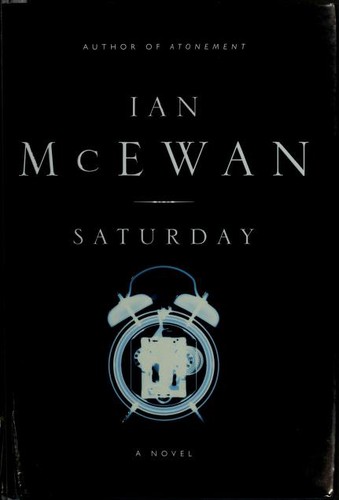
Ian McEwan’s Saturday follows a single day in the life of a London neurosurgeon. Published in 2005, it unfolds on February 15, 2003 – the day of the global anti-Iraq War demonstrations, the largest coordinated protest in human history up to that point. Henry Perowne wakes before dawn, watches a burning plane cross the sky over London, and spends the day navigating the specific texture of his privileged life while a political world he cannot fully process churns outside. McEwan builds his novel to a confrontation that tests everything the day has established.
What Happens in Saturday
Henry Perowne is a consultant neurosurgeon, happily married to a newspaper lawyer named Rosalind, father of Daisy, a poet living in Paris, and Theo, a blues guitarist. He lives in a Georgian townhouse in Fitzrovia. His life is full and satisfying in ways he is aware of without being complacent about.
The day’s events include: watching the plane, which turns out to be a damaged aircraft with a fuel leak rather than an attack; a fender-bender with a car driven by Baxter, a young man who shows signs of Huntington’s disease; a squash game with a colleague; a visit to his dementia-afflicted mother in her care facility; preparing for a family dinner. The novel follows him through each of these with the granular attention to thought and sensation that is McEwan’s signature mode.
The confrontation with Baxter, whom Perowne has diagnosed within seconds of meeting him, is not resolved at the fender-bender. Baxter returns in the evening, and what happens then is the novel’s central dramatic event – a scene in which poetry, medicine, and the specific architecture of a family’s life are all tested simultaneously.
Henry Perowne
Perowne is a materialist who has spent his career inside the brain and cannot find evidence there for any of the things that literature and religion claim to offer: meaning, transcendence, the soul. His skepticism about his daughter’s poetry and about his wife’s legal idealism is rendered with affection rather than contempt; he is not arguing against these things, he simply cannot reach them.
McEwan builds his portrait of Perowne with meticulous care. He is a man who knows one thing extraordinarily well – the brain’s mechanics – and who navigates everything else with the same approach: careful observation, measured response, trust in the procedures that have worked before. His encounter with Baxter tests this approach against something it was not designed for.
The Political Frame
The Iraq War demonstrations provide the novel’s political context without being its subject. Perowne’s daughter is against the war; Perowne, who has treated victims of Saddam Hussein’s regime, is not sure. The novel refuses to resolve this disagreement, which is its political honesty. McEwan is interested in the difficulty of knowing what to do when the question is genuinely hard, and the family argument about Iraq is one of the novel’s most carefully managed scenes.
McEwan’s Technique
Saturday demonstrates McEwan’s characteristic method at its most sustained: close third-person narration that stays almost entirely within one consciousness, rendering the world through the specific knowledge and assumptions of that consciousness. The neuroscience in the novel is accurate; McEwan researched operating-theater procedure with the same care he brings to every technical domain he enters. The result is a portrait of a doctor who thinks like a doctor, not like a literary character pretending to be a doctor.
The novel’s unity of time – a single day – is a formal constraint that McEwan uses to concentrate rather than limit. Everything is present on this day, from Perowne’s professional life to the state of his marriage to the relationship between the privileged and the not-privileged in contemporary London.
Who This Book Is For
Readers interested in the contemporary novel of consciousness, in the relationship between private life and public catastrophe, in medicine as subject matter, or in McEwan’s particular brand of intelligent thriller will find Saturday one of his most accomplished works. It asks whether a good life can coexist with the knowledge of what is happening in the world outside its walls, and it answers honestly.
Frequently Asked Questions
- Is Saturday McEwan’s best novel?
- It is one of his most ambitious. Atonement, published two years earlier, is more widely regarded as his masterpiece, but Saturday is more formally inventive in its use of the single day and more explicitly engaged with the political moment of its composition.
- Why does Baxter respond to the poetry?
- The scene in which Baxter is stopped by a poem being read aloud is the novel’s most discussed moment. McEwan’s explanation involves the specific neurology of Huntington’s disease and its relationship to aesthetic experience. He has said he researched this carefully. The scene also functions as an argument for art’s power to reach past defenses, which is one of the novel’s central concerns.
- Is Henry Perowne sympathetic?
- He is rendered with enough interiority that readers understand him, and with enough critical distance that they can see his limits. Whether he is sympathetic depends on how a reader responds to his particular combination of genuine goodness and limited imaginative reach beyond his own experience.
- How does Saturday handle the Iraq War?
- With more intellectual honesty than most literary fiction of the period. McEwan does not come down clearly against the war, which generated some controversy at the time. The novel is more interested in the difficulty of the question than in providing a correct answer.
- Is the novel relevant outside the specific historical moment?
- Yes. The Iraq War context is specific, but the novel’s central questions – about privilege, about what we owe each other, about whether good lives can be secured against the world – are not period-specific.
- How does Saturday compare to Atonement?
- Atonement is more structurally ambitious and more concerned with the relationship between fiction and truth. Saturday is tighter and more focused on a single consciousness. Both are essential McEwan.
- What role does music play in the novel?
- Theo’s blues guitar and Perowne’s response to it is one of the novel’s recurring threads. Perowne cannot access poetry in the way his daughter wants him to, but he can access music. The distinction matters to the novel’s argument about different forms of art and different kinds of consciousness.
- Does Saturday have violence?
- Yes. The confrontation with Baxter in the evening is violent. McEwan handles it with clinical precision rather than sensationalism, which is consistent with Perowne’s professional training and with the novel’s overall method.
Book Details
- Title
- Saturday
- Author
- Ian McEwan
- Genre
- Literary Fiction
- Publisher
- Nan A. Talese/Doubleday
- ISBN
- 9780385511803
- WritersReview Rating
- 4.0 / 5