
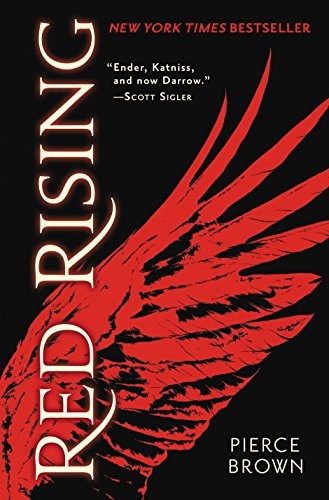
Red Rising
Del Rey · 2014 · 416 pages
ISBN: 9780345539786
Review Editor
James Voss
Red Rising opens deep underground on Mars, in the mining tunnels where Darrow, a young Red, works alongside his wife Eo to extract helium-3 that supposedly makes the surface habitable for future generations. The Reds believe themselves essential pioneers; the truth is far more brutal. Pierce Brown published this debut novel in January 2014, and it announces a writer with real ambition: the book is thick with Roman mythology (the color-coded Society draws on Greco-Roman naming conventions throughout), brutal set-pieces, and an underlying anger about inequality that drives every chapter forward.
The setup works like a trap snapping shut. Darrow loses Eo early, and her death sets everything in motion. The Society’s eugenicist hierarchy, with Golds at the top, Reds at the bottom, and a dozen Colors in between, is not just backdrop: it is the novel’s core subject. Darrow is recruited by a resistance group, surgically altered to pass as a Gold, and sent to infiltrate the Institute, an elite school where Gold teenagers fight mock wars designed to sort them into leadership roles. The first hundred pages feel almost separate from what follows, which can surprise readers expecting immediate action. That patience Brown asks of you earns out by midbook.
The novel’s premise draws from multiple sources, including The Hunger Games and classical Roman history, and Brown acknowledges those influences openly. What he builds from them, though, is distinctly his own: a story about what it costs to fight a system from inside it, told through a protagonist who is genuinely changed by the fight.
Character Arcs and Development
Darrow is not a simple hero. He enters the Institute grieving and furious, which gives Brown space to show how anger can become a strategic resource rather than just a liability. By the time Darrow is leading a house of Golds in the Institute’s war games, he has begun to genuinely admire and like some of them, and this creates the novel’s most interesting tension: what do you do when the enemy turns out to contain actual human beings?
Mustang, later revealed to be Virginia au Augustus, is the character who most tests this tension. She and Darrow meet as equals rather than adversaries, and their dynamic avoids the usual romantic-rival-turned-ally formula. Mustang has her own ideas about power, loyalty, and justice, and she never quite bends to Darrow’s orbit. She pushes back. Brown gives her the intelligence to see through Darrow’s performance before most other characters do, and their scenes together have a low-grade electricity precisely because each is hiding something from the other.
Cassius au Bellona starts as Darrow’s most natural ally: charming, sharp, the kind of person who makes danger feel social. What happens between them in the middle section is genuinely painful because Brown has done the work to make you care about both characters before he drives them apart. The secondary characters, including Sevro (the small and feral Gold who attaches to Darrow) and Roque (the idealistic poet-soldier), all have clear personalities and don’t blur together the way side characters in action-heavy novels so often do.
Pacing
The first act, set in the Red mines, moves slowly, and by design. Brown wants you to feel the weight of that life before he strips it away. Some readers find this patience frustrating; others will recognize it as the novel earning its later momentum. Once Darrow arrives at the Institute, the pace shifts completely. The war-game sequences are long and intricate, with alliances forming and breaking across what amounts to a political chessboard played out through physical violence. The middle of the novel sags only slightly in sections where the logistics of tribal warfare become hard to track. A few chapters in the second act feel like setup for moves that pay off later, which is forgivable structure but still requires some trust on the reader’s part.
The final act tightens significantly. Brown knows how to build a climax across multiple fronts rather than collapsing everything into a single confrontation, and the last hundred pages move fast enough that you’ll read past where you intended to stop. The payoffs for threads laid in the first hundred pages arrive in a way that feels earned rather than convenient, which is a harder trick than it sounds for a debut.
Deeper Thematic Exploration
The obvious comparison is to The Hunger Games, and Brown was aware of it from the start. But Red Rising does something more politically specific than Collins’s series. The Society is not simply an authoritarian regime run by cartoonish villains. It is a system that distributes its benefits and its cruelties with enough precision that the people at the top genuinely believe in its logic. The Golds do not think of themselves as oppressors; they think of themselves as the naturally excellent class, shaped by breeding and education into the only people capable of maintaining civilization. Brown makes this ideology coherent enough that you can see how someone raised inside it would believe it. This makes Darrow’s project scarier: he is not just trying to overthrow a tyrant but to crack a worldview that answers its own objections.
The Roman mythology works harder than decoration. The Gold students name their houses after Roman deities. Their values echo Roman virtus: martial excellence, family loyalty, the display of controlled brutality as proof of fitness to rule. Brown uses this framework to get at something real about how hierarchies justify themselves through aesthetics and ritual. The Institute is explicitly designed to select for the qualities that keep the Society’s structure intact. It does not produce the best possible leaders; it produces leaders who believe that the system producing them is itself the best possible system. That circularity is the point.
Identity runs as the other major theme, connecting everything. Darrow is literally inhabiting a different body than the one he was born into. He carries his dead wife’s memory into a world that would have considered her subhuman. Every friendship he builds inside the Institute rests on a lie about who he is, which creates an almost unbearable dramatic irony: Darrow comes to genuinely value people who would want him dead if they knew the truth. Brown does not resolve this tension cheaply. Darrow has to choose, repeatedly, between his mission and his actual human connections, and neither choice is free of cost.
There is also a quieter argument the novel makes about sacrifice and what it does to the person doing the sacrificing. Eo’s death initiates Darrow’s revolution, but Brown is honest about the fact that Darrow’s grief hardens into something less pure over the course of the book. By the time the Institute section ends, Darrow is not the person Eo believed in. Whether that transformation is necessary or tragic, the novel leaves productively open.
Style and Voice
Brown writes in first-person present tense, which is a harder choice than it looks. Present tense creates intimacy and urgency at the cost of the expansive historical sweep that past tense allows. Brown handles it well in action sequences, where the tense keeps the reader inside the moment without distance. It works less well in the quieter chapters, where the present tense occasionally feels artificially breathless for the content. The voice is muscular and specific, heavy on physicality and sensation. Brown is good at conveying what a body endures. There are passages where the prose pulls back from action into something closer to reflection, and these tend to be the strongest writing in the book: Darrow observing what he is becoming and not entirely liking it.
The Roman naming conventions and the invented slang (bloodydamn, gorydamn, and a handful of others) could have felt like ornament. They earn their place because Brown uses them consistently and because the worldbuilding is solid enough to support them. The Society does not feel like set dressing; it feels like a place with its own internal logic, one that could have developed differently and might yet.
Verdict
Red Rising is a debut novel that has enough ambition to stumble over itself in places and enough execution to make those stumbles worth tolerating. If you like science fiction that asks political questions, or if you have a tolerance for extended sequences of tactical violence staged by morally compromised people, this is the book for you. The Roman mythology angle sets it apart from its obvious genre neighbors, and Darrow is a more interesting protagonist than the typical dystopian hero: he is not pure, and the novel does not pretend otherwise.
Readers looking for lyrical prose or character-driven quietude will not find it here. This is a plot-first novel, and plot-first in the Roman sense, which means everything is working toward power and dominance. Those who bounce off the violence may find themselves stranded in the Institute sections. But readers who can meet the book on its own terms will find it delivers what it promises, and in a genre crowded with similar premises, that is not nothing. The series that follows only gets larger in scope; this first book is the best place to find out whether the world Brown built is one you want to spend time in.
Frequently Asked Questions about Red Rising
What is Red Rising by Pierce Brown about?
Red Rising is a 2014 dystopian science fiction novel set on a future Mars, where society is rigidly divided into color-coded castes with the Golds ruling and the Reds laboring at the bottom. The story follows Darrow, a young Red miner whose wife is executed after an act of defiance against the ruling order. Darrow is secretly recruited by a resistance movement, surgically transformed to pass as a Gold, and sent to infiltrate the elite Institute where the ruling class trains its next generation of leaders. At its core the book is about class, identity, and whether you can fight a system without being corrupted by it.
Is Red Rising part of a series?
Yes. Red Rising is the first book in the Red Rising Saga by Pierce Brown. The original trilogy continues with Golden Son (2015) and Morning Star (2016), which conclude Darrow’s initial arc. Three further books follow: Iron Gold (2018), Dark Age (2019), and Light Bringer (2023), expanding the story to a solar-system scale. The first book works as a complete story with a satisfying arc, so you are not required to commit to the full series to get a payoff, though most readers who finish it do continue.
What are the main themes in Red Rising?
The novel works through several interlocking concerns. Class and caste: the Society’s color hierarchy is detailed and internally consistent, designed to make oppression feel natural to everyone inside it. Identity: Darrow’s physical transformation forces him to ask who he is when everything external about him has changed. Sacrifice and loyalty: almost every meaningful relationship in the novel eventually demands a choice between mission and genuine human connection. And power: the Institute sections are essentially a laboratory for studying how people acquire, use, and justify dominance over others.
How does Red Rising compare to The Hunger Games?
Both center on a protagonist from a subjugated underclass thrown into a violent competition run by an oppressive ruling order. But Red Rising leans harder into political complexity and Roman mythology; the competitors at the Institute are members of the ruling class itself, and the novel’s concerns are less about spectacle and more about ideology. Brown also leaves his protagonist more morally compromised than Katniss: Darrow makes choices throughout that are genuinely difficult to categorize as heroic, which gives the book a different texture.
How long is Red Rising and is it a difficult read?
The Del Rey edition runs 416 pages. The prose is accessible rather than demanding, but the world-building requires attention: the color-caste system, the Roman mythological naming conventions, and the political structure of the Society all need to be held in mind simultaneously. The first hundred pages move more slowly than the rest, which puts some readers off. Those who push through that opening act will find the Institute sections considerably faster-paced and harder to put down.
Is there a movie or TV adaptation of Red Rising?
As of mid-2025, no Red Rising film or television series has been released. Universal Pictures optioned the rights, and a film adaptation has been in various stages of development for years, with ongoing industry reports suggesting renewed interest. No confirmed cast, director, or release date has been announced. Fans have been waiting a long time and should manage expectations accordingly.
What age group is Red Rising appropriate for?
Red Rising is published as adult science fiction, though older teenagers (16 and up) regularly read and enjoy it. The novel contains significant violence, including deaths of characters the reader has come to care about, and graphic descriptions of physical injury and combat. The political themes and moral complexity reward mature readers, and the length and pacing suit readers comfortable with longer genre novels. It is not appropriate for younger children or for readers who are sensitive to depictions of violence.
Should I read Red Rising, and is it worth it?
If you enjoy dystopian science fiction with political teeth, or if you liked The Hunger Games and want something longer and more morally complicated, yes. The first book works as a complete story, so you can read it without committing to the full saga. Readers who need quieter, more introspective fiction to stay engaged will likely find the Institute’s tactical violence exhausting. But for readers who want a debut with genuine ambition and a protagonist worth arguing with, Red Rising delivers on what it promises.
Book Details
- Title
- Red Rising
- Author
- Pierce Brown
- Genre
- Mystery & Thriller
- Publisher
- Del Rey
- Year Published
- 2014
- Pages
- 416
- ISBN
- 9780345539786
- WritersReview Rating
- 4.2 / 5