
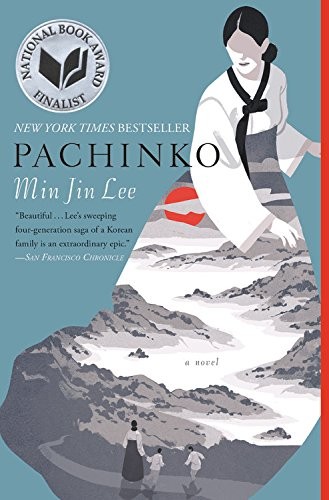
Pachinko
Grand Central Publishing · 2017 · 496 pages
ISBN: 9781455563920
🏆 National Book Award Finalist for Fiction (2017)
Medici Book Club Prize Winner
Dayton Literary Peace Prize Runner-Up
New York Times 10 Best Books of 2017
American Library Association Notable Book (2018)
New York Times 100 Best Books of the 21st Century (#15)
Review Editor
Eleanor Marsh
Pachinko, Min Jin Lee’s second novel, published in 2017 by Grand Central Publishing, follows four generations of a Korean family living in Japan across nearly eighty years. The story begins in 1910 in a small fishing village in Yeongdo, Korea, where a young woman named Sunja becomes pregnant by Hansu, a wealthy, married Korean businessman with ties to the yakuza. When a sickly but kind-hearted Christian minister named Isak offers to marry her and take her to Osaka, Sunja accepts, setting in motion a family saga that stretches from Japanese-occupied Korea through World War II and into the late 1980s. Lee spent nearly thirty years working on this novel, and the scope of that labor shows on every page. This is a book about what it costs to survive in a country that does not want you, and what that survival looks like when measured not in years but in generations.
At its core, Pachinko asks a deceptively simple question: what happens when a family’s entire existence is shaped by where they came from and where they can never fully belong? The Zainichi Koreans, ethnic Koreans born and raised in Japan, occupy a social position that most Western readers will find both unfamiliar and deeply recognizable. Lee uses the Baek family as her lens into this community, and through them, she builds something far larger than a single family’s story.
The novel’s title refers to the Japanese pinball gambling game that becomes central to the family’s livelihood in later generations. It also serves as a metaphor that Lee never overplays: lives, like pachinko balls, are launched into systems they cannot control, bouncing through channels of luck, prejudice, love, and economics before landing wherever gravity and chance decide.
Character Arcs and Development
Sunja is the novel’s gravitational center, even as the narrative expands to include her sons, her in-laws, and eventually her grandson. When we first meet her, she is a teenage girl helping her widowed mother run a boarding house. Her arc is not a dramatic transformation so much as an accumulation. Each decade adds weight to her, and Lee tracks this with patient attention to the physical details of Sunja’s labor: the kimchi she makes and sells at markets, the meals she stretches to feed a family during wartime. Sunja does not become a different person; she becomes more deeply, more stubbornly herself.
Her two sons, Noa and Mozasu, represent two divergent responses to the same impossible position. Noa is brilliant, reserved, and desperate to assimilate. Mozasu is practical, warm, and unapologetic. He goes into the pachinko business because that is one of the few industries open to Koreans in Japan. The contrast between the brothers is one of the novel’s most compelling tensions. Noa’s story builds toward a revelation that carries enormous emotional force.
The supporting cast is equally well-drawn. Isak, the minister, has genuine complexity: his faith is sincere but also a form of avoidance. Hansu loves Sunja in a possessive, transactional way. Kyunghee, Sunja’s sister-in-law, is the novel’s quiet revelation: a woman whose kindness is a deliberate, daily choice.
Pacing
Pachinko moves at the pace of a family chronicle. Lee builds the story through the rhythms of daily life: meals cooked, businesses opened, children born, loved ones buried. There are dramatic events, but Lee rarely lingers on spectacle. She is more interested in what happens the morning after the crisis.
If the novel has a structural weakness, it is in the fourth generation. Solomon’s storyline feels thinner than what came before. Lee compensates by weaving his chapters with Sunja’s late-life reflections, which ground the novel’s final movement in earned emotion.
Deeper Thematic Exploration
The question that animates every page is whether belonging is something you earn or something granted to you. The Zainichi Koreans face discrimination that is both systemic and intimate. Lee shows it in specific humiliations: the landlord who refuses to rent to a Korean family, the schoolyard taunts, the banking system that treats Korean applicants as risks.
What makes Lee’s treatment so effective is her refusal to reduce characters to their suffering. They fall in love, argue about money, eat good food, build businesses. Lee insists on their full humanity, and this insistence is itself a political act.
The novel wrestles with assimilation versus identity. Noa’s erasure of himself becomes the novel’s most devastating strand. Mozasu’s success in pachinko comes with its own compromises. There is no clean answer, no path through discrimination that does not extract some price.
Lee is also interested in the economics of survival. Money is never abstract. It is the kimchi Sunja sells to feed her children, the candy Mozasu trades as a boy, the real estate deal that defines Solomon’s young adulthood.
Style and Voice
Lee writes in clean, declarative prose that favors clarity over ornamentation. Her sentences are direct, her paragraphs economical. This style serves the novel’s scope well. She has a gift for the telling detail: the way a character folds their hands, the specific ingredients in a meal. These small observations accumulate into a textured world that feels lived-in.
The narrative perspective shifts across chapters, moving between characters and time periods with confidence. Even when the prose maintains its characteristic restraint, Lee finds moments of startling emotional directness, particularly in Sunja’s later chapters.
Verdict
Pachinko is a novel that earns its length and its ambition. Lee has written a family story that doubles as a history lesson, a meditation on identity, and a quiet argument for the dignity of ordinary lives lived under extraordinary pressure. Solomon’s sections lack the gravitational pull of earlier generations, but these are minor complaints against a work of such scope and compassion.
If you have any interest in Korean history, the immigrant experience, family sagas, or fiction that insists on the complexity of people too often reduced to stereotypes, Pachinko belongs on your shelf. Read it with patience, and it will reward you with something close to wisdom.
Frequently Asked Questions about Pachinko
What is Pachinko by Min Jin Lee about?
Pachinko follows four generations of a Korean family living in Japan from 1910 to 1989. It begins when Sunja becomes pregnant and marries a Christian minister who takes her to Osaka. The novel traces the family as they navigate poverty, discrimination, war, and the struggle to build a life in a country that treats them as permanent outsiders.
Is Pachinko based on a true story?
Pachinko is fiction, but deeply grounded in the real history of Zainichi Koreans. Min Jin Lee spent nearly thirty years researching and writing the novel. The historical events depicted are all factual, though the characters are invented.
What are the main themes in Pachinko?
The central themes include identity and belonging, the economics of survival for marginalized communities, the tension between assimilation and cultural preservation, the bonds and burdens of family across generations, and the role of chance and systemic forces in shaping individual lives.
How long is Pachinko and is it a difficult read?
Pachinko is 496 pages. The prose is clean and accessible. Most readers find it absorbing once they settle into its rhythm, though the large cast across multiple generations may require some attention early on.
Is there a TV adaptation of Pachinko?
Yes. Apple TV+ released a television adaptation in March 2022, created by Soo Hugh. The series stars Lee Min-ho, Youn Yuh-jung, and Kim Min-ha, filmed in Korean, Japanese, and English. It received critical acclaim and was renewed for additional seasons.
What age group is Pachinko appropriate for?
Pachinko is written for adult readers, suitable for ages 16 and up. It contains some mature content but nothing graphic or gratuitous. It is frequently assigned in college courses and advanced high school literature classes.
How does Pachinko compare to Min Jin Lee’s other novels?
Pachinko is Lee’s second novel after Free Food for Millionaires (2007). Pachinko is far more ambitious in scope, spanning four generations and nearly a century. Most readers consider Pachinko the stronger work.
Should I read Pachinko and is it worth it?
If you enjoy sweeping family sagas, historical fiction, or novels that illuminate unfamiliar corners of the world, absolutely. Readers who loved A Fine Balance, Homegoing, or The Joy Luck Club will find a kindred spirit here.
Book Details
- Title
- Pachinko
- Author
- Min Jin Lee
- Genre
- Literary Fiction
- Publisher
- Grand Central Publishing
- Year Published
- 2017
- Pages
- 496
- ISBN
- 9781455563920
- Awards
- 🏆 National Book Award Finalist for Fiction (2017) Medici Book Club Prize Winner Dayton Literary Peace Prize Runner-Up New York Times 10 Best Books of 2017 American Library Association Notable Book (2018) New York Times 100 Best Books of the 21st Century (#15)
- WritersReview Rating
- 5.0 / 5