
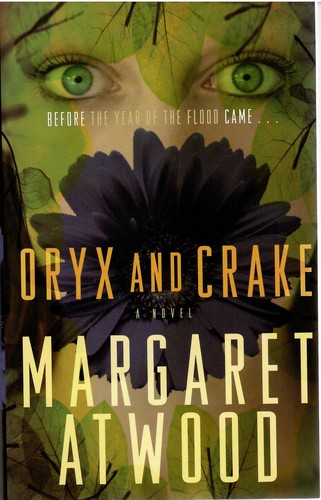
Oryx and Crake
Nan A. Talese/Doubleday · 2003 · 389 pages
ISBN: 9780385721677
Review Editor
Marcus Webb
Published in 2003, Oryx and Crake is the first novel in Margaret Atwood’s MaddAddam trilogy. Set in a near-future North America dominated by biotech corporations, the novel opens on a man calling himself Snowman, the last human being on earth as far as he can tell. He lives at the edge of a settlement of humanoid creatures called Crakers, beings engineered by a corporate genius to be gentle, environmentally harmonious, and free from the worst impulses that plagued their makers. Snowman is their reluctant prophet, spinning stories about the god Crake and the goddess Oryx to explain a world the Crakers were never designed to question.
The novel moves in two streams: Snowman’s bleak present, where he is starving and slowly losing his grip on sanity, and the long flashback that explains how he got there. In the past he was Jimmy, the humanities-minded son of a genetic engineer, growing up inside the walled compounds of corporations like HelthWyzer and OrganInc. These companies sold life extension, custom organs, and pharmaceutical dreams to the privileged while the outside world, the “pleeblands,” deteriorated. His best friend was Glenn, a science prodigy who renamed himself Crake and eventually achieved something no one in human history had attempted: the deliberate extinction of his own species.
Oryx, the third vertex of the novel’s triangle, enters Jimmy’s consciousness first as a child in an illegal video, then later as Crake’s lover and the Crakers’ teacher, and finally as the woman whose memory Snowman carries through every waking hour. She is described as likely originating from South or Southeast Asia, sold by her family as a small child, and passed through a series of exploitative arrangements before Crake finds her and gives her a name and a job. She teaches the Crakers about the world they live in with a calm that neither Jimmy nor the reader can fully decipher. What she actually thinks about any of this remains, deliberately, out of reach.
Atwood started writing the novel in early 2001, during a book tour for The Blind Assassin, after watching red-necked crakes in Australia. She paused after September 11, then completed it for publication in 2003. The timing matters: this is a novel written during a period when questions about corporate power, bioethics, and environmental collapse were shifting from academic to urgent. It shows in every chapter.
Character Arcs and Development
Jimmy/Snowman is the emotional anchor of the novel, and Atwood draws him with real complexity. He is not heroic. He is impulsive, self-pitying, capable of small cruelties, and painfully aware of his secondary status in every room he enters. He knows he is the “word person” in a world that has decided words matter less than genes. What makes him worth following across 400 pages is his persistent, inarticulate attachment to the people he loves and his almost comic inability to do anything useful about it. He watches the world end and makes jokes he knows no one will remember.
Crake is the novel’s most intellectually charged creation: a cold, methodical genius who concludes that human nature is the problem requiring a solution. Atwood is careful not to make him a cartoon. He genuinely cares about the planet. He understands the brutality embedded in the existing order and decides, with the logic of someone who has never quite grasped why other people’s feelings should override his calculations, to replace it. The novel is most uncomfortable in the moments when Crake’s reasoning seems, at the edges, impossible to entirely dismiss.
Oryx is the weakest of the three central figures, and her relative thinness on the page has drawn sustained critical attention. Whether this reflects deliberate design, a comment on how men perceive women from impoverished backgrounds, or a genuine characterization gap depends on what you bring to the reading. What is not in dispute is that Oryx gets fewer pages than she deserves. Secondary figures fare better: Jimmy’s depressive mother, his compromised father, and various compound dwellers come alive through the specific, small details Atwood deploys with precision.
Pacing
The novel builds carefully and earns your patience. The first hundred pages ask you to trust that the dual timelines will eventually lock together, and the trust is rewarded. Atwood uses Snowman’s present-tense journey toward the ruins of a compound as a structural clock that prevents the flashback sections from sprawling. The middle section, covering Jimmy and Crake’s late teens and early twenties as they move through institutes and compounds, is where the world-building is richest and the satirical imagination runs hottest. There is genuine wit in the corporate compound names (HelthWyzer, RejoovenEsense, AnooYoo) and in the technologies her characters take for granted: the pigoons, the wolvogs, the ChickieNobs. These passages sustain their pace because the weirdness is always grounded in something recognizable.
What does sag slightly is the final convergence, when the disaster Snowman has been circling arrives at Crake’s compound. The violence comes quickly, perhaps too quickly for a novel that has taken such care to build its world. The ambiguous final image is haunting but leaves some readers feeling deprived of something they cannot quite name. This is a novel where the setup is stronger than the landing.
Deeper Thematic Exploration
The central tension in Oryx and Crake runs between Jimmy’s training in the humanities and Crake’s supremacy in the sciences, and Atwood uses this contrast to ask what is lost when a civilization decides that only measurable things matter. Jimmy’s field, rhetoric, history, and poetry, is treated as a joke by every institution he moves through. It turns out to be the only tool capable of giving the Crakers’ world any meaning after the catastrophe. Stories are what survive. The novel makes this argument quietly, without sentiment, which makes it more persuasive.
Beneath this is a serious engagement with the nature of corporate power. The compounds in Oryx and Crake are not tyrannies in the way Gilead is in The Handmaid’s Tale. They are more insidious, organized around comfort, research grants, and voluntary participation. The people inside them chose to be there. The violence of the system is largely invisible to those it benefits most, which is exactly what makes the novel feel current. Atwood published it in 2003, and its imagery of gated scientific communities, pharmaceutical monopolies, and environmental collapse has not dated in any meaningful way.
The novel also asks uncomfortable questions about obsession and love, particularly in Jimmy’s fixation on Oryx, whom he first encounters as a child being exploited. Atwood does not resolve this cleanly. The love story is real, pathetic, and morally tangled in ways that persist long after the book ends. There is no safe reading of it.
Finally, there are the Crakers themselves, Crake’s engineered successors, who are genuinely alien. They live without jealousy, make music without understanding it, and regard Snowman as a creature of baffling tragedy. Their innocence is not stupidity; it is the product of thousands of deliberate edits. Atwood asks whether a species that is incapable of cruelty is still recognizably human, and she declines to give a comfortable answer. This is the question that lingers longest after the novel ends.
Style and Voice
Atwood’s prose in Oryx and Crake is disciplined and dry, shifting registers with ease. The present-tense Snowman sections have a lean, depleted quality that suits his situation: short sentences, interrupted thoughts, gallows humor deployed as armor. The flashback sections open up into something more expansive, with room for irony and the controlled baroque weirdness of the world she has built. Corporate advertising language, invented here for products like BlyssPluss and HelthWyzer’s recruitment materials, is instantly recognizable as a heightened version of the language already circulating in the early 2000s. The comedy lands because it is not far enough from the truth to be comfortable.
The novel’s intertextual layers include nods to Coleridge’s Rime of the Ancient Mariner, to Hamlet’s revenge structure, and to the Book of Genesis. These are worn lightly and reward attention without demanding it. Atwood trusts her reader. What distinguishes the voice throughout is its refusal to explain more than it needs to: the novel respects the intelligence of the person reading it, and that respect is part of what makes the difficult material bearable.
Verdict
Oryx and Crake is a necessary novel and a genuinely unsettling one. It is not a thriller about a pandemic; it is a novel about the conditions that make catastrophe possible, told through a man who watched it happen and survived for reasons that haunt him more than his losses do. If you were gripped by The Handmaid’s Tale and want to see what Atwood does when she turns her attention from patriarchal institutions to corporate ones, this is the book to read next. The BBC named it one of the 100 most influential novels of the 20th and 21st centuries; the Guardian placed it among the 100 best books of the 21st century. Neither list is wrong.
The character of Oryx is a persistent limitation, and readers who want emotional catharsis in the final pages may find the novel’s deliberately ambiguous ending unsatisfying. But if you are willing to sit with open questions, Atwood rewards the patience. The sequels, The Year of the Flood and MaddAddam, add dimensions that make the trilogy cumulatively stronger than any single volume. You can read this one on its own, but there is a reasonable chance you will not want to stop here.
Frequently Asked Questions about Oryx and Crake
What is Oryx and Crake by Margaret Atwood about?
Oryx and Crake is a 2003 speculative fiction novel set in a near-future world controlled by biotech corporations. The story follows Snowman, who appears to be the last surviving human being, and unfolds in two timelines: Snowman’s bleak present, living among a species of engineered post-human creatures called Crakers, and the long flashback revealing how his brilliant, dangerous childhood friend Crake engineered the extinction of humanity. Love, obsession, corporate power, and ecological collapse run through both storylines.
Is Oryx and Crake science fiction or literary fiction?
Margaret Atwood herself describes the novel as “speculative fiction” rather than science fiction, because it depicts technologies that were already emerging or scientifically plausible at the time of writing. It sits comfortably in both categories. The prose quality and thematic ambition place it squarely in the literary fiction tradition, while the biotech world-building and post-apocalyptic premise make it equally at home among the best science fiction of the 2000s.
What are the main themes in Oryx and Crake?
The novel’s central themes include the ethics of genetic engineering and corporate-funded science, the value of the humanities in a society that has come to dismiss them, environmental destruction as an inevitable consequence of short-term thinking, and the moral complexity of love and obsession. Running through all of these is a persistent question: what, exactly, makes us human, and whether anything survives once those qualities are edited out or extinguished.
How long is Oryx and Crake and is it a difficult read?
The Anchor Books paperback runs 389 pages. The prose is clear and propulsive, and the novel is not difficult in the sense of requiring specialist knowledge. The nonlinear structure, alternating between Snowman’s present and Jimmy’s past, requires some orientation in the first few chapters, but most readers find their footing quickly. The content includes graphic depictions of a degraded society, including child exploitation and global pandemic, which some readers find challenging regardless of prose difficulty.
Is there a movie or TV adaptation of Oryx and Crake?
No adaptation of Oryx and Crake or the MaddAddam trilogy has been released as of 2025. A television adaptation has been in development for years, with Darren Aronofsky attached as executive producer. The project was initially developed for HBO, then moved to Paramount Television and Anonymous Content in 2018, with scripts already written. A 2023 opera adaptation, with music by Soren Nils Eichberg, premiered at the Hessisches Staatstheater Wiesbaden in Germany.
What age group or reading level is Oryx and Crake for?
Oryx and Crake is written for adult readers. The novel depicts child exploitation, graphic violence, and sexual content, and has been banned from several US school districts and state library systems because of this material. It is a novel for mature readers who are prepared for a story that does not flinch from depicting a world in serious moral decline. Most readers encounter it in college or in adult life, and it is widely taught in university literature and environmental studies courses.
How does Oryx and Crake compare to The Handmaid’s Tale by Margaret Atwood?
Both novels present near-future dystopias grounded in systems of power that feel like extensions of present-day trends, but they diagnose different diseases. The Handmaid’s Tale focuses on patriarchal religious theocracy; Oryx and Crake focuses on corporate-scientific power and environmental collapse. The Handmaid’s Tale has a clearer, more emotionally direct protagonist in Offred, while Oryx and Crake is structurally more complex and intellectually cooler. Readers who prefer emotional intensity tend to prefer The Handmaid’s Tale; readers who prefer ideas and dark humor often find Oryx and Crake the more interesting book.
Should I read Oryx and Crake and is it worth it?
Yes, particularly if you are interested in where corporate-driven technological ambition, genetic engineering, and environmental neglect are heading. Atwood built a world in 2003 that has only become more relevant since. The novel rewards readers who are comfortable with ambiguity: the ending is open, the moral center is unstable, and the love story is more disturbing than comforting. If you want something that takes its subject seriously without reaching for easy answers, this is worth your time.
Book Details
- Title
- Oryx and Crake
- Author
- Margaret Atwood
- Genre
- Science Fiction
- Publisher
- Nan A. Talese/Doubleday
- Year Published
- 2003
- Pages
- 389
- ISBN
- 9780385721677
- WritersReview Rating
- 4.3 / 5