
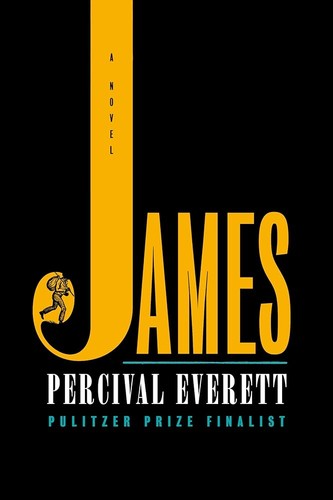
Percival Everett has been writing fierce, funny, philosophically ambitious novels for more than four decades, but James, published in March 2024 by Doubleday, is the book that made the wider literary world pay attention all at once. It won the 2024 Kirkus Prize, the 2024 National Book Award for Fiction, and the 2025 Pulitzer Prize for Fiction. The premise is disarmingly simple: take Mark Twain’s Adventures of Huckleberry Finn, a novel that nearly every American has encountered in school, and retell it from the perspective of Jim, the enslaved man at its center.
Except that Everett’s Jim is not Twain’s Jim. In Twain’s novel, Jim is portrayed as credulous, superstitious, and simple-minded, redeemed primarily by his loyalty and warmth. Everett’s Jim, who eventually reclaims the name James, is secretly one of the most educated people in his community. He reads philosophy in Judge Thatcher’s library while pretending to be illiterate. He speaks Standard English fluently with other enslaved people, debating Locke and Voltaire in their company, and switches to an exaggerated dialect the moment any white person enters the room. His apparent simplicity is not his character. It is his armor.
The novel begins in Hannibal, Missouri, in the weeks before Huck Finn fakes his own death. Jim learns that his owner, Miss Watson, plans to sell him downriver, and he flees to Jackson Island, where he soon encounters Huck, who has staged his disappearance to escape an abusive father. From there, the two take to the Mississippi on a raft, moving through a landscape of danger and occasional grace, encountering the con men known as the King and the Duke, surviving floods, and testing the limits of trust across a racial divide that neither of them fully understands. Everett follows the skeleton of Twain’s plot closely enough that readers who know the original will recognize the scenery, while transforming almost everything that happens inside it.
Character Arcs and Development
Jim is one of the most fully realized characters in recent American fiction, and Everett refuses to make him a symbol or a saint. He is calculating, sometimes ruthless, and capable of a dry, bone-dry humor that makes you laugh and then feel slightly ashamed of laughing. He is also, in the simplest terms, a father trying to get back to his family. His arc is the arc of a person deciding how much longer he can perform a role that keeps him alive but costs him something essential every single day. The novel’s great suspense is not physical, or not only physical. It is the question of when and whether Jim will stop performing, and what it will cost him when he does.
Huck, in Everett’s version, is more morally complicated than Twain’s boy adventurer. He is still endearing, still capable of surprising decency, but Everett is interested in the limits of that decency, in how much a kind-hearted person can be complicit in an ugly system simply by accepting its terms as normal. The relationship between Jim and Huck deepens in ways the novel does not telegraph in advance, and their bond is tested by secrets that cut in both directions. Secondary characters get sharper edges here. The King and the Duke are recognizable from Twain as shameless charlatans, but Everett draws them with a more deliberate malice, a quality of threat that keeps you genuinely uneasy whenever they reappear.
Norman, a former enslaved man who now passes for white, enters later in the narrative and becomes one of its most quietly devastating presences. His exhaustion, the cost of living inside a false identity, rhymes with Jim’s own performed self in ways that give the novel genuine psychological complexity. The minor enslaved characters scattered throughout, each surviving by different calculations, each carrying a different version of the same fundamental burden, give the world of the novel a texture and a density that Twain’s version, filtered through Huck’s limited and partial vantage point, simply could not have achieved. They know things Huck does not know. The whole book is built on this irony: the person we thought we were following through American history was following someone whose full story we had never been permitted to hear.
Pacing
The novel moves in the picaresque mode, episodic by design, each section bringing a new situation, a new set of dangers, a new cast of people for Jim to read and respond to. This structure mirrors Twain’s original, but Everett is more willing to slow down inside Jim’s interior life, to let him sit with a philosophical problem or a moral quandary for several pages. The prose earns these pauses; they are not padding, but genuine thinking-on-the-page.
A middle section involving a minstrel troupe, while thematically among the richest passages in the book, does test the reader’s patience. The narrative turns more allegorical here, and the forward momentum that carries you through the first half goes a bit slack. Readers who want the novel to hum along at thriller speed may find this stretch demanding. This is a complaint about architecture more than execution. Everett knows exactly what he is doing, and the slowdown serves the book’s larger argument about performance and commodification. The final third accelerates sharply and closes with a force that earns everything the middle section asked you to wait for.
Deeper Thematic Exploration
The book’s central formal device, Jim’s deliberate code-switching, is not just a character detail. It is the argument. From the novel’s opening pages, we watch Jim and the other enslaved characters speak among themselves in full, articulate, sometimes biting language, then perform ignorance the moment a white face appears. This is not subservience. It is a survival strategy calibrated to keep them all alive, and Everett renders it with a precision that makes the labor of it viscerally apparent. The constant vigilance required, the way it carves away at a person’s sense of self over a lifetime, is the novel’s most sustained emotional subject.
Running alongside that theme is a meditation on literacy and selfhood. Jim reads Voltaire, Locke, and other Enlightenment philosophers in secret, and Everett uses these readings to stage a series of fever-dream philosophical debates that are among the most audacious passages in contemporary American fiction. Jim arguing with a hallucinated Voltaire about polygenism, about who gets to advocate for whose freedom, is not a digression from the adventure plot. It is the whole point. The Enlightenment declared all men equal and then built elaborate intellectual frameworks to exclude most of them, and Everett is interested in what it does to a person who has read those frameworks and still has to serve dinner to the men who believe them. Jim does not conclude that the philosophers were simply wrong. He concludes something more uncomfortable: that they were right by their own terms, and that their terms were the problem.
The minstrel show sequence layers another dimension onto the code-switching theme. Jim ends up performing in Daniel Decatur Emmett’s troupe, performing exaggerated Blackness for white audiences who paid to see a caricature of what they already believed. Here is the commodification of Black performance made literally visible: the entertainment industry as an extension of the same logic that made Jim’s daily survival performance necessary in the first place. Everett does not drive this point home with a sledgehammer. He trusts the reader to feel the charge of what he has assembled, and the restraint makes it land harder.
Style and Voice
Everett writes clean, controlled prose that does not call attention to itself. Jim’s narrative voice is dry and precise, occasionally sardonic, capable of both tenderness and devastating understatement. The gap between Jim’s inner voice and his performed speech creates a kind of double register on the page, and Everett deploys it with technical precision. You can feel the effort of each switch, the small act of self-erasure it requires, because you have already heard how Jim actually thinks and speaks.
One passage early in the novel, in which Jim considers the verb “to be” and what it means to have your existence defined by someone else’s language, is extraordinary. The philosophical interludes are formally risky, the kind of choice that some readers will find exhilarating and others will find jarring. They work because Everett earns them, establishing Jim’s intellectual life so thoroughly that his dream-debates with Enlightenment philosophers feel like a natural extension of how he processes the world rather than an authorial intrusion.
Verdict
You do not need to have read Adventures of Huckleberry Finn to love James, though knowing the original makes the experience richer in the same way that knowing a song deepens your response to a brilliant, fundamentally different version of it. Everett has written a novel that stands entirely on its own terms, powered by one of the most compelling protagonists in recent memory. If you want a book about race, identity, and the performance of selfhood that does not moralize or condescend, this is the one. If you want a novel with a protagonist who earns his transformation on the page rather than just having it happen to him, this is that too.
The middle section requires patience, and the philosophical dream sequences are not for every reader. But the final act is among the most quietly devastating stretches of American fiction published in this decade. James is the kind of book that changes how you read everything that came before it, including, especially, the book it was built upon.
Frequently Asked Questions about James by Percival Everett
What is James by Percival Everett about?
James is a reimagining of Mark Twain’s Adventures of Huckleberry Finn told from the perspective of Jim, the enslaved man at the center of Twain’s novel. In Everett’s version, Jim (who reclaims the name James) is secretly educated and code-switches between eloquent speech with other enslaved people and performed ignorance in front of white people. The novel follows him fleeing potential sale, traveling with Huck Finn down the Mississippi, and navigating a dangerous antebellum America while searching for a way to reunite with his family.
Do I need to have read Huckleberry Finn before reading James?
No. Everett’s novel works as a completely standalone story, and many readers encounter it without any prior knowledge of Twain’s original. That said, familiarity with Huckleberry Finn deepens the experience considerably, because Everett is in active conversation with Twain’s text, recontextualizing scenes and characters in ways that resonate more fully when you know the source. Either way, James delivers on its own terms.
What awards has James by Percival Everett won?
James won the 2024 Kirkus Prize for Fiction, the 2024 National Book Award for Fiction, and the 2025 Pulitzer Prize for Fiction. It was also a finalist for the 2024 Booker Prize and the PEN/Faulkner Award, and appeared on more than 30 best-of-year lists. Universal Pictures and Amblin Entertainment acquired the film rights in 2024, with Steven Spielberg attached as executive producer.
What are the main themes in James by Percival Everett?
The central themes are racial performance and code-switching, the relationship between literacy and selfhood, and the limits of Enlightenment liberalism when applied to those the Enlightenment excluded. The novel also explores complicity, asking how much a decent person can participate in an unjust system simply by accepting its terms. A subtler thread concerns the commodification of Black performance, dramatized through a minstrel show sequence in the middle of the book.
How long is James and is it a difficult read?
James is 320 pages and reads quickly despite its serious subject matter. Everett writes in a clean, propulsive prose style, and most readers will finish the novel in three to five sittings. The middle section involving a minstrel troupe turns more allegorical and philosophical, and there are several fever-dream sequences in which Jim debates figures like Voltaire. These passages reward attention but may slow down readers looking for straightforward plot momentum.
Is there a movie adaptation of James by Percival Everett?
As of 2024, Universal Pictures and Amblin Entertainment acquired the feature film rights to James, with Steven Spielberg attached as executive producer. Director Taika Waititi was reported to be in early talks to helm the project. No release date had been announced at the time of this review, but the acquisition signals significant Hollywood interest in bringing the novel to screen.
How does James compare to Percival Everett’s other books?
Everett has published more than 20 novels, many of them critically admired but little read outside literary circles. His 2021 novel The Trees, a savage satire about racial violence, was shortlisted for the Booker Prize and gave him his first taste of wide readership. James represents a different register from much of his earlier work: more emotionally direct, less satirically combative, and built around a protagonist whose interiority holds the entire novel together. Many readers who loved James have gone on to discover his earlier books, which are consistently worth the effort.
Should I read James by Percival Everett and is it worth it?
Yes, without reservation, if you are interested in American history, literary reinvention, or simply in a novel with a protagonist who feels fully alive on every page. James is the rare book that is both hugely readable and genuinely demanding, and it earns every award it has received. Readers who want fast-paced plot above everything else may struggle with the philosophical middle section, but for anyone willing to move at the novel’s own pace, it is one of the most rewarding reading experiences of recent years.
Book Details
- Title
- James
- Author
- Percival Everett
- Genre
- Science Fiction
- Publisher
- Doubleday
- Year Published
- 2024
- Pages
- 320
- ISBN
- 9780385550369
- WritersReview Rating
- 5.0 / 5