
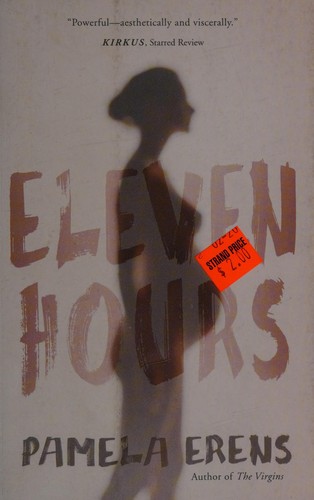
Eleven Hours
Tin House Books · 2016 · 165 pages
ISBN: 9781941040294
Review Editor
Eleanor Marsh
Summary
Pamela Erens’s third novel, published by Tin House Books in 2016, takes a single setting and holds it for the length of the book. Eleven Hours unfolds entirely in a hospital labor and delivery ward over the course of, as the title announces, eleven hours. The novel follows two women: Lore Atlas, who arrives at the hospital alone and in early labor, and Frannie Perez, the nurse assigned to her care. We stay in this room for the duration. The world outside barely intrudes.
Lore is in her early thirties, having a first baby. The relationship with her partner has just ended, abruptly and badly, and she is navigating labor without him. Frannie has her own history, which the novel reveals in pieces; she is experienced, careful, and carries something private that shapes how she responds to the situation in front of her. The eleven hours of the title are not quite real-time (the narrative compresses and expands as Erens needs), but the effect is something close to it: the reader experiences the labor alongside both women, in the present tense, without the safety of retrospective distance.
At 165 pages, this is a short novel. The compression is deliberate. Erens has said in interviews that she was interested in the experience of labor as a subject almost entirely absent from literary fiction despite being one of the most transformative physical experiences that human beings can go through, and she wanted to write about it with the same seriousness she would bring to any other extreme human experience. The result is a book that is harder to classify and harder to forget than its premise might suggest.
Character Arcs and Development
Lore arrives at the hospital guarded and alone. She has a birth plan. She has done her research. She is, at the outset, the kind of person who tries to manage what happens to her by knowing things about it in advance. Labor, of course, does not respect plans, and much of her arc across the novel is the arc of someone slowly having their defenses dismantled by a process that does not care about them. This is not a sentimental transformation; Erens does not let Lore become soft or teachable in the way that genre convention might demand. What shifts in her is more subtle: a loosening, a willingness to accept help, an acknowledgment that control was always partly fiction.
Frannie is the more internally complex figure. She is a skilled and compassionate nurse who also has specific reasons for finding this particular shift difficult, reasons the novel parcels out carefully. Her professionalism is genuine, not a mask for coldness; she actually cares about Lore and about the labor’s outcome. But Erens gives her enough interior life that she is not simply a support character for Lore’s experience. She has her own relationship with birth and loss, her own reasons for being in this room on this night, and the novel honors both women equally.
The relationship between Lore and Frannie is not quite friendship, not quite the relationship between a patient and a healthcare provider, and not quite the relationship between strangers thrown together by circumstance. It is all three things at once, and Erens handles its development with care and honesty. There is no false resolution to the structural inequalities between them (race, class, the power differential of nurse and patient), but something real grows between them within those constraints. The secondary character of a resident who assists late in the labor is handled with brevity but also with specificity.
Pacing
The formal constraint of the single setting and near-real-time narration creates its own momentum. Eleven Hours never drags despite being entirely without the scene changes, time jumps, and subplot diversions that most novels use to vary their rhythm. Erens understands that labor has its own natural pacing structure: the intervals between contractions, the intensification as the hours pass, the specific textures of early labor versus transition versus pushing. She uses this structure rather than fighting it, and the result is a novel that moves like the process it describes: sometimes waiting, sometimes overwhelming.
The backstory for both women is woven into the present-tense narration without feeling like interruption. Erens uses the gaps between contractions and the lulls between crises to give the reader what it needs to know about both characters’ histories. At no point does the novel feel like it is stopping to provide information; the backstory arrives when it arrives because that is when the character’s mind goes there.
Deeper Thematic Exploration
The novel’s most obvious subject is the body, specifically the female body, as a site of extraordinary experience that literary fiction has largely ignored or softened. Erens writes labor without euphemism or romanticization and also without horror-movie excess. She simply describes what happens in careful, honest detail, and the effect is both illuminating and quietly political. This is something that happens to a very large number of people. It has been treated in most literary fiction as either backdrop or crisis. Erens makes it the whole thing, and in doing so she implicitly argues for its significance.
But the novel is also about race and class in American medicine. Frannie is a Black woman and Lore is white, and Erens handles this with care: she does not pretend the difference is irrelevant, but she also does not reduce either woman to a representative of her demographic position. The structural inequalities are present, acknowledged, and neither dissolved nor made the explicit subject of the book. The novel trusts the reader to see them.
There is also a thread about what trust looks like between people who have no particular reason to trust each other. Lore has to trust Frannie with her body, which is a specific and unusual kind of trust. Frannie has to trust her own judgment in a high-stakes medical situation while also being genuinely present with another human being in distress. The novel is interested in what happens when professional competence and human connection are not just compatible but necessary to each other.
And underneath all of this runs a meditation on loss: on the specific forms of loss that surround birth, on what it means to become a parent without the support you expected to have, and on how people carry previous losses into new experiences without being defined by them. This is handled lightly and never becomes the explicit subject, but it gives the novel its emotional depth.
Style and Voice
Erens writes in present tense throughout, which is the right choice for this material. It keeps the reader inside the experience rather than receiving it retrospectively. The narration moves between close third-person for Lore and close third-person for Frannie, sometimes within the same page, with transitions that are handled smoothly enough that the shifts rarely feel mechanical.
The prose style is precise and sensory without being ornate. Erens names things accurately, including medical things, without turning the novel into a clinical document. She finds the emotional register inside the physical description rather than keeping them separate. A contraction is described as a physical event and simultaneously as an emotional one, and the two aspects illuminate each other. There are sentences in this novel that manage to be completely plain and completely surprising at the same time, which is a hard thing to pull off.
Compared to Erens’s other novels (The Understory, The Virgins), Eleven Hours is the most formally constrained and arguably the most confident. The Virgins showed a writer with strong instincts working toward something; Eleven Hours shows a writer who has figured out exactly what she wants to do and knows how to do it.
Verdict
Eleven Hours is a short novel that takes a surprising subject seriously and does something genuinely new with it. It is not for readers who want sweep or event or the kind of narrative satisfaction that comes from large arcs and multiple storylines. What it offers instead is an unusually close and honest account of an extreme human experience, and two characters drawn with enough specificity and care that the reader carries them out of the book.
The strongest recommendation for this novel is probably the simplest one: it does something that almost no other literary novel does, and it does it well. If that is not enough to interest you, the book is short enough that finding out whether it connects is not a large investment. Readers who have given birth or been present for births will find it different from most fiction about the subject; readers who have not will find it illuminating in ways that are harder to anticipate.
Frequently Asked Questions about Eleven Hours
What is Eleven Hours by Pamela Erens about?
Eleven Hours is a novel set entirely in a hospital labor and delivery ward over eleven hours. It follows two women: Lore Atlas, who arrives alone to give birth after her relationship has just ended, and Frannie Perez, her labor nurse. The novel unfolds in something close to real time, tracking both the physical progress of labor and the developing relationship between these two very different women.
Is Eleven Hours fiction or memoir?
It is fiction. Pamela Erens has not written about her own labor experiences in a memoir context; Eleven Hours is a fully imagined work. The novel’s specificity and intimacy come from careful research and from Erens’s attention to embodied experience, not from autobiography. It reads with the density of lived experience without being autobiographical.
How long is Eleven Hours and is it a quick read?
The novel is 165 pages. Most readers will finish it in a single sitting or across two evenings. It is not a difficult read in terms of prose style, but it is an intense one. The present-tense narration and compressed timeframe create a kind of sustained attention that makes it feel longer than its page count, in the good sense.
Is Eleven Hours appropriate for readers who are pregnant or have recently given birth?
The novel is honest and unflinching about the pain and risk of labor, including complications. It does not sensationalize, but it does not soften either. Readers who are currently pregnant or who have recently had difficult birth experiences should know what they are getting into. That said, many readers who have given birth report finding it cathartic and validating rather than distressing.
What are the main themes in Eleven Hours?
The central themes include the female body as a serious literary subject, trust between strangers in extreme circumstances, race and class in American healthcare, and loss in its various forms. The novel is also about professional care and human connection as things that reinforce rather than undermine each other, and about how people manage experiences for which no amount of preparation is entirely sufficient.
Is there a movie or TV adaptation of Eleven Hours?
There is no known film or television adaptation of Eleven Hours as of 2026. The novel’s formal constraints (single setting, near-real-time narration, interior focus) make it somewhat challenging to adapt directly, though the material is not impossible for film.
How does Eleven Hours compare to Pamela Erens’s other novels?
Erens is also the author of The Understory and The Virgins. Eleven Hours is generally considered her most formally ambitious and concentrated work. The constraint of the single setting and real-time structure produces an intensity that distinguishes it within her writing. Readers who connect with Eleven Hours and want more would do well to read The Virgins next, which shares some of its psychological precision.
Should I read Eleven Hours and who will love it most?
Readers who value formally inventive literary fiction, who are interested in the body as a subject for serious writing, and who can appreciate compression and restraint over sweep and event will find it rewarding. It is not a plot-driven novel. It is, instead, an unusually close account of an extreme human experience, and readers who want that kind of intimacy will find this one of the more distinctive literary novels of recent years.
Book Details
- Title
- Eleven Hours
- Author
- Pamela Erens
- Genre
- Literary Fiction
- Publisher
- Tin House Books
- Year Published
- 2016
- Pages
- 165
- ISBN
- 9781941040294
- WritersReview Rating
- 4.0 / 5