
Summary
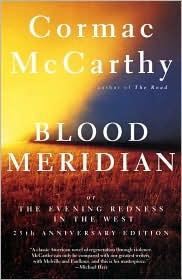
Cormac McCarthy published Blood Meridian in 1985, and it found almost no audience for years before critics began recognizing it as something exceptional. It is now regarded as one of the greatest American novels ever written, and it remains among the most challenging: violent to a degree that still shocks, philosophically dark in ways that offer no comfort, and written in prose of such sustained power that it seems to exist in a different register from most fiction.
The novel follows a teenager known only as “the kid,” a runaway from Tennessee who falls in with a band of scalp hunters in the mid-nineteenth century American Southwest and Mexican borderlands. The historical basis is the Glanton Gang, a real group of scalp hunters contracted by Mexican states to kill Apache raiders who slaughtered indiscriminately. At the center of the gang is Judge Holden, one of the most unsettling figures in American fiction: enormous, hairless, learned in geology and languages and law and violence, who moves through the massacres with a terrible serenity and a philosophy of war as the highest human activity.
The plot is a series of raids, massacres, journeys across brutal landscapes, and moments of strange beauty. It follows the loose picaresque logic of a Western, but the Western genre is a vehicle for something else: a confrontation with violence as a feature of American history and human nature rather than a problem to be solved.
Character Arcs and Development
The kid is deliberately underwritten. He has “a taste for mindless violence” established early, but as the novel progresses he becomes notable for small, intermittent gestures toward mercy in an environment that punishes mercy. He is not heroic. He does not transcend his circumstances. He is a witness, and his limitations as a witness are part of McCarthy’s point: this history was committed by people who were not exceptional, not uniquely evil, just present and compliant.
Judge Holden is one of the most fully realized monsters in American fiction. He is a philosopher of violence, not a cartoon of it: a figure who has thought through the implications of violence and arrived at a coherent, if monstrous, worldview. His long speeches about war and dominion are extraordinary set pieces, and they are genuinely disturbing because they are not simply insane. They are wrong, but they are argued.
Themes and Symbolism
Blood Meridian argues, through its structure rather than through statement, that violence is not an aberration in American history but its engine. The westward expansion was accomplished through systematic extermination, and the mythology of the frontier erases this. McCarthy refuses the erasure. The Glanton Gang is not an exception to the Western story but its logical extension, told without mythology.
The landscape is not backdrop but almost a character: the Sonoran Desert rendered as a place of genuine and indifferent beauty, utterly unmoved by the violence committed on its surface. McCarthy’s geological precision creates a temporal scale that dwarfs human history.
Writing Style and Craft
McCarthy’s prose here is the most sustained and extreme expression of his particular style: long sentences built from coordinated clauses with almost no punctuation, biblical cadences, an extraordinary vocabulary reaching back through the history of English, and a refusal to use quotation marks for dialogue. Some passages, particularly the dawn and sunset descriptions, are among the most beautiful writing in American literature. They appear without irony immediately before or after scenes of extreme violence, and the juxtaposition is purposeful.
Final Assessment
Blood Meridian is not a novel for every reader, and it would be dishonest to pretend otherwise. It is extraordinarily violent, philosophically bleak, and deliberately resistant to the comfort of conventional narrative. What it offers in return is prose of rare power, a confrontation with American history that refuses every available mythology, and a character in Judge Holden who is genuinely unlike anything else in American fiction.
FAQ
- What is Blood Meridian by Cormac McCarthy about?
- Blood Meridian follows “the kid,” a nameless teenage runaway who falls in with the Glanton Gang, a historical band of scalp hunters in the American Southwest and Mexican borderlands in the 1840s and 1850s. At its center is Judge Holden, a philosophically articulate figure who treats war as the highest human activity. The novel is a confrontation with violence as a structural feature of American history.
- Is Blood Meridian based on a true story?
- Yes, partially. The Glanton Gang was a real historical entity, and many events are drawn from the historical record, particularly Samuel Chamberlain’s memoir My Confession. Judge Holden may have been a real person. McCarthy takes these materials and transforms them into myth rather than historical fiction.
- Why is Blood Meridian considered so violent?
- The novel contains extended and graphic descriptions of massacre and murder, rendered without melodrama or moral distancing. McCarthy presents this violence with the same prose style as everything else, in long beautiful sentences, which prevents the reader from looking away. The violence is the point: it is what actually happened, and McCarthy refuses the comfortable narrative distances conventional historical fiction provides.
- Is Blood Meridian part of a series?
- No. It is a standalone novel. It shares thematic territory with McCarthy’s later work, particularly No Country for Old Men and The Road, but stands entirely alone as a work.
- How difficult is Blood Meridian to read?
- It is one of the most demanding novels in the American canon, for two reasons: the violence is extreme and sustained, and the prose style is dense with archaic vocabulary and almost no conventional narrative orientation. Readers coming to McCarthy for the first time may want to start with All the Pretty Horses or No Country for Old Men first.
- What is the significance of Judge Holden?
- Judge Holden is the novel’s philosophical center. He argues that war is the supreme human activity and that all human enterprise is ultimately reducible to the question of dominion over others. McCarthy gives him enough intelligence and rhetorical force that his worldview cannot simply be dismissed as madness, which is what makes him so disturbing.
- Should I read Blood Meridian?
- If you are a serious reader of American literature who can tolerate extreme violence and philosophical darkness, yes. If you are new to McCarthy or sensitive to graphic content, start elsewhere. For readers who can engage with it on its own terms, it offers something that genuinely changes the scale against which you measure other fiction.
Book Details
- Title
- Blood Meridian
- Author
- Cormac McCarthy
- Genre
- Literary Fiction
- Publisher
- Vintage Books
- ISBN
- 9780679728757
- WritersReview Rating
- 5.0 / 5