
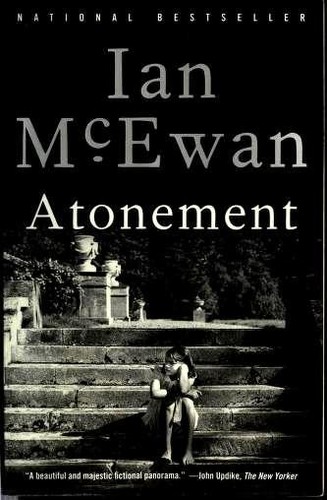
Atonement
Anchor Books · 2001 · 351 pages
ISBN: 9780385721790
🏆 WH Smith Literary Award (2002)
National Book Critics Circle Award for Fiction (2003)
Los Angeles Times Prize for Fiction (2003)
Santiago Prize for the European Novel (2004)
Shortlisted for the Booker Prize (2001)
Review Editor
Eleanor Marsh
Ian McEwan’s Atonement, first published in 2001, is a novel that operates on two frequencies at once: it is a sweeping story about love, war, and class in mid-twentieth-century England, and it is a ruthless interrogation of storytelling itself. The book opens on a blisteringly hot day in 1935 at the Tallis family’s Surrey estate, where thirteen-year-old Briony Tallis, an aspiring writer with a feverish imagination, witnesses a series of interactions between her older sister Cecilia and Robbie Turner, the housekeeper’s son. What Briony sees, and what she thinks she understands, sets in motion a lie that will shatter multiple lives.
Robbie, a Cambridge-educated young man whose tuition was paid by the Tallis patriarch, is on the cusp of a romance with Cecilia when Briony’s misinterpretation of events leads to a catastrophic false accusation. The consequences ripple outward: Robbie is sent to prison, then to the battlefields of France during the Second World War; Cecilia severs ties with her family; and Briony, growing older, begins to reckon with what she has done. The novel moves from the cloistered privilege of the Tallis estate to the horrors of the Dunkirk retreat to wartime London hospitals, tracking how a single act of a child’s imagination can unmake the world around it.
McEwan dedicates roughly a third of the novel to the events of that single summer day, a choice that might seem indulgent until you realize the whole book depends on it. Every detail of those hours matters because Briony’s crime is one of interpretation. She reads the world like a novelist, shaping what she sees into a story that fits her expectations. The slow, almost unbearable precision of that opening section is the point.
Character Arcs and Development
Briony Tallis is one of the most complex characters in contemporary fiction, and McEwan’s greatest achievement in this novel is making her neither villain nor victim but something harder to classify. At thirteen, she is precocious, controlling, and desperate for narrative order. She writes plays and stories with tidy morals. When the messiness of adult sexuality intrudes on her world, she reaches for the simplest available story: a villain, a damsel, a crime. The tragedy is that she is not malicious. She is a child doing what children with active imaginations do, but the stakes are real and the damage is irreversible.
As an older Briony, working as a wartime nurse, the character becomes something richer. McEwan shows her scrubbing floors and tending wounds with a penance that is both admirable and suspect. Is she atoning, or is she constructing another narrative in which she gets to be the heroine of her own redemption? The novel refuses to let that question resolve cleanly. Even in the final section, when Briony is an elderly novelist looking back on her life, the reader is left uncertain about how much of what came before was truth and how much was another act of authorial shaping.
McEwan draws Cecilia and Robbie with tremendous clarity, though the novel gives them less interior space than Briony. Cecilia’s transformation from a restless, directionless young woman into someone steely with purpose happens largely offstage, which is itself a consequence of Briony’s crime: the lovers are robbed of their story. Robbie’s sections, particularly during the retreat to Dunkirk, are among the most visceral war writing published in the last quarter century. His physical deterioration maps onto a psychological one, and McEwan never lets the reader forget that the young man stumbling through northern France had his life stolen by a child’s fantasy.
Pacing
The novel’s pacing is deliberately uneven, and that unevenness is its architecture. Part One, set entirely on the Tallis estate during that long summer day, unfolds with slow, excruciating tension. McEwan circles the same events from multiple perspectives, each pass adding a new layer of misunderstanding. Some readers find this section slow. It is slow. But the slowness forces you to sit inside the machinery of misperception, watching Briony assemble her false narrative piece by piece. By the time the accusation lands, it hits like a physical blow precisely because you have been held in suspense for so long.
Part Two, following Robbie’s journey to Dunkirk, shifts into a completely different register. The prose becomes clipped, sensory, almost hallucinatory. Bodies in ditches, a leg in a tree, a bombed-out farmhouse: McEwan compresses the chaos of war into a relentless forward march that mirrors Robbie’s desperate push toward the coast. Part Three, with Briony as a probationary nurse, finds a middle gear, methodical and punishing. The final section, barely twenty pages long, detonates everything that came before it. The tonal shifts between these sections are not flaws; they mirror the way the lie fractures these lives into incompatible realities.
Deeper Thematic Exploration
Atonement is, at its core, a novel about the moral weight of fiction. Briony’s original sin is an act of storytelling: she takes ambiguous evidence and shapes it into a narrative that condemns an innocent man. The novel asks whether writing can undo that kind of harm, or whether the act of turning life into narrative is always, to some degree, a violation. When the elderly Briony reveals that she has been writing the book we just read, and that she has given Cecilia and Robbie the happy ending they never had in life, the reader is forced to reconsider everything. Was the novel an act of atonement or another act of control?
Class runs through the book like a fault line. Robbie is brilliant, educated, and ambitious, but he is the housekeeper’s son, and that fact makes Briony’s accusation stick. The Tallis family’s willingness to believe the worst about him has everything to do with his origins. Paul Marshall, the real predator in the novel, escapes suspicion because he is wealthy, connected, and socially legible in ways Robbie is not. McEwan handles this without heavy-handedness; the class dynamics are embedded in gesture, assumption, and silence rather than stated outright.
The novel also wrestles with the gap between experience and representation. The Dunkirk section is not just a war narrative; it is McEwan’s attempt to render something that resists rendering. Robbie, walking through a landscape of death, cannot process what he sees. The prose keeps reaching for precision and falling short, which is exactly right. Later, Briony’s efforts to write about what happened prove inadequate in a different way: she aestheticizes suffering, smooths it into literary shape. The tension between wanting to tell the truth and the inevitable distortions of language is the engine that drives the whole book.
Style and Voice
McEwan’s prose in Atonement is among the finest he has ever produced. The opening section adopts a Woolfian expansiveness, with long sentences that track the movement of consciousness across a room or a garden. The vocabulary is precise without being showy: McEwan will spend a paragraph on the way light falls through a window or the exact sound of a fountain, and every detail earns its place. When the setting shifts to wartime France, the style strips down. Sentences shorten. Adjectives thin out. The effect is jarring and intentional, as if the war has burned away the novel’s capacity for ornament.
The narrative point of view shifts between characters in Part One, giving the reader access to Briony, Cecilia, and Robbie in turn. This is more than a structural choice; it is the novel’s argument made formal. We see how the same moment looks entirely different depending on who is watching, and we understand, with gathering dread, that Briony’s version will be the one that counts. The final section’s shift to first person is a gut punch because it retroactively destabilizes every beautifully rendered scene that preceded it. You realize the reliable narrator may have been unreliable all along.
Verdict
Atonement belongs on the short list of great English-language novels published this century. It works as a love story, a war novel, a coming-of-age narrative, and a metafictional puzzle, and the remarkable thing is that none of these layers diminishes the others. You feel the romance between Cecilia and Robbie in your chest. You flinch at the Dunkirk scenes. And then the ending pulls the rug out and forces you to rethink the entire experience.
If you want a novel that respects your intelligence, that rewards rereading, and that will leave you arguing with friends about its final pages, this is it. Readers who prefer tidy resolutions or who want to trust their narrator absolutely may find the ending frustrating, and that frustration is part of the design. McEwan wrote a book about the impossibility of perfect atonement, and he had the nerve to prove his point with the novel itself. It is a book that stays in your head long after you close it, not because of any single scene, but because it changes the way you think about what stories can and cannot do.
Frequently Asked Questions about Atonement
What is Atonement by Ian McEwan about?
Atonement follows thirteen-year-old Briony Tallis, who witnesses a series of encounters between her older sister Cecilia and Robbie Turner, the housekeeper’s son, on a hot summer day in 1935 England. Briony’s misinterpretation of these events leads her to make a false accusation that destroys Robbie’s life and separates the lovers. The novel traces the consequences across decades, moving from the English countryside to the beaches of Dunkirk to wartime London, exploring whether the damage done by a child’s lie can ever be repaired.
Is Atonement by Ian McEwan based on a true story?
Atonement is a work of fiction, not based on a specific true story. However, McEwan drew on real historical events, particularly the 1940 evacuation of Dunkirk, and conducted extensive research into wartime nursing at St Thomas’ Hospital in London. The novel’s English country house setting and its exploration of class tension in 1930s Britain are grounded in real social history, even though the Tallis family and their story are entirely invented.
What are the main themes in Atonement by Ian McEwan?
The novel explores guilt and atonement, asking whether genuine redemption is possible or only its literary imitation. It examines the power and danger of storytelling, since Briony’s crime is essentially an act of narrative: she imposes a false story onto real events. Class and social privilege shape the plot, as Robbie’s working-class origins make him vulnerable to accusation. The novel also addresses the relationship between memory and truth, and the way war strips away the comforts of civilized life.
How long is Atonement and is it a difficult read?
The novel runs approximately 350 pages in most paperback editions. The prose is literary and detailed, particularly in the opening section set at the Tallis estate, which moves at a deliberate pace. The Dunkirk chapters are intense and contain graphic wartime imagery. The final section introduces a metafictional twist that rewards careful reading. It is not a casual beach read, but any confident adult reader will find it accessible, and the story’s emotional pull carries you through the denser passages.
Is there a movie adaptation of Atonement?
Yes. A film adaptation was released in 2007, directed by Joe Wright and starring Keira Knightley as Cecilia, James McAvoy as Robbie, and Saoirse Ronan as the young Briony. The film was widely praised and won the Academy Award for Best Original Score, along with a Golden Globe for Best Motion Picture (Drama). It was nominated for seven Academy Awards total. The film is faithful to the novel’s structure and emotional arc, though it necessarily compresses the book’s interior detail.
What age group or reading level is Atonement appropriate for?
Atonement is best suited for readers aged sixteen and older. The novel contains a sexual scene, wartime violence including graphic depictions of injury and death, and a false accusation of sexual assault that is central to the plot. The thematic complexity, including the metafictional ending, will resonate most with mature readers. It is widely taught in university literature courses and advanced high school English programs in the UK and US.
How does Atonement compare to Ian McEwan’s other novels?
Atonement is widely considered McEwan’s finest novel and marked a turning point in his career. His earlier works, including The Cement Garden and Enduring Love, tend to be shorter, more tightly focused, and preoccupied with shock and psychological extremity. Atonement is more expansive, historically grounded, and structurally ambitious than anything he had written before. Later novels like Saturday and On Chesil Beach returned to smaller canvases, making Atonement the high-water mark of his ambition. It remains his most acclaimed and bestselling book.
Should I read Atonement and is it worth it?
If you care about fiction that does more than entertain, yes. Atonement is a novel that operates on every level: it tells a moving love story, delivers some of the best war writing in modern fiction, and then forces you to question the nature of storytelling itself. Readers who love books by Kazuo Ishiguro, Michael Cunningham, or Penelope Fitzgerald will find a kindred spirit here. If you dislike ambiguous endings or prefer straightforward narratives, the final section may frustrate you, but even that frustration is part of what makes the novel extraordinary.
Book Details
- Title
- Atonement
- Author
- Ian McEwan
- Genre
- Literary Fiction
- Publisher
- Anchor Books
- Year Published
- 2001
- Pages
- 351
- ISBN
- 9780385721790
- Awards
- 🏆 WH Smith Literary Award (2002) National Book Critics Circle Award for Fiction (2003) Los Angeles Times Prize for Fiction (2003) Santiago Prize for the European Novel (2004) Shortlisted for the Booker Prize (2001)
- WritersReview Rating
- 4.9 / 5