
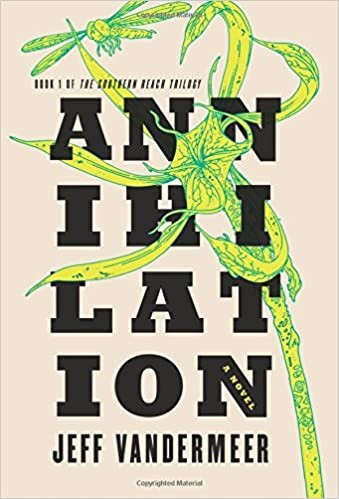
Annihilation
Farrar, Straus and Giroux · 2014 · 195 pages
ISBN: 9780374104092
Review Editor
Marcus Webb
Summary
Four women cross the border into Area X, a government-quarantined coastal wilderness that has consumed eleven previous expeditions. They carry no names, only titles: biologist, anthropologist, psychologist, surveyor. The organization that dispatched them, the Southern Reach, keeps its briefings deliberately vague. Previous teams returned hollowed out, then died of cancer within months. Others committed mass suicide. Others turned on each other with violence nobody fully explained.
The biologist narrates through a field journal she keeps during the expedition. Her husband joined an earlier team and came back a stranger: vacant, gentle, and soon dead. She volunteers partly to understand what took him. Inside Area X, the four women discover an unmapped tunnel plunging into the earth, descend toward something inscribed on its walls in living organisms, and begin to fracture from each other and from themselves.
Area X delivers on its reputation. The landscape carries a quality of prismatic beauty and biological menace that the biologist documents with the attention of a scientist and the wariness of someone who suspects documentation will not help. By the final pages, three expedition members are gone, and the biologist has become something she would not have recognized at the start.
Character Arcs
VanderMeer strips his characters of names deliberately. They exist as functions: biologist, psychologist, surveyor, anthropologist. The Southern Reach wants ciphers it can send into unknown territory without the complications of personhood. Area X reduces them further, into components of a biological system that has no use for individual identity.
The biologist resists this reduction more than her colleagues, though not through conventional heroism. She describes her lifelong emotional detachment from other people in the same precise terms she applies to fungal taxonomy: not as a wound but as a feature, a fact of her particular organism. Area X recognizes this quality and works with it. Where the other expedition members feel mounting dread, she feels mounting clarity. The spores she inhales in the tunnel accelerate what was already in motion.
Her husband’s journals, recovered from inside a derelict lighthouse, provide the novel’s second most substantial arc. Through fragments, a picture assembles: a sociable, curious man who entered Area X and came back wearing his face without fully occupying it. The biologist’s grief does not perform itself. It saturates the narrative from underneath, visible in what she notices and what she refuses to articulate directly.
The psychologist functions as the most complex antagonist the novel offers. She lies about the expedition’s parameters, manipulates the team through embedded hypnotic suggestions, and withholds information that might have kept people alive. Whether she acts from institutional loyalty, genuine care, or something Area X already installed in her remains unresolved. Her final act at the lighthouse, screaming the word “annihilation” at the biologist in an attempt to trigger a hypnotic kill-switch, reads as both a betrayal and a warning.
The surveyor and anthropologist receive minimal development, which is precisely the point. Area X has no patience for complexity it cannot use.
Pacing
At 195 pages, Annihilation covers distance quickly even when its narrator moves slowly. The prose sustains a quality of deferred threat: something has already happened before the first sentence, and something worse is always approaching. VanderMeer structures the expedition’s deterioration with care. Each revelation, the tunnel, the inscription, the lighthouse journals, the Crawler, arrives at the moment the reader has built sufficient dread to receive it. Nothing gets explained and nothing gets rushed.
The novel slows in its middle section, when the biologist spends several pages working through her husband’s journal. The information matters, but the shift in register costs the book momentum it takes considerable effort to recover.
The final quarter moves with controlled speed. The confrontation with the Crawler is deliberately disorienting: the biologist cannot fully describe what she sees, and the reader cannot make sense of what she describes. VanderMeer earns this opacity through everything that preceded it. The ending, in which the biologist decides to remain inside Area X and follow the coastline rather than attempting to leave, arrives with a sense of inevitability that feels neither tragic nor triumphant. It is the only note this novel could honestly close on.
Deeper Thematic Exploration
Area X carries ecological weight that VanderMeer has never tried to disguise. His stated inspiration included a hike through St. Marks National Wildlife Refuge in Florida and the Deepwater Horizon disaster of 2010. He imagined a zone that actively removes human contamination, reclaims land, and transforms the organisms that enter it into components of whatever it is becoming. Area X does not want to destroy humanity so much as it wants to continue without us.
The recurring image of cursive writing composed of living organisms on the tunnel wall focuses the novel’s central question: what does it mean for one kind of intelligence to attempt communication with another across a fundamental biological incompatibility? The biologist approaches the inscription with scientific rigor and still cannot explain who wrote it or what it intends. Area X does not want to be understood. It wants to persist.
The decision to withhold character names carries ideological weight beyond narrative efficiency. Named characters carry histories, relationships, personal stakes. Unnamed expedition members are easier to send somewhere from which they will not return. The Southern Reach’s institutional coldness parallels Area X’s biological indifference: both systems process human beings as expendable material. VanderMeer draws this parallel quietly, but it accumulates across the novel’s length into something that sits uncomfortably.
The “brightness” the biologist develops after inhaling spores operates simultaneously as a literal biological event and as a figure for transformation through sustained encounter with the genuinely nonhuman. She grows more perceptive, more detached from social performance, more alien to herself and to the reader. By the final pages, she chooses Area X over return. VanderMeer treats this not as tragedy but as completion. She has always been more at home among organisms than among people, and Area X is the first environment that makes full use of what she already was.
The bureaucratic response to Area X also draws on the Deepwater Horizon subtext: information withheld from the public, risk managed through ignorance, institutional processes deployed against a problem that institutions cannot solve. The Southern Reach’s management of its expeditions satirizes the governmental response to environmental catastrophe without belaboring the analogy.
Style and Voice
VanderMeer writes with a naturalist’s precision and a horror writer’s patience. The biologist catalogs what she sees through the vocabulary of field biology: subspecies, behavioral patterns, the quality of available light. This register makes Area X more unsettling, not less. When the genuinely inexplicable appears, she processes it through the same observational framework she applies to mundane organisms, and the juxtaposition carries a charge that more conventionally expressive horror prose could not produce.
The sentences run long but do not lose control. VanderMeer subordinates clauses the way organisms layer over one another, each element dependent on what sits beneath it, each one adding pressure. The rhythm becomes hypnotic across the novel’s length: the reader stays oriented in grammar while losing track of time.
The first-person journal format earns its place. The biologist tells the reader explicitly that she has condensed and revised her observations, which means the reader always receives a shaped account rather than raw experience. This editorial distance reveals character in the gaps: she is not someone who processes emotion in real time. She processes it later, alone, in writing, and what reaches the page has already passed through several filters.
Passages of genuine lyric beauty interrupt the dread at intervals. VanderMeer describes bioluminescent words on the tunnel wall, the behavior of dolphins in an Area X canal, and the view from the lighthouse with an intensity that refuses to subordinate wonder to threat. The novel treats nature as alien not because it wants to harm us but because it has no interest in us at all. That distinction is the source of its particular disquiet.
Verdict
Annihilation does not provide answers. VanderMeer establishes Area X as a zone of genuine mystery and refuses to resolve it in this book or across the trilogy. Readers who require narrative resolution will find the ending unsatisfying. Readers who can follow a question into the dark without demanding it lead somewhere specific will find one of the more unusual science fiction novels of the past two decades.
The Nebula Award was not misplaced. VanderMeer bets here that sustained uncertainty, biological precision, and a narrator with a genuinely strange interior life can carry a 195-page novel with no romantic subplot, no military response, no villain with comprehensible motives, and no answer to the central question. That is a high-risk creative choice, and it pays off.
The weaknesses deserve acknowledgment. The supporting cast serves primarily as furniture. The middle section loses focus for several pages. The novel’s opacity occasionally tips from productive ambiguity into vagueness that serves no clear purpose. These are the costs of attempting something genuinely strange in commercial fiction, and VanderMeer accepts them with apparent awareness.
The literary lineage is visible: Roadside Picnic, Lovecraft’s cosmic indifference, Philip K. Dick’s unstable realities. But Annihilation synthesizes these influences into something that feels original, largely because its narrator does. The biologist’s final decision to remain in Area X, to follow the coastline and discover what lies at its end, is the only honest conclusion for a novel this committed to the idea that some territory cannot be mapped from outside it.
Frequently Asked Questions
Is Annihilation appropriate for readers who do not usually read science fiction?
Yes. VanderMeer draws more from literary horror and ecological writing than from conventional science fiction mechanics. Readers who enjoy atmospheric, psychologically complex fiction by writers like Kazuo Ishiguro or Shirley Jackson will likely find Annihilation more accessible than readers expecting hard science fiction with technical explanations and clear resolutions.
How does the novel compare to the 2018 film adaptation directed by Alex Garland?
They share a premise and several images but diverge substantially in tone and conclusion. Garland’s film resolves more and explains more. The novel withholds almost everything. Both work on their own terms. The film is more immediately accessible; the novel is more disquieting and stays with you longer.
Do I need to read the full trilogy to get a satisfying experience from Annihilation?
Annihilation works as a standalone. It does not resolve its central mystery and does not pretend to. The sequels, Authority and Acceptance, expand the mythology and provide additional context, but they do not deliver the resolution readers might hope for. If unresolved mystery frustrates you, the trilogy will not fix that feeling.
What is Area X, exactly?
VanderMeer never answers this directly, which is the point. Area X might represent an alien incursion, a natural phenomenon, a governmental experiment gone catastrophically wrong, or something for which no existing category applies. The novel presents evidence consistent with several readings and forecloses none of them. Sitting with that uncertainty is part of the experience the book offers.
Why does VanderMeer withhold the characters’ names?
The choice reflects both the Southern Reach’s institutional logic (names create attachment, and attachment creates liability in personnel it expects to lose) and the novel’s thematic interest in identity and erasure. Area X does not care what you are called. Named people have histories and relationships that make them harder to send into places from which they will not return. The Southern Reach prefers not to think about that.
Is this book more science fiction or horror?
Both, with “weird fiction” as the most accurate genre label. The novel draws from the cosmic horror tradition (Lovecraft, Algernon Blackwood) as much as from science fiction. The threat is less about monsters or technology than about encountering something that operates by entirely different rules than the ones human cognition uses to organize experience. That disorientation is where the horror lives.
What does “the brightness” refer to in the novel?
The brightness describes the biological and psychological transformation the biologist undergoes after inhaling spores from the inscription in the tunnel. It increases her perceptual acuity, reduces her social inhibitions, and accelerates her growing identification with Area X rather than with the human world she came from. Whether it represents contamination, communion, or something for which neither word quite applies is one of the novel’s deliberately open questions.
Should I read the novel before or after watching the 2018 film?
The order matters less than you might expect because the two works diverge significantly after the first act. Reading the novel first gives you richer context for several images in the film. Watching the film first provides visual reference points that may help orient you in the novel’s more abstract passages. Either order works; they function as separate artistic responses to the same core premise rather than as adaptation and source.
Book Details
- Title
- Annihilation
- Author
- Jeff VanderMeer
- Genre
- Science Fiction
- Publisher
- Farrar, Straus and Giroux
- Year Published
- 2014
- Pages
- 195
- ISBN
- 9780374104092
- WritersReview Rating
- 4.2 / 5