
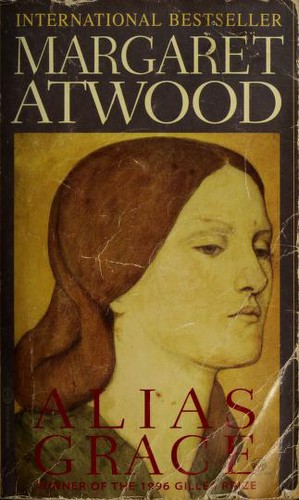
Margaret Atwood’s Alias Grace is a historical novel built around a real unsolved question: did Grace Marks kill anyone? In 1843, Grace Marks, a sixteen-year-old Irish immigrant servant, was convicted along with a stablehand named James McDermott for the murders of their employer Thomas Kinnear and his housekeeper Nancy Montgomery in Upper Canada. McDermott was hanged; Grace, after years of controversy, was eventually pardoned. Whether she was guilty, how guilty, and what she actually knew or did remains unknown. Atwood uses this uncertainty not as a problem to solve but as a condition to inhabit.
What Happens in Alias Grace
The novel is set primarily in the 1850s, when Grace is serving her life sentence in the Kingston Penitentiary. A young American doctor named Simon Jordan comes to interview her, commissioned by a group of reformers who believe she may have been wrongly convicted or who at least want her case reexamined. Jordan conducts sessions with Grace in which she tells him her life story – her childhood in Ireland, the sea crossing, her years in service, the events leading up to the murders.
Grace is a brilliant narrator of her own experience in ways that are also precisely calibrated to tell the doctor as little as possible about the thing he most wants to know. She digresses, circles, interrupts herself. She is funny, charming, and opaque. Jordan finds himself increasingly drawn to her in ways that he cannot fully understand or control, and his own parallel story – his romantic life, his professional anxieties, his unraveling during the winter he spends near Kingston – unfolds alongside Grace’s account.
The novel incorporates historical documents: newspaper accounts, trial transcripts, letters, medical case notes, poems. These documents do not clarify the historical record; they complicate it. Atwood is demonstrating that the archive does not reveal truth; it reveals the assumptions and interests of the people who created it.
Grace as Narrator
Grace is one of Atwood’s great creations. She is not an innocent victim – Atwood is not interested in that argument – but she is also not a monster. She is a person of considerable intelligence and survival instinct who has spent years understanding exactly what men like Simon Jordan want from her and providing precisely enough of it to remain interesting without becoming vulnerable. Her narration is a performance, and the novel is interested in the question of whether any account of the self is anything other than performance.
The novel refuses to tell the reader whether Grace is guilty. It offers the evidence, it offers Grace’s account, and it leaves the question open. This is not a failure of nerve; it is the novel’s central argument: that we cannot know what happened, and that our desire to know is itself the thing worth examining.
Historical Fiction as Method
Atwood researched the historical record extensively and is transparent about what she invented. The novel includes an author’s note distinguishing historical fact from fictional addition. This transparency is part of the novel’s argument about the relationship between truth and narrative: Atwood is showing her work, making visible the process by which a story becomes a story.
The novel also engages with the conditions of women’s lives in mid-nineteenth-century Canada with the precision of a social historian. The servant class, the vulnerability of women without property or family protection, the ways in which respectability and suspicion were distributed by class and gender – all of this is rendered with care and anger.
Atwood’s Prose
Atwood gives Grace a voice that is deceptively simple – plain sentences, careful observation, a slight formal quality that reflects Grace’s Irish-Protestant background and her years of reading in prison. The prose shifts when Atwood moves to Jordan’s perspective, becoming more educated and more anxious, more susceptible to self-deception. The contrast between the two voices is itself an argument about who has more self-knowledge.
Who This Book Is For
Readers interested in historical fiction, in unreliable narration, in feminist literary history, or in Atwood’s range beyond The Handmaid’s Tale will find Alias Grace one of her most accomplished and interesting works. It is quieter than her speculative fiction and more concerned with the specific texture of the past. It rewards patient reading.
Frequently Asked Questions
- Is Grace Marks a real person?
- Yes. The murders of Thomas Kinnear and Nancy Montgomery occurred in 1843 in Upper Canada (now Ontario). Grace Marks was a real historical figure who was convicted, served decades in prison, and was eventually pardoned in 1872.
- Does the novel reveal whether Grace is guilty?
- No. Atwood deliberately leaves the question unresolved. The novel is more interested in the question of how we decide guilt and innocence – the assumptions we bring to evidence – than in providing a verdict.
- Is there a TV adaptation?
- Yes. Netflix produced a six-episode miniseries in 2017, written by Sarah Polley and starring Sarah Gadon as Grace. It is widely considered one of the better literary adaptations of recent years.
- How does Alias Grace differ from The Handmaid’s Tale?
- The Handmaid’s Tale is speculative fiction set in a near-future dystopia; Alias Grace is historical fiction set in the 1840s to 1850s. Both are interested in the oppression of women and in unreliable narration, but they work in different registers. Alias Grace is more interested in ambiguity; The Handmaid’s Tale is more interested in structural analysis.
- Is the hypnosis scene historically accurate?
- The use of hypnosis as a therapeutic and investigative tool was a real nineteenth-century practice. The specific scene in the novel is fictional, but the cultural context is accurate.
- What is the significance of the quilt patterns?
- Grace sews quilt patches throughout the novel, and the chapter titles are named after quilt patterns. The quilts function as a form of women’s history – a record of domestic life that parallels and sometimes contradicts the official historical record that the novel also presents.
- How long is Alias Grace?
- Approximately 468 pages. It is longer than The Handmaid’s Tale and moves at a more deliberate pace, but most readers find the pace appropriate to Grace’s story.
- Is Alias Grace suitable for book clubs?
- It is an excellent book club choice. The unresolved question of Grace’s guilt generates genuine disagreement, and the novel’s use of historical material offers many entry points for discussion. The Netflix adaptation can serve as a useful complement.
Book Details
- Title
- Alias Grace
- Author
- Margaret Atwood
- Genre
- Literary Fiction
- Publisher
- Seal Books
- ISBN
- 9780770427597
- WritersReview Rating
- 5.0 / 5