
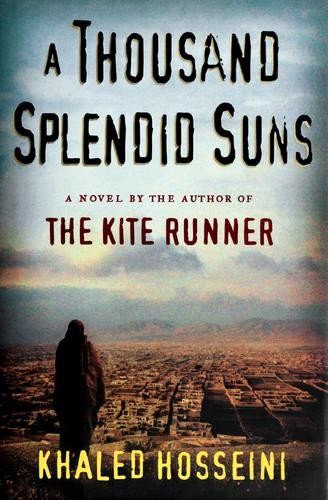
A Thousand Splendid Suns
Riverhead Books · 2007 · 372 pages
ISBN: 9781594483073
🏆 Book Sense Book of the Year (Adult Fiction, 2008)
Richard and Judy Best Read of the Year (2008)
Commonwealth Club of California Book Award (Silver Medal, Fiction, 2007)
Review Editor
Eleanor Marsh
Khaled Hosseini’s second novel, A Thousand Splendid Suns, arrived in 2007 on the heels of The Kite Runner’s massive success and promptly proved that his debut was no fluke. Where The Kite Runner told the story of two boys in a fractured friendship, this novel turns its attention to two women whose lives collide inside a Kabul home that becomes both prison and, eventually, a place of fierce solidarity. Spanning from the early 1960s through 2003, the book follows Mariam and Laila across four decades of Afghan history, from relative peace through Soviet occupation, civil war, Taliban rule, and the American invasion. It is a novel about what happens to ordinary people when the world around them keeps breaking, and about the love that persists in the wreckage.
Mariam, born illegitimate to a wealthy businessman and his former housekeeper, grows up in a kolba on the outskirts of Herat, raised by a bitter mother who calls her a harami (bastard) and warns her that enduring is the only skill a woman needs. When a devastating act of abandonment leaves Mariam alone at fifteen, she is married off to Rasheed, a shoemaker in Kabul three decades her senior. Laila enters the story a generation later: a bright, educated girl from a progressive Kabul family whose world is shattered by rocket fire during the civil war. Their paths converge when Laila, pregnant and desperate, becomes Rasheed’s second wife. What follows is a story of two women who move from suspicion and jealousy to a bond deeper than either of them could have imagined.
The title borrows a line from a seventeenth-century poem about Kabul by Saib Tabrizi, and the novel earns it. Hosseini writes about Afghanistan with the authority of someone who left the country as a child but never stopped carrying it.
Character Arcs and Development
Mariam’s transformation is the emotional spine of the novel. She begins as a girl who craves her father Jalil’s approval with a desperation that will make your chest tight, showing up at his cinema only to be left standing outside all night. By the time we find her decades later, weathered by years of Rasheed’s cruelty and the loss of multiple pregnancies, she has become a woman whose silence reads less like submission and more like a quiet accounting of everything she is owed. Hosseini never lets Mariam become a mere symbol of suffering. She has flashes of pettiness, jealousy, and self-pity that keep her human. Her initial coldness toward Laila feels earned and real. And the decision she makes in the novel’s final act, a choice that redefines sacrifice, lands with the force it does precisely because we have watched her arrive at it through forty years of accumulated pain and hard-won love.
Laila serves as Mariam’s counterpoint: younger, better educated, raised by a father who believed girls deserved the same opportunities as boys. She enters Rasheed’s household with more fire than Mariam ever had, but the novel is careful to show how that fire gets tested. Her love for Tariq, the boy she grew up with, is both her anchor and her vulnerability. When she believes Tariq is dead, her decision to marry Rasheed is not stupidity; it is survival calculus performed under impossible conditions. Watching Laila navigate motherhood while enduring Rasheed’s escalating abuse, you see a woman who keeps choosing life even when life offers very little in return.
Rasheed himself is drawn with a bluntness that some readers may find one-dimensional, but Hosseini seeds enough detail to make him legible as a product of his world rather than a cartoon villain. His early charm, his grief over a drowned son, his slow corrosion into cruelty: these are sketched rather than painted, but they serve the novel’s purpose. He is the wall that Mariam and Laila must eventually break through together.
Pacing
The novel moves in three large sections, roughly tracking Mariam’s early life, Laila’s childhood and the convergence of their stories, and their shared struggle under Rasheed’s roof during the Taliban years. The first section is the slowest, spending considerable time establishing Mariam’s childhood in Herat and her relationship with Jalil. Some readers will feel this section lingers, but the emotional groundwork it lays pays off enormously later. Once Laila enters the story around page 150, the pace accelerates and rarely lets up.
The middle section, covering the civil war years and Laila’s losses, moves with a propulsive urgency that mirrors the chaos engulfing Kabul. Hosseini is not subtle about deploying historical events as narrative turning points; rockets land at exactly the moments they need to for the plot. This is a legitimate criticism, but it rarely breaks the spell because the human drama is so tightly wound around the political one. The final third, set during Taliban rule, is almost unbearably tense. Hosseini piles restrictions on his characters with the same relentlessness that the regime piled them on Afghan women, and the claustrophobia is palpable.
Deeper Thematic Exploration
At its core, A Thousand Splendid Suns is a novel about legitimacy: who gets to claim it, who is denied it, and what happens when you build a life without it. Mariam is born illegitimate, and the word harami follows her like a shadow. She is illegitimate in her father’s household, illegitimate in Rasheed’s estimation after she fails to produce a son, illegitimate in a society that treats women as property to be managed. Laila, by contrast, starts with every advantage Mariam lacked, only to watch those advantages stripped away by war. The novel argues, quietly but insistently, that the distinction between these two women’s starting points matters far less than the resilience they share.
Hosseini also writes with real anger about what happens to women when men wage war. The Soviet occupation, the mujahideen infighting, and the Taliban regime are not just historical backdrop; they are forces that progressively shrink the physical and psychological space available to Mariam and Laila. Under the Taliban, Laila cannot walk to the hospital without a male escort. Mariam cannot leave the house without a burqa. The novel makes you feel the accumulation of these restrictions as a physical weight. Hosseini never lets the reader forget that the grand geopolitical struggles that fill history books play out, for millions of women, as a daily negotiation with survival inside their own homes.
Motherhood runs through the novel as both a source of power and a vulnerability. Laila’s love for her daughter Aziza and son Zalmai drives nearly every major decision she makes. Mariam’s inability to have children defines how Rasheed treats her. And the eventual bond between Mariam and Laila is, in many ways, a mother-daughter relationship: Mariam becomes the protective figure that Laila lost when her own mother withdrew into grief. The novel suggests that this capacity to love and protect, even when the world offers no protection in return, is the most radical act of defiance available to its characters.
Style and Voice
Hosseini writes in a clean, direct prose that prioritizes emotional clarity over literary ornamentation. His sentences are short, his paragraphs lean, and his vocabulary deliberately accessible. This is not a novel that calls attention to its own language. Some critics have noted that the prose can feel workmanlike, and that is a fair observation; you will not find the kind of sentence-level beauty here that you might in a novel by Michael Ondaatje or Marilynne Robinson.
But Hosseini’s plainness is also his strength. The novel’s power comes from its accumulation of specific, concrete details: the smell of Jalil’s cologne when he visits the kolba, the sound of Rasheed’s belt being unbuckled, the feel of Mariam’s hands in bread dough. These small sensory moments build into something larger than any individual sentence. The dual-perspective structure works well, alternating between Mariam and Laila in a way that lets the reader see each woman through the other’s eyes. The shifts in point of view are handled cleanly, without gimmicks, and the convergence of the two narratives feels both inevitable and surprising.
Verdict
A Thousand Splendid Suns is a novel that earns its emotional weight honestly. It tells you a story about two women in Kabul, and by the time you finish, you feel like you have lived alongside them. Hosseini is not the most elegant prose stylist, and the novel’s reliance on historical coincidence can feel heavy-handed in places. But these are minor complaints against a book that does what the best popular fiction does: it makes you care deeply about people whose lives look nothing like your own, and it does so without condescension or sentimentality.
If you are looking for a novel that will wreck you in the best way, this is it. Readers who loved The Kite Runner will find a more mature, more structurally ambitious book here. Readers who care about Afghanistan, about women’s lives under oppression, or simply about what ordinary people are capable of when everything is taken from them, will find this book indispensable. It is not a comfortable read, but it is a necessary one, and the final pages will stay with you for a very long time.
Frequently Asked Questions about A Thousand Splendid Suns
What is A Thousand Splendid Suns by Khaled Hosseini about?
A Thousand Splendid Suns follows two Afghan women, Mariam and Laila, born a generation apart, whose lives become intertwined when they are both married to the same abusive husband in Kabul. The novel spans four decades of Afghan history, from the 1960s through the post-2001 American invasion, and explores how war, poverty, and patriarchal violence shape these women’s lives while also revealing their extraordinary resilience and capacity for love.
Is A Thousand Splendid Suns based on a true story?
The novel is fiction, but Hosseini drew heavily on real historical events and the lived experiences of Afghan women. Hosseini, who was born in Kabul and left Afghanistan as a child, conducted research trips back to the country and spoke with women who lived through the Taliban era. The political events in the novel, including the Soviet invasion, the civil war, and Taliban rule, are historically accurate, and the domestic conditions depicted reflect well-documented patterns of life for many Afghan women.
What are the main themes in A Thousand Splendid Suns?
The novel’s central themes include the resilience of women under oppression, the devastating personal toll of war on civilian life, the complexities of motherhood and sacrifice, and the search for identity and legitimacy in a society that denies women both. It also explores the tension between hope and endurance, the bonds that form between women who share suffering, and how love can persist even in the most brutal circumstances.
How long is A Thousand Splendid Suns and is it a difficult read?
The novel is 372 pages in its original hardcover edition. The prose is straightforward and accessible, so it is not a difficult read in terms of language or structure. However, the content is emotionally intense. Hosseini depicts domestic violence, war trauma, and the oppression of women with unflinching honesty, so readers should be prepared for scenes that are painful to sit with. Most readers find they finish it quickly because the story is so absorbing.
Is there a movie or TV adaptation of A Thousand Splendid Suns?
As of 2026, no film version has been released, though Columbia Pictures acquired the movie rights and screenwriter Steven Zaillian wrote a screenplay. A stage adaptation premiered in San Francisco in 2017, co-produced by the American Conservatory Theater and Theatre Calgary. In 2021, One Community announced plans to develop the novel as a limited television series, though production details remain sparse.
What age group or reading level is A Thousand Splendid Suns appropriate for?
The novel is written for adult readers and is most commonly read by those aged sixteen and older. It is frequently assigned in high school AP English and college literature courses. The book contains depictions of domestic violence, sexual assault, and wartime atrocities that may be disturbing for younger readers. Parents and teachers should use their judgment, but mature high school students generally engage with the material thoughtfully.
How does A Thousand Splendid Suns compare to The Kite Runner by Khaled Hosseini?
Both novels are set in Afghanistan and deal with personal relationships against a backdrop of political upheaval, but they differ in focus and scope. The Kite Runner centers on male friendship, guilt, and redemption, while A Thousand Splendid Suns centers on two women’s shared endurance under domestic and political oppression. Many readers consider A Thousand Splendid Suns the more emotionally devastating of the two, with a broader historical canvas and a more complex narrative structure that alternates between two protagonists rather than one.
Should I read A Thousand Splendid Suns and is it worth it?
If you want a novel that combines a deeply moving human story with a window into a part of the world that Western readers often see only through news headlines, this book is absolutely worth your time. It will appeal to readers who value character-driven fiction, historical depth, and emotional honesty. Those who struggle with depictions of violence against women should approach it with care, but most readers who finish it describe it as one of the most affecting novels they have ever read.
Book Details
- Title
- A Thousand Splendid Suns
- Author
- Khaled Hosseini
- Genre
- Literary Fiction
- Publisher
- Riverhead Books
- Year Published
- 2007
- Pages
- 372
- ISBN
- 9781594483073
- Awards
- 🏆 Book Sense Book of the Year (Adult Fiction, 2008) Richard and Judy Best Read of the Year (2008) Commonwealth Club of California Book Award (Silver Medal, Fiction, 2007)
- WritersReview Rating
- 4.9 / 5