
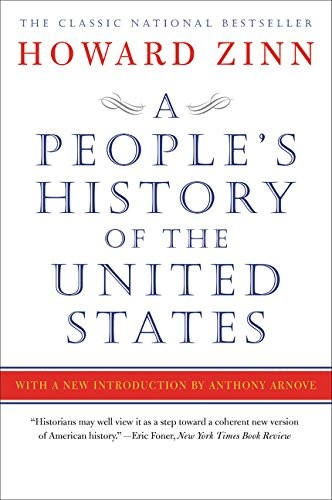
A People’s History of the United States
HarperCollins · 1980 · 729 pages
ISBN: 9780062397348
Review Editor
Thomas Calloway
Summary
Howard Zinn opens A People’s History of the United States with Columbus’s arrival in the Caribbean and his first encounter with the Arawak people, whom he described in his journal as gentle, intelligent, and potential Christians and then enslaved for gold extraction. The Arawak had, as Zinn quotes, no iron tools and no desire to use them for violence. Within a generation of European contact, they had been effectively exterminated. Zinn begins here because this is where American history begins if you are not the conqueror, and the book proceeds from there to examine American history consistently from the perspective of those who were conquered, enslaved, exploited, displaced, and silenced.
First published in 1980, the book has sold more than two million copies, which makes it one of the most widely read works of American history ever published. It covers the full arc of American history from Columbus through the early 1970s, with particular attention to labor movements, the civil rights movement, the treatment of Native Americans, the history of slavery and its aftermath, American foreign policy, and the gap between the official history of freedom and democracy and the experience of those for whom freedom and democracy were either denied or incomplete.
Zinn was a historian, a political activist, and a veteran of the civil rights movement, and his book reflects all three identities. It is not a neutral history; it is explicitly a corrective, an attempt to balance what Zinn saw as a long tradition of history written from the top down by and for the powerful.
Character Arcs and Development
Zinn’s method is to center figures who have been marginalized by conventional histories: Bacon’s Rebellion farmers, Lowell mill girls, union organizers, suffragists, civil rights activists, Vietnam veterans who opposed the war, and ordinary people who resisted in ways that did not make it into the standard account. These figures are often rendered briefly, as evidence of a larger argument rather than as fully individuated biographical subjects, which is the book’s method rather than its weakness: it is a history of movements and systems, not of great men.
The most sustained characterizations are of political leaders who appear in the conventional histories as heroes, and whom Zinn renders more critically. Columbus is a slave trader. Columbus and the founding fathers are slaveholders whose rhetoric of liberty did not extend to the people they owned. Zinn’s presidents are evaluated primarily by their treatment of the poor and the colonized rather than by their management of elite politics.
Pacing
The book moves through American history chronologically, with chapters organized around periods and themes rather than events. The pacing is deliberate and sometimes dense: Zinn packs a great deal of evidence into each chapter, and readers accustomed to narrative history will find this approach more demanding than McCullough or Goodwin. The most powerful sections are those dealing with the history of slavery, the labor movement, and the treatment of Native Americans, where Zinn’s accumulation of evidence is most compelling. The later chapters, covering the twentieth century, are less compelling because the material is more familiar and the argument more predictable.
Deeper Thematic Exploration
The book’s central argument is that American history cannot be understood if it is told only from the perspective of its official heroes and their stated intentions. The Declaration of Independence says that all men are created equal; the history of who was excluded from that statement, how they were excluded, and how they fought back is at least as important as the statement itself. Zinn makes this argument consistently and with considerable evidence, and the argument is largely correct as a corrective to the sanitized version of American history that dominated popular and textbook accounts when the book was first published.
The book’s weakness is its own version of the same problem it critiques: it is a history told from the perspective of the oppressed that has as little patience for the complexity of those in power as the conventional histories have for the complexity of those without power. The powerful are consistently rendered as venal or cynical; the oppressed are consistently rendered as heroic; and the truth, which involves both groups as human beings with mixed motives and imperfect understanding, is sometimes sacrificed to the polemical purpose.
Style and Voice
Zinn writes with clarity, passion, and obvious conviction. He is not a prose stylist in the conventional sense; his writing is functional rather than literary. But he has a gift for the telling quotation and the revealing anecdote, and his ability to synthesize enormous amounts of material into a readable narrative is considerable. The book is long but not difficult; it asks readers to challenge their assumptions rather than to master complex analytical frameworks.
Verdict
A People’s History of the United States is one of the most important works of American popular history precisely because it raises questions that no honest account of the American past can ignore. Its account of who has been left out of the standard story is substantially correct and remains necessary reading. Its tendency to simplify the powerful as consistently cynical is a real limitation, and readers who take it as the last word on American history rather than a necessary corrective will have a distorted picture. Read alongside conventional histories, it is invaluable. Read alone, it is incomplete in a different direction than the books it corrects.
Four stars: an essential and transformative work of popular history that has changed how millions of Americans understand their past.
What is the argument of A People’s History?
Zinn argues that American history as conventionally taught and written tells the story of great men and official heroes while ignoring or minimizing the experience of those who were conquered, enslaved, exploited, and silenced. His book attempts to tell American history from the perspective of these groups: Native Americans, enslaved people, workers, women, immigrants, and anti-war activists. He does not claim that his account is the complete truth, but that it is the truth that has been suppressed, and that a full understanding of American history requires confronting it.
Is A People’s History accurate?
The factual material is generally accurate and well-sourced; historians have not challenged its specific claims to any significant degree. The book’s controversial aspects are its framing and emphasis: critics argue that it presents a one-sided view that renders the powerful as consistently venal while idealizing resistance movements, and that it omits evidence that complicates its argument. These are legitimate criticisms of the book as a complete history rather than a corrective one. Zinn himself acknowledged that his was a partial perspective; the question is whether readers understand this when engaging with the book.
Why has this book been controversial?
It has been controversial for two related reasons. First, it challenges a patriotic narrative of American history that many Americans hold dear, presenting the founding fathers as slaveholders rather than heroes, the conquest of the West as a campaign of destruction rather than a march of progress, and American foreign policy as frequently serving elite interests rather than democratic ideals. Second, it is explicitly written from a left-wing perspective, which has made it a target of conservative criticism. Both the celebration and the criticism of the book often say more about the politics of the reader than about the historical accuracy of its claims.
Who was Howard Zinn?
Howard Zinn (1922-2010) was a historian, political scientist, playwright, and activist. He served as a bombardier in World War II and later became a pacifist. He taught at Spelman College, a historically Black women’s college in Atlanta, where he became involved in the civil rights movement and was eventually fired for his activism. He later taught at Boston University for many years. He was a founding member of the Students for a Democratic Society and a prominent opponent of the Vietnam War. A People’s History was published in 1980 and grew steadily in reputation over the following decades.
How should this book be read?
It should be read as a corrective and a provocation rather than as a comprehensive history. Zinn himself described it as a partial history, deliberately emphasizing perspectives that had been underrepresented in conventional accounts. Readers who engage with it alongside standard histories will find it most valuable: it raises questions, provides evidence, and shifts perspectives in ways that enrich rather than replace the conventional narrative. Readers who take it as the final word on American history will be left with an account that is as incomplete in its own direction as the accounts it corrects.
Is this book taught in schools?
Yes, it is widely taught in high school and university history courses, often as a counterpoint to standard textbooks. Its use in schools has been politically controversial in several states, where it has been the subject of curriculum debates. The debates themselves are revealing: the question of whose perspective counts as objective and whose counts as political is exactly the question Zinn’s book raises. It has also been banned or challenged in several school districts, which has generally increased rather than decreased its readership.
How does this book compare to conventional American history textbooks?
The most obvious difference is perspective: conventional textbooks are organized around political and military events and the leaders who shaped them; Zinn’s book is organized around social movements and the experiences of those outside the corridors of power. Conventional textbooks tend to present American history as a story of progress and expanding freedom; Zinn presents it as a story of class conflict, racial exploitation, and the often violent suppression of dissent. Both framings capture important truths; neither captures the whole truth.
What are the most powerful sections of the book?
The chapters on the history of slavery and its aftermath, the history of labor organizing in the late nineteenth and early twentieth centuries, and the treatment of Native Americans are generally considered the book’s strongest. These are areas where the gap between the official narrative and the historical record is widest, and where Zinn’s accumulation of evidence is most compelling. The chapters on twentieth-century foreign policy are also strong, drawing on primary sources to challenge the official justifications for American military interventions in a way that remains relevant.
Book Details
- Title
- A People’s History of the United States
- Author
- Howard Zinn
- Genre
- History
- Publisher
- HarperCollins
- Year Published
- 1980
- Pages
- 729
- ISBN
- 9780062397348
- WritersReview Rating
- 4.0 / 5