Tristan Palmgren
Tristan Palmgren is an American science fiction author whose debut novel brought a distinctive philosophical and historical intelligence to space opera, immediately establishing him as a writer with ambitions beyond the genre’s entertainment baseline. He has a background in history and his deep engagement with historiography — the study of how history is written, constructed, and contested — is central to the intellectual project of his debut work. He lives in the United States and his academic background informs both the density of his world-building and the sophistication of his engagement with questions of cultural power and historical erasure.
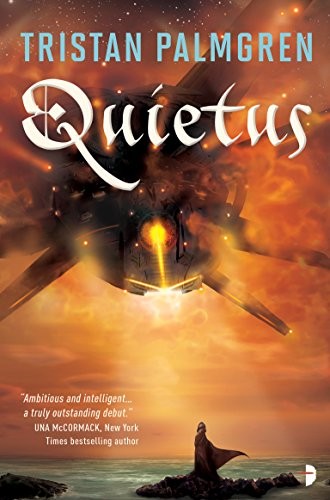
Quietus (2018), available on WritersReview, is his debut novel and is an audaciously conceived work that interweaves the story of a fourteenth-century plague survivor in medieval Europe with that of a far-future anthropologist from a post-scarcity civilisation who has been studying historical catastrophes across parallel timelines. The novel asks what it means to observe suffering from a position of safety and power, what obligations the observer has to the observed, and whether intervention is ever truly neutral. These are not new questions in science fiction — they are the classic dilemmas of time travel fiction — but Palmgren approaches them with unusual philosophical rigour and emotional seriousness, and his medieval sequences are written with a vividness and historical specificity that goes well beyond the usual SF deployment of historical settings as backdrop.
The novel’s structural ambition — the sustained interweaving of two very different narrative registers, the intimate and the cosmic — requires considerable craft to execute, and Palmgren largely delivers on the challenge. His prose is confident and his historical research is evident without being displayed for its own sake. The novel raises questions about the relationship between civilisational power and historical consciousness that feel genuinely urgent in the current moment, and it does so without sacrificing narrative momentum.
Palmgren represents the kind of debut that the science fiction field periodically produces: a writer who arrives fully formed with a clear and distinctive voice, genuine intellectual ambitions, and the craft to realise them. His subsequent work continues to develop the themes and formal interests of his debut, and he remains a writer worth following closely by anyone interested in science fiction that takes both its genre pleasures and its philosophical responsibilities seriously.