R.F. Kuang
R.F. Kuang is an American fantasy and literary fiction author whose work has established her, at a remarkably young age, as one of the most important and provocative voices in contemporary speculative fiction. Born in 1996 in Guangzhou, China, and raised in the United States, Kuang studied history at Georgetown University, received a master’s in China studies from Oxford, and later completed graduate work in linguistics at Cambridge. This intensive academic background—in imperial history, colonial studies, and the politics of language—saturates her fiction with a scholarly rigor unusual in commercial fantasy, and gives her narratives their particular moral force.
Kuang’s debut was the Poppy War trilogy (2018–2022), a grimdark fantasy series inspired by twentieth-century Chinese history, particularly the Second Sino-Japanese War and the Nanjing Massacre. The trilogy drew both praise and controversy for its unflinching depiction of atrocity and its refusal to sanitize the violence of war or the mechanisms of imperialism. It announced a writer of extraordinary ambition who was unafraid to use fantasy’s freedoms to confront historical trauma directly, and it won her a devoted readership and numerous award nominations.
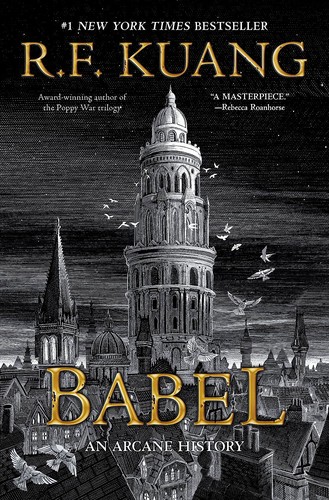
Babel, or the Necessity of Violence: An Arcane History of the Oxford Translators’ Revolution (2022), featured on WritersReview, represents Kuang’s most complete artistic achievement to date. Set in an alternative 1830s Oxford where a tower called Babel houses the world’s most powerful translation institute—and where silver bars engraved with matched words from different languages generate the magic that powers the British Empire—the novel follows a cohort of students from colonized nations who are trained to serve the imperial project and must ultimately decide what they owe the empire that educated them. The novel is simultaneously a scholarly novel of ideas, a coming-of-age narrative, a historical thriller, and a sustained meditation on language, power, colonialism, and complicity. It won the Hugo Award, the Nebula Award, and the Locus Award, among others, and became an international bestseller.
Kuang’s prose has the clarity of someone trained in argument and the vividness of someone deeply read in literature. Her footnotes are a distinctive formal device, expanding the world of the novel while keeping the reader aware that they are reading a constructed history. She writes about power without illusions but not without love—her characters are formed by the institutions that oppress them, and their tragedy is inseparable from their complicity.
Her novel Yellowface (2023) shifted to contemporary literary satire, skewering the publishing industry’s relationship to race and cultural appropriation with biting wit. Now in her late twenties, Kuang has already written more than most authors achieve in a career, and shows no signs of narrowing her ambitions. She is one of the defining literary voices of her generation.