Leo Tolstoy
Count Lev Nikolayevich Tolstoy was born on September 9, 1828, at Yasnaya Polyana, his family’s estate in the Tula region of Russia, the fourth of five children of an aristocratic family. Both of his parents died before he was nine, and he was raised by relatives. He studied oriental languages and law at Kazan University before withdrawing, then joined the Russian Army and served in the Caucasus and the Crimean War. These experiences gave him direct knowledge of combat and an abiding anti-militarism that deepened over his lifetime. His early autobiographical trilogy, beginning with Childhood (1852), established him as a promising new voice in Russian letters.
Tolstoy married Sophia Behrs in 1862 and settled at Yasnaya Polyana, where they had thirteen children. Sophia served as his copyist, transcribing successive drafts of his major works by hand. The marriage, initially happy, grew strained as Tolstoy’s moral philosophy evolved toward an asceticism increasingly at odds with their domestic life. Through these decades he produced the two great novels on which his immortality rests. War and Peace (1869) was a vast panoramic account of Russian society during the Napoleonic Wars; Anna Karenina, published serially between 1875 and 1878, was an intimate study of marriage, desire, and moral consequence.
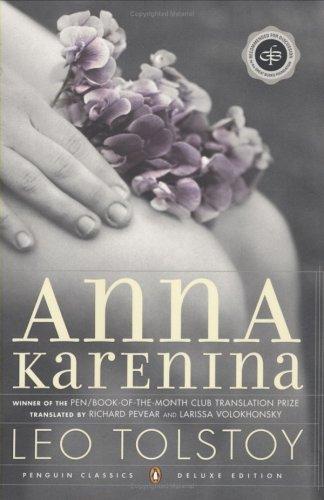
Anna Karenina is among the greatest novels ever written. It tells two parallel stories: the adulterous love of Anna and the cavalry officer Vronsky, which ends in tragedy, and the more hopeful courtship and marriage of the landowner Levin and young Kitty Shcherbatskaya. Through these interwoven narratives Tolstoy examines marriage, desire, the social position of women, faith, and the nature of moral choice with a comprehensiveness and psychological truth that has never been surpassed. The novel’s opening sentence — ‘All happy families are alike; each unhappy family is unhappy in its own way’ — is among the most famous in world literature.
Tolstoy’s prose combines documentary precision in social observation with passages of extraordinary interior revelation. He developed free indirect discourse as a systematic technique for representing thought, and his rendering of Anna’s psychology in the novel’s closing sections remains an unmatched achievement of narrative consciousness. After completing Anna Karenina, he underwent a profound spiritual crisis, repudiating his great novels as morally frivolous and developing a personal Christianity emphasizing nonviolence and the renunciation of property.
Leo Tolstoy died on November 20, 1910, aged eighty-two, having fled his estate in his final weeks in pursuit of the simple peasant life he had long idealized. His influence on world literature has been incalculable. Every major novelist who followed him — James, Proust, Woolf, Faulkner — worked in his shadow, and Anna Karenina remains one of the supreme achievements of the novel form.