Jared Diamond
Jared Diamond was born in 1937 in Boston, Massachusetts, to a physician father and a musician and linguist mother—a combination of scientific and humanistic influences that would prove formative for his career as one of the most ambitious interdisciplinary thinkers of the twentieth century. He attended Roxbury Latin School before earning his undergraduate degree from Harvard College in 1958 and his PhD in physiology and membrane biophysics from Trinity College, Cambridge, in 1961. He joined the faculty of UCLA Medical School, where he has spent his career as a professor of physiology, geography, and evolutionary biology. His early scientific work focused on the ecology and evolutionary biology of birds, particularly in New Guinea, where he has conducted extensive fieldwork since the 1960s—work that gave him direct access to cultures and environments that would deeply inform his later macro-historical writing.
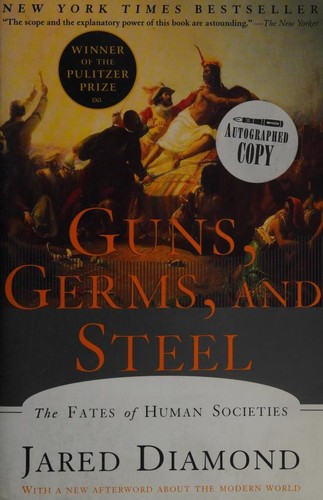
Diamond’s scholarly reputation was established through numerous papers and two specialist books on birds and ecology before he undertook the project that would make him a globally influential public intellectual. The question that animates Guns, Germs, and Steel: The Fates of Human Societies (1997), available on Writers Review, was posed to him by a New Guinean politician named Yali, who asked: “Why is it that you white people developed so much cargo and brought it to New Guinea, but we black people had little cargo of our own?” Diamond’s answer, developed over more than 500 pages of synthesis across biology, anthropology, linguistics, and history, is that the differences in development between societies on different continents are not the result of racial or intellectual differences but of environmental and geographical factors—the differential availability of domesticable plant and animal species, geographical orientations that facilitated or impeded the spread of agriculture and technology, and the disease environments that shaped immunity across populations.
The book won the Pulitzer Prize for General Nonfiction in 1998 and became one of the most widely read and debated works of popular science and history of the late twentieth century. It has been translated into thirty-three languages and has sold millions of copies worldwide, influencing how a generation of educated readers thinks about the relationship between geography, biology, and human history. Follow-up works including Collapse: How Societies Choose to Fail or Succeed (2005) and The World Until Yesterday (2012) extended Diamond’s comparative approach to questions of environmental sustainability.
Diamond’s prose is clear and methodical, organized around the patient building of an argument from specific evidence toward large conclusions. He is at his best when grounding his macro-historical thesis in specific ecological or biological detail, and his willingness to range across disciplines gives his work a synthetic power that specialists working within a single field rarely achieve. Critics have raised important objections to aspects of his deterministic framework, noting that it can underplay the role of human agency, contingency, and cultural factors in history; these debates have enriched the field he helped create.
Jared Diamond continues to teach at UCLA and to write books and essays that bring scientific and historical thinking to bear on the largest questions of human society. Now in his late eighties, he remains one of the most active and intellectually engaged figures in American public intellectual life—a scientist who became a humanist, a fieldworker who became a synthesizer, and a writer who helped convince millions of readers that history, biology, and geography are aspects of a single, interconnected story.