Isaac Asimov
Isaac Asimov was born on January 2, 1920, in Petrovichi, Russia (now part of the Smolensk region), and immigrated with his family to Brooklyn, New York, in 1923. He grew up in his family’s candy store, teaching himself to read before school age and consuming science fiction pulp magazines from the store’s shelves. He entered Columbia University at fifteen and eventually earned a doctorate in biochemistry in 1948, going on to join the faculty of Boston University School of Medicine as an associate professor — a position he held nominally even after he had long since left academic life to write full time. His scientific training gave his fiction an authority and internal consistency that distinguished it from most of his contemporaries.
Asimov began publishing science fiction stories in the late 1930s, quickly establishing himself as one of the central figures of science fiction’s Golden Age under the editorship of John W. Campbell at Astounding Science Fiction. His Robot stories, written throughout the 1940s and 1950s, introduced the famous Three Laws of Robotics — a logical framework for governing machine behavior that has influenced debates about artificial intelligence ethics to the present day. These stories were collected in I, Robot (1950) and subsequent volumes, and the robot novels The Caves of Steel and The Naked Sun blended science fiction with classical detective fiction to remarkable effect.
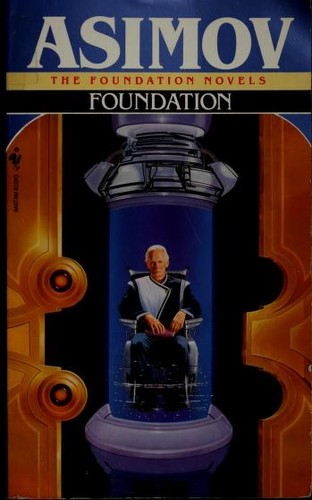
His magnum opus, the Foundation series, began as a sequence of stories published in Astounding from 1942 onward and was collected as Foundation (1951), Foundation and Empire (1952), and Second Foundation (1953). Set tens of thousands of years in the future, the series follows mathematician Hari Seldon, who uses the science of psychohistory — statistical prediction of mass human behavior — to forestall a predicted galactic dark age. The Foundation novels won a one-time Hugo Award as the Best All-Time Series in 1966, recognition of their extraordinary influence on the field. Asimov returned to the series late in his career with Foundation’s Edge (1982) and three further volumes, eventually linking the Foundation and Robot universes into a single, vast future history.
Asimov was a prolific writer across virtually every category of the Dewey Decimal System. Beyond fiction, he wrote popular science books on astronomy, mathematics, chemistry, biology, history, and the Bible, producing more than five hundred books in total. His prose style was deliberately functional — clear, direct, and unadorned — prioritizing the communication of ideas over literary effect. Critics sometimes faulted this approach, but his champions argued that no other writer in the genre conveyed the excitement of scientific ideas with greater clarity or enthusiasm. His autobiographical writings, including In Memory Yet Green (1979) and I. Asimov (1994), are vivid records of a singular life in letters.
Asimov died on April 6, 1992, in New York City, from heart and kidney failure resulting from HIV infection contracted through a blood transfusion during bypass surgery — a fact disclosed only posthumously. His influence on science fiction, popular science writing, and the cultural imagination of technology has been profound and lasting. The Apple TV+ series Foundation (2021–) has brought his ideas to new audiences, and his concepts — psychohistory, the Three Laws, the Galactic Empire — remain touchstones in discussions of artificial intelligence, social prediction, and the long-term future of civilization.