Ilya Kaminsky
Ilya Kaminsky was born in 1977 in Odessa, in what was then the Soviet Union, into a Jewish family. He lost most of his hearing at age four after an undiagnosed ear infection, a fact that becomes deeply resonant given that his most celebrated work is a book about a town of the deaf. He emigrated to the United States in 1993 with his family as refugees, settling in Rochester, New York, after the fall of the Soviet Union. He became a US citizen in 2001, the year his mother died, an event he has described as central to his identity as an American poet. He earned his BA from Georgetown University and his JD from the University of California, Hastings, before completing his MFA and devoting himself to poetry. He is currently a professor in the MFA program at Georgia Tech.
Kaminsky published his debut collection, Dancing in Odessa, in 2004. The book drew on his Soviet childhood, his deafness, and his immigration, weaving personal memory with historical catastrophe in lyrics of extraordinary concentration and musical power. It won the Whiting Writers Award, the American Academy of Arts and Letters Metcalf Award, and the Dorset Prize, and was translated into numerous languages. It established Kaminsky as one of the most important poets to emerge in American poetry in a generation.
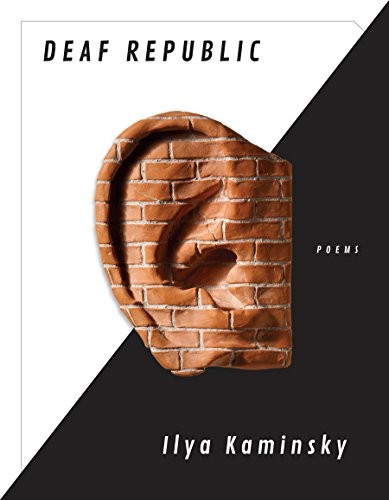
Deaf Republic (2019), available on WritersReview, is his masterpiece and one of the most acclaimed poetry collections of the century so far. Set in an imaginary Eastern European town under military occupation, the book is structured as two acts of a play. When soldiers shoot a deaf boy in the town square, the townspeople respond with silence — they stop speaking aloud entirely, communicating only in sign. The book is at once a fable about resistance and complicity, a meditation on deafness as political stance and existential condition, and a love story unfolding inside catastrophe. Its imagery is viscerally precise, its emotional register both tender and devastating, and its formal invention — poems that are simultaneously lyric, dramatic, and narrative — unlike anything else in contemporary American poetry.
Deaf Republic won the Anisfield-Wolf Book Award and was a finalist for the National Book Award, the National Book Critics Circle Award, and the Griffin Poetry Prize. It was named the best poetry book of the decade by multiple critics and publications. Kaminsky has also edited and translated major anthologies of world poetry, including Ecco Anthology of International Poetry (2010), and has been a tireless advocate for poetry in translation.
Kaminsky writes in English, his second language, and has spoken about how the experience of learning a new language as an adult — together with his deafness — shaped his understanding of silence, sound, and the politics of what we choose to hear. He is widely regarded as one of the essential poets writing in English today, a writer whose work demands and rewards the fullest possible attention.