Hermann Hesse
Hermann Hesse was born on July 2, 1877, in Calw, a small town in the Black Forest region of Germany, the son of a missionary father and a mother who had herself been born in India. His upbringing was deeply religious — both of his parents were Pietist missionaries and his maternal grandfather a distinguished Indologist — and this dual inheritance of Protestant Christian tradition and scholarly engagement with Indian and Asian thought would become the essential spiritual DNA of his fiction. As a teenager, Hesse suffered a serious mental breakdown, was briefly institutionalized, and attempted suicide; he was removed from the Maulbronn Seminary, where he had been placed in preparation for the ministry, after an experience of intense psychological crisis. These early confrontations with the darkness of the inner life gave him the material for a lifetime’s worth of fiction about the search for spiritual meaning.
Hesse worked as a bookseller and antiquarian before achieving his first literary success with Peter Camenzind (1904), a novel about a young man’s rejection of bourgeois society in favor of nature and solitary artistic life. His subsequent novels, including Beneath the Wheel (1906) and Gertrude (1910), continued his examination of the conflict between the individual’s spiritual needs and the demands of social conformity. The First World War, during which Hesse wrote pacifist essays that earned him the condemnation of German nationalists, deepened his interest in Eastern philosophy and in Jungian psychoanalysis, both of which became central to the visionary novels of his maturity.
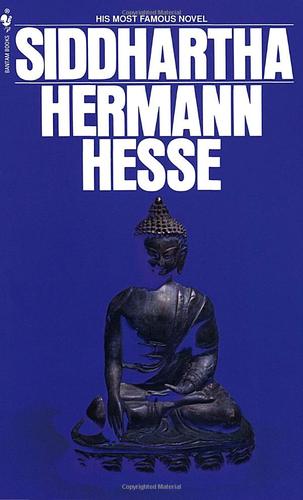
Siddhartha, published in 1922, is his most widely read and translated work — a brief, luminous novel that follows a young Brahmin’s spiritual journey in ancient India, from the luxury of his father’s home through the extremes of asceticism and sensual indulgence to, finally, a river where he learns the lesson of the eternal present from a ferryman. The novel draws on Buddhist and Hindu sources but is not strictly doctrinaire; it is rather a distillation of Hesse’s own spiritual search into a fable of rare clarity and beauty. It became particularly beloved among the counterculture generation of the 1960s and 1970s, when its message of individual spiritual seeking outside conventional religious and social structures resonated powerfully.
Hesse’s prose style in Siddhartha is deliberately simple and incantatory, more closely related to ancient narrative traditions than to the psychological complexity of modern fiction. He writes with a grave lyricism and a patience that allows the novel’s spiritual insights to emerge organically from the narrative rather than being asserted. The simplicity of the style is deceptive: it is the product of extensive revision and a profound engagement with the spiritual traditions he was attempting to distill.
Hermann Hesse received the Nobel Prize in Literature in 1946. He died on August 9, 1962. His influence has been particularly strong on readers at moments of spiritual searching, and Siddhartha in particular has served as a companion and guide for millions of readers across cultures and generations. His body of work represents one of the most sustained and sincere literary engagements with the question of how a person might live a meaningful life in the modern world.